Best place to buy filters

I started down this rabbit hole after the Nexaph Staph fiasco. I was reading how some companies print the sterile indicators in black ink instead of the color changing ink to prove sterility; was getting me even more freaked out.

I wanted to buy an autoclave (reasonably cheap on the used market; old dentists equipment mostly), set up a laminar flow hood, etc.

What I did learn was it isn't the steam that sterilizes. It's the temp and time. The steam just makes it happen quicker. If the stoppers don't pop out, that's not a problem. I also read that UV light does not penetrate packaging well, and is not well-suited to sterilizing needles, vials, cartridges, filters, etc.

I finally gave up and decided to just buy filters, needles, and vials from reputable suppliers instead.

Steam reduces the temperature a lot and the time. To sterilise with steam, you need like 120c for 15-30 minutes.

To dry sterilise you need 170c for two hours. The polymers in the stopper and rubber top in the cartridge may be compromised for that hot for that long. They're designed to be steam sterilised to no more than 130c.

And an Instapot tops out at 121c
 
Business opportunity there for you, friend. Let me know when it opens up 🤣
I briefly considered this a couple months ago.

The reality is, I have no more qualifications than the alibaba suppliers. This is just transferring the "trust me, bro" from their mouth to mine. My mouth happens to be inside the United States when I'm saying those words, instead of overseas. Is it worth a few dollars to someone? I'm not sure.
 
I started down this rabbit hole after the Nexaph Staph fiasco. I was reading how some companies print the sterile indicators in black ink instead of the color changing ink to prove sterility; was getting me even more freaked out.

I wanted to buy an autoclave (reasonably cheap on the used market; old dentists equipment mostly), set up a laminar flow hood, etc.

What I did learn was it isn't the steam that sterilizes. It's the temp and time. The steam just makes it happen quicker. If the stoppers don't pop out, that's not a problem. I also read that UV light does not penetrate packaging well, and is not well-suited to sterilizing needles, vials, cartridges, filters, etc.

I finally gave up and decided to just buy filters, needles, and vials from reputable suppliers instead.
You guys/gals are going to make me start filtering. I'm going to start a Reta and supplies Go Fund Me for me. 🤣
 
I briefly considered this a couple months ago.

The reality is, I have no more qualifications than the alibaba suppliers. This is just transferring the "trust me, bro" from their mouth to mine. My mouth happens to be inside the United States when I'm saying those words, instead of overseas. Is it worth a few dollars to someone? I'm not sure.
I think it would be, yes.
 
Wow what a process. Seems like lots of points you can actually introduce more bacteria as well, not to mention trusting the filters and sterile vials are actually sterile too
It only takes time the first time you filter. I don't use gloves, but I do wash my hands. I also don't spray everything with alcohol, just the surface of my work area. The whole process now is about 3 extra minutes.

Even if the vials are sterile, they are not depyrogenated, at least not on Amazon. I ordered these in 2 mL and 5 mL: https://www.medical-and-lab-supplie...terile-2ml-13mm-neck-clear-sealed-glass-vials
 
Wow what a process. Seems like lots of points you can actually introduce more bacteria as well, not to mention trusting the filters and sterile vials are actually sterile too

My thoughts were the same before I started filtering. If I had sterility results for the kit that I was reconstituting that suggested the batch was sterile I thought that filtering actually was counter productive and allowed the opportunity for contamination. Not so much anymore. Filtering is easy, quick and if you use sterile supplies a very good idea.
 
Damnit I was too late...


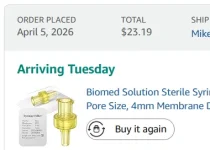
About a dollar a piece with free shipping from China. Def look into those because 4mm is the best to avoid any loss. Even if you air and water purge the filters at the end a 13mm is going to have more loss than a 4.
I saw these on Amazon and had been confused because they look so different than what I've seen in all the recon videos. I had also heard 4mm was best. How do these work for you? Are they the same and just afresh to the luer lock?
 
Same. I filter everything because why not screw a filter on there when I'm moving it to a new home anyway. I use a 4mm filter for everything but KLOW, and I do not bother myself about the 0.5 mg max I might lose in the holdup. I got more.
Woah....i can't use a 4mm filter for KLOW? Will it be 13mm that works? And I'm guessing 13mm works for the rest I'm doing.
 
Woah....i can't use a 4mm filter for KLOW? Will it be 13mm that works? And I'm guessing 13mm works for the rest I'm doing.
KLOW is thicker, so it's more likely to clog a 4 mm. I have 13 mm just for it. I use 4 mm for everything else that's 3 mL or under. Some use 13 mm for everything, but the hold back volume is 7-10 IU. I'm not giving that up, and I'm not using BAC to flush it. It's like liquid gold now.
 
I heard back from Biologix, they intend on having the 4mm PES filters back in stock by June.

Thank you for your inquiry.

We have confirmed with our relevant colleagues that we have the corresponding product available, the item of this product is 08-PES0422R.

The price is the same as the P08-PES1322R you purchased (Package: Pack (100 Pcs)), which is $50.89 per pack. The price for one case is $243.09.

We would like to confirm your required quantity.

Currently, this item is out of stock in our warehouse. If you would like to place a pre-order, we plan to arrange shipment around June.


Esther
Customer Service

Biologix USA Inc
931 Via Alondra, Camarillo, CA 93012
(805) 586 - 6718 Ext. 103

www.biologixusa.com
 
I heard back from Biologix, they intend on having the 4mm PES filters back in stock by June.

Thank you for your inquiry.

We have confirmed with our relevant colleagues that we have the corresponding product available, the item of this product is 08-PES0422R.

The price is the same as the P08-PES1322R you purchased (Package: Pack (100 Pcs)), which is $50.89 per pack. The price for one case is $243.09.

We would like to confirm your required quantity.

Currently, this item is out of stock in our warehouse. If you would like to place a pre-order, we plan to arrange shipment around June.


Esther
Customer Service

Biologix USA Inc
931 Via Alondra, Camarillo, CA 93012
(805) 586 - 6718 Ext. 103

www.biologixusa.com

Wow! That’s a long time. I ordered some of these on March 24th on backorder and they filled the order on April 8. When I ordered they didn’t say how long, but I didn’t need the filters right away, so I figured it didn’t matter.

Biologix appears to fill orders in the order as received. A friend ordered a box the day before me and received her shipment at least a week before me. Her’s was on backorder too. So, if someone is not in a rush, it might be good just to place an order. It’s possible that it could be filled earlier than June.
 
I was filtering a couple of days ago and got lost in my steps, I'm pretty absent minded these days, so I decided to write these down for my own use. I wrote these based on the video I posted from Peptide test. It seems like a lot of needles, but needles are so inexpensive, it makes sense to discard when they are man handled. I'm sure I'll pick up speed the more and more I filter and probably won't need a checklist eventually.


Step 0. Thoroughly wipe down the work surface with 70% isopropyl alcohol (IPA) and allow to fully dry before placing any materials. Wipe all vial stoppers and cartridge septa with 70% IPA and allow to dry prior to use.
Step 1. Reconstitute lyophilized peptide per standard protocol.
Step 2. Detach the reconstitution needle from the luer-lock syringe; safely discard the needle.
Step 3. Insert a sterile venting needle into the destination vial or cartridge to equalize pressure during transfer. (Optional: fit the venting needle with a 0.22 µm filter to maintain sterility of the headspace prior to insertion if so desired.)
Step 4. Attach a fresh drawing needle to the luer-lock syringe.
Step 5. Draw the full volume of reconstituted peptide into the syringe.
Step 6. Detach the drawing needle from the luer-lock syringe; safely discard the needle.
Step 7. Attach a sterile 0.22 µm syringe filter directly to the luer-lock tip of the syringe. Attach a sterile needle to the outlet port of the filter.
Step 8. Pierce the septum of the destination vessel with the outlet needle and express the peptide solution through the filter into the destination vessel.

Optional: Filter Recovery Flush
(Recovers the dead volume / hold-up volume retained within the filter housing — typically 0.1–0.2 mL (10–20 units on a U-100 syringe), depending on filter size.)

Step 9. With the venting needle still seated in the destination vessel, carefully disconnect the luer-lock syringe from the inlet of the filter, leaving the filter and outlet needle in place in the septum.
Step 10. Attach a fresh drawing needle to the now-empty luer-lock syringe.
Step 11. Draw an appropriate volume of bacteriostatic water into the syringe — typically equal to or slightly greater than the filter's rated hold-up volume (e.g., 0.1–0.2 mL / 10–20 units on a U-100 syringe).
Step 12. Detach the drawing needle from the luer-lock syringe; safely discard the needle.
Step 13. Reconnect the luer-lock syringe (containing bacteriostatic water) to the inlet port of the filter assembly from Step 9.
Step 14. Slowly express the bacteriostatic water through the filter to flush retained peptide into the destination vessel.
Step 15. Remove the filter assembly and venting needle. Cap or seal the destination vessel. Gently swirl or invert to mix the flush volume with the filtered peptide. Label with peptide name, concentration (adjusted for flush dilution if relevant), reconstitution date, and diluent used.

 
I was filtering a couple of days ago and got lost in my steps, I'm pretty absent minded these days, so I decided to write these down for my own use. I wrote these based on the video I posted from Peptide test. It seems like a lot of needles, but needles are so inexpensive, it makes sense to discard when they are man handled. I'm sure I'll pick up speed the more and more I filter and probably won't need a checklist eventually.


Step 0. Thoroughly wipe down the work surface with 70% isopropyl alcohol (IPA) and allow to fully dry before placing any materials. Wipe all vial stoppers and cartridge septa with 70% IPA and allow to dry prior to use.
Step 1. Reconstitute lyophilized peptide per standard protocol.
Step 2. Detach the reconstitution needle from the luer-lock syringe; safely discard the needle.
Step 3. Insert a sterile venting needle into the destination vial or cartridge to equalize pressure during transfer. (Optional: fit the venting needle with a 0.22 µm filter to maintain sterility of the headspace prior to insertion if so desired.)
Step 4. Attach a fresh drawing needle to the luer-lock syringe.
Step 5. Draw the full volume of reconstituted peptide into the syringe.
Step 6. Detach the drawing needle from the luer-lock syringe; safely discard the needle.
Step 7. Attach a sterile 0.22 µm syringe filter directly to the luer-lock tip of the syringe. Attach a sterile needle to the outlet port of the filter.
Step 8. Pierce the septum of the destination vessel with the outlet needle and express the peptide solution through the filter into the destination vessel.

Optional: Filter Recovery Flush
(Recovers the dead volume / hold-up volume retained within the filter housing — typically 0.1–0.2 mL (10–20 units on a U-100 syringe), depending on filter size.)

Step 9. With the venting needle still seated in the destination vessel, carefully disconnect the luer-lock syringe from the inlet of the filter, leaving the filter and outlet needle in place in the septum.
Step 10. Attach a fresh drawing needle to the now-empty luer-lock syringe.
Step 11. Draw an appropriate volume of bacteriostatic water into the syringe — typically equal to or slightly greater than the filter's rated hold-up volume (e.g., 0.1–0.2 mL / 10–20 units on a U-100 syringe).
Step 12. Detach the drawing needle from the luer-lock syringe; safely discard the needle.
Step 13. Reconnect the luer-lock syringe (containing bacteriostatic water) to the inlet port of the filter assembly from Step 9.
Step 14. Slowly express the bacteriostatic water through the filter to flush retained peptide into the destination vessel.
Step 15. Remove the filter assembly and venting needle. Cap or seal the destination vessel. Gently swirl or invert to mix the flush volume with the filtered peptide. Label with peptide name, concentration (adjusted for flush dilution if relevant), reconstitution date, and diluent used.
Are you flushing the filter?
 
Are you flushing the filter?

I'm not and I think some people just skip the flush because of the cost of grey being what it is, that 10 to 15 units isn't a big deal. I added those steps because that's what the video showed. The last two peptides I filtered will be discarded before the vial is finished so I figured I didn't need every last drop.

I'm also not currently on any expensive peptides. Something that required a lot of pins and was relatively expensive, say tesamorelin for example, I might be a bit more frugal and want to push that holdback through. I have some inbound T120 that I'm going to reconstitute with 3mL of bac. Not fulshing that filter for 10 or 15 units. Not worth the time or additional chance of contamination.
 
I'm not and I think some people just skip the flush because of the cost of grey being what it is, that 10 to 15 units isn't a big deal. I added those steps because that's what the video showed. The last two peptides I filtered will be discarded before the vial is finished so I figured I didn't need every last drop.

I'm also not currently on any expensive peptides. Something that required a lot of pins and was relatively expensive, say tesamorelin for example, I might be a bit more frugal and want to push that holdback through. I have some inbound T120 that I'm going to reconstitute with 3mL of bac. Not fulshing that filter for 10 or 15 units. Not worth the time or additional chance of contamination.
Got it, my wife and I are both on Reta and depending on the vial size, I might recon two. I have a 100 cheap 1ml luer locks with needles that I can pull 10-15 units BAC, pull the needles and flush the filter.
 
So, if someone is not in a rush, it might be good just to place an order. It’s possible that it could be filled earlier than June.
I would, but they simply aren't on their website at all right now.

They said they'd notify me when they are back in stock. I'll post up here when they do.

I'm ok with using 13's for now, but wouldn't mind the 4 if you can really push 3ml thru it. Many have said they can.
 

Trending Topics

Forum Statistics

Threads
18,321
Posts
191,314
Members
61,351
Newest
gamble247
Back
Top Bottom