FOXO4-DRI

trojanpeptide

GLP-1 Enthusiast
Member Since
Nov 9, 2025
Posts
156
Likes Received
374
Location
saskatoon, canada
Canada
I'm having a real rough time tracking down this peptide. I don't want FOXO4; I want FOXO4-DRI, and if you ask the vendors, they will say whatever you want, yes it's foxo4, or yes its foxo4-dri, but none of them have a CoA.

The thing is I see product code F410 being offered by several vendors, but I've asked some vendors and they say it is FOXO4-DRI and others say its just FOXO4. So now I don't trust any F410 code.
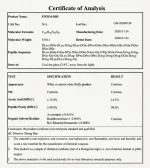
1776359582804.webp
One of the companies gave me this as their CoA wtf.

Does anyone know where to find FOXO4-DRI with a CoA? Or at least that it's verified? I don't want to waste money buying from one of these vendors, then spending money on testing, just to find out its just FOXO4.

and btw, this is a warning for others out there too, be careful with that product code. I'm not saying it is or isn't FOXO4-DRI, just that some vendors said it isn't.
 
To the best of my knowledge there is no FOX04 manufactured or available anywhere. If the vendor says FOX04 it really is FOX04-DRI.

To the best of my knowledge there is no FOX04 manufactured or available anywhere. If the vendor says FOX04 it really is FOX04-DRI.

Having said that, be really, really, thorough on your research before you use this on a human subject.

This was never intended to be used on a human subject. It was developed just to study senolytics.

There was no long-term tracking for the rodent subjects used in tests, 2 months after the tests they were destroyed. So we don’t even know if the mice acquired long term health issues.

We have no human PK data. Extrapolating from the mouse trials the dose would be 25 – 30 mg every other day for 5 – 11 rounds.

The data suggests FOX04-DRI wouldn’t make any sense at a low dose.

The data suggests this wouldn’t make any sense for a subject that wasn’t 65+ yo.

If you do it, please do lots of labs before and after and share the results.

The danger with FOXO4‑DRI is not “you might feel sick for a few days.”

The danger is:
  • You may disrupt p53‑mediated tumor suppression.
  • You may impair tissue repair.
  • You may accelerate a latent cancer.
  • You may trigger organ‑specific toxicity that has never been mapped.
  • You may cause irreversible long‑term effects that appear months or years later.
My complete summary of all the research I could find is available here: FOXO4-DRI.pdf
 
To the best of my knowledge there is no FOX04 manufactured or available anywhere. If the vendor says FOX04 it really is FOX04-DRI.

To the best of my knowledge there is no FOX04 manufactured or available anywhere. If the vendor says FOX04 it really is FOX04-DRI.

Having said that, be really, really, thorough on your research before you use this on a human subject.

This was never intended to be used on a human subject. It was developed just to study senolytics.

There was no long-term tracking for the rodent subjects used in tests, 2 months after the tests they were destroyed. So we don’t even know if the mice acquired long term health issues.

We have no human PK data. Extrapolating from the mouse trials the dose would be 25 – 30 mg every other day for 5 – 11 rounds.

The data suggests FOX04-DRI wouldn’t make any sense at a low dose.

The data suggests this wouldn’t make any sense for a subject that wasn’t 65+ yo.

If you do it, please do lots of labs before and after and share the results.

The danger with FOXO4‑DRI is not “you might feel sick for a few days.”

The danger is:
  • You may disrupt p53‑mediated tumor suppression.
  • You may impair tissue repair.
  • You may accelerate a latent cancer.
  • You may trigger organ‑specific toxicity that has never been mapped.
  • You may cause irreversible long‑term effects that appear months or years later.
My complete summary of all the research I could find is available here: FOXO4-DRI.pdf
I looked long and hard at this one and came to the same conclusion. I'll pass. I could have saved many hours with the document you compiled. Nice job.
 
Well shoot i wish i would
Have read this before. I bought some single
Vials but have not used them at all and after this i probably will not even use them on my lab rat. Good points
 
Well shoot i wish i would
Have read this before. I bought some single
Vials but have not used them at all and after this i probably will not even use them on my lab rat. Good points
I've done the same thing. I've got vials of stuff I will never use. I saw it. I thought I wanted it. Didn't do my research. Now it's just sitting in the freezer.
 
Thank you @Researcher6076 for sharing your research. So F410 is FOXO4-DRI? Because homopeptide told me they only have plain foxo4, but that just makes no sense to me; who would use that and for what? I'll heed your warning and pause.
I actually have some Dasatinib otw now, this will probably be much safer to try. Even that could lead to deleterious results, but at least there's a lot more research on it.

On a side note though, there are some who have used foxo4-dri and have shared their experiences, but it's far and few.
 
Thank you @Researcher6076 for sharing your research. So F410 is FOXO4-DRI? Because homopeptide told me they only have plain foxo4, but that just makes no sense to me; who would use that and for what? I'll heed your warning and pause.
I actually have some Dasatinib otw now, this will probably be much safer to try. Even that could lead to deleterious results, but at least there's a lot more research on it.

On a side note though, there are some who have used foxo4-dri and have shared their experiences, but it's far and few.

One of those new vendors that just popped up this week shows both FOX04 and FOX04-DRI on their price list. Now that’s just weird considering the OPPOSITE effect.
 
I've done the same thing. I've got vials of stuff I will never use. I saw it. I thought I wanted it. Didn't do my research. Now it's just sitting in the freezer.
I've been reading over the document, and agree, yes there are risks, but there are also many benefits. Everything I read here regarding (some of) the risks would also apply to other senolytics, such as D&Q and maybe fisetin. Also a matter of dosages; start small go slow, clear a little, not a lot, seems like a good strategy.
The biggest concern I have regarding FOXO4-DRI is that the peptide needs to cross two membranes and that this was achieved in the mouse studies by, iirc, fusing the peptide to an HIV vector. It was also delivered intravenously, which I won't be doing that lol.

Although, it's been difficult for me to acquire years, and the years have taught me to listen to the Universe. I will start slowly with D&Q. Maybe even D&Q&F(isetin).
 
I've done the same thing. I've got vials of stuff I will never use. I saw it. I thought I wanted it. Didn't do my research. Now it's just sitting in the freezer.
First off, you are super epic for this FOX04-DRI research paper. Also saved a ton of time reading through this.

Two questions:
1. Do you have similar papers or a folder that you can share with me? Would love to see your other research compilations.

2. You mentioned other research supplies that you bought and decided to pass on after digging deeper. What were those?
 
First off, you are super epic for this FOX04-DRI research paper. Also saved a ton of time reading through this.

Two questions:
1. Do you have similar papers or a folder that you can share with me? Would love to see your other research compilations.

2. You mentioned other research supplies that you bought and decided to pass on after digging deeper. What were those?
I've got about 20 or 25 other research summaries on different peptides. About a dozen made my stack, the others didn't.

If you want to see them I'm OK with sharing them. Give me a couple of days to be sure they all have the appropriate disclaimers added that they are not medical advice, etc. I'll give you access to the whole folder.

You can read them for yourself and decide what looks good and what looks iffy.
 
I've got about 20 or 25 other research summaries on different peptides. About a dozen made my stack, the others didn't.

If you want to see them I'm OK with sharing them. Give me a couple of days to be sure they all have the appropriate disclaimers added that they are not medical advice, etc. I'll give you access to the whole folder.

You can read them for yourself and decide what looks good and what looks iffy.
I am sharing what I've got for research summaries for about two dozen different peptides. I'm not telling anyone what to do. Just sharing the information, I put together for myself. The perfect is the enemy of the good, these could be better, but instead of obsessing to clean them up I’m just sharing.

Please, if you find errors or missing information let me know. No ego here, I make mistakes.

Please read the full disclaimer in README.pdf . And here is the folder link Share containing these file:

5 Amino 1q.pdf
bpc-157.pdf
CJC 1295 NODAC + Ipamorelin.pdf
Epitalon for sleep.pdf
Epitalon plus Thymalin.pdf
Epitalon plus Vilon.pdf
FOXO4-DRI.pdf
GHK-cu.pdf
GLOW.pdf
Glutathione.pdf
kpv.pdf
MOTS-C.pdf
NAD+.pdf
Prostamax.pdf
retatrutide.pdf
Selank.pdf
Semax.pdf
SS-31.pdf
tb-500.pdf
Tesamorelin.pdf
Thymosin Alpha 1.pdf
tirzepatide.pdf
Vesugen.pdf
vilon.pdf
 
I am sharing what I've got for research summaries for about two dozen different peptides. I'm not telling anyone what to do. Just sharing the information, I put together for myself. The perfect is the enemy of the good, these could be better, but instead of obsessing to clean them up I’m just sharing.

Please, if you find errors or missing information let me know. No ego here, I make mistakes.

Please read the full disclaimer in README.pdf . And here is the folder link Share containing these file:

5 Amino 1q.pdf
bpc-157.pdf
CJC 1295 NODAC + Ipamorelin.pdf
Epitalon for sleep.pdf
Epitalon plus Thymalin.pdf
Epitalon plus Vilon.pdf
FOXO4-DRI.pdf
GHK-cu.pdf
GLOW.pdf
Glutathione.pdf
kpv.pdf
MOTS-C.pdf
NAD+.pdf
Prostamax.pdf
retatrutide.pdf
Selank.pdf
Semax.pdf
SS-31.pdf
tb-500.pdf
Tesamorelin.pdf
Thymosin Alpha 1.pdf
tirzepatide.pdf
Vesugen.pdf
vilon.pdf
I am a believer on these peps, Epitalon plus Thymalin
 
I just ordered some from a vendor a week ago that now shows Out of Stock.

I've done 2 cycles of Fox (yes, DRI). Couldn't tell any difference with the first round.
I've had a very small tender point on my left temple for probably over 20 years. It would get a little rough spot the size of the tip of a pencil lead that hurt to the touch. I'd apply a mix of Vitamin D and a specific selenium supplement overnight. It would basically 'eat' the spot that would then heal over the next few days, then in a month or 2 would be back. (although the tenderness never went away fully)
About 2/3 of the way through my last round of Fox, that spot disappeared and hasn't been back. I can push on that spot as hard as I want and I feel nothing. That was a couple months ago. The Fox is the only thing I can think of that was different that time.
 
Last edited:
I am sharing what I've got for research summaries for about two dozen different peptides. I'm not telling anyone what to do. Just sharing the information, I put together for myself. The perfect is the enemy of the good, these could be better, but instead of obsessing to clean them up I’m just sharing.
You should put this in its own thread. A lot of people would probably be interested that may not find it here.
 
I am sharing what I've got for research summaries for about two dozen different peptides. I'm not telling anyone what to do. Just sharing the information, I put together for myself. The perfect is the enemy of the good, these could be better, but instead of obsessing to clean them up I’m just sharing.

Please, if you find errors or missing information let me know. No ego here, I make mistakes.

Please read the full disclaimer in README.pdf . And here is the folder link Share containing these file:

5 Amino 1q.pdf
bpc-157.pdf
CJC 1295 NODAC + Ipamorelin.pdf
Epitalon for sleep.pdf
Epitalon plus Thymalin.pdf
Epitalon plus Vilon.pdf
FOXO4-DRI.pdf
GHK-cu.pdf
GLOW.pdf
Glutathione.pdf
kpv.pdf
MOTS-C.pdf
NAD+.pdf
Prostamax.pdf
retatrutide.pdf
Selank.pdf
Semax.pdf
SS-31.pdf
tb-500.pdf
Tesamorelin.pdf
Thymosin Alpha 1.pdf
tirzepatide.pdf
Vesugen.pdf
vilon.pdf
Thanks for sharing this!
 
This right here would make it a hell no for me.

Thank you for sharing your research files, by the way. ❤️
Well... Several popular peptides can accelerate latent cancer. All the gh secretagogues share that warning. Tb-500 absolutely too.

We want growth. We want healing. Generally things that promote growth and healing can theoretically accelerate latent cancers and micro tumors. They can't cause cancer de novo, but they can give any cancer that does exist a boost.

That creates a challenge for each of us to find our own risk tolerance.
 
Well... Several popular peptides can accelerate latent cancer. All the gh secretagogues share that warning. Tb-500 absolutely too.

We want growth. We want healing. Generally things that promote growth and healing can theoretically accelerate latent cancers and micro tumors. They can't cause cancer de novo, but they can give any cancer that does exist a boost.

That creates a challenge for each of us to find our own risk tolerance.
The reward would have to be awfully high for me to take the risk.
 
Thank you @Researcher6076 for sharing your research. So F410 is FOXO4-DRI? Because homopeptide told me they only have plain foxo4, but that just makes no sense to me; who would use that and for what? I'll heed your warning and pause.
I actually have some Dasatinib otw now, this will probably be much safer to try. Even that could lead to deleterious results, but at least there's a lot more research on it.

On a side note though, there are some who have used foxo4-dri and have shared their experiences, but it's far and few.

Yeah all small molecule senolytics are anticancer agents. Navitoclax/Venetoclax and dasatanib for example. There are dosage studies on these and phase 3 trials that clearly identify side effect and toxicity profiles. I would definitely do those first and they are fairly cheap and easy to procur.

For FOXO4-DRI it seems to be a potent senolytic but there is so little real world, controlled data on it. Like there is no phase2/3 studies showing proper dosing protocols and measuring effectiveness on a variety of SASP biomarkers. However, I dont see how it could activate latent cancers like someone mentioned since it is an inhibitor of p53 inhibition by FOXO4. I mean p53 activation triggers apoptosis in cancer. Also reduction of SASP phenotype means a healthier tissue microenvironment and less proliferation of cancer cells. If im missing something someone please enlighten me. The DRI also seems associated with cell penetrance so that doesnt seem to be an issue.

In any case, Id much rather do dasatanib/venetoclax with Quercetin/Fisetin than FOXO4. There is real world evidence that these work and their combination can be especially potent. But i dont see what the huge risk is for FOXO4-DRI at small dosage that people have reported.
 
The reward would have to be awfully high for me to take the risk.
Yeah thats why i wont be doing any progrowth/prohealing peptides, GH secretagogues and melanotan. Not worth it. However, FOXO4-DRI doesnt fit in that group and should be anti-cancer through its mechanism of action. So im not sure why people are mentioning that here.
 
Yeah all small molecule senolytics are anticancer agents. Navitoclax/Venetoclax and dasatanib for example. There are dosage studies on these and phase 3 trials that clearly identify side effect and toxicity profiles. I would definitely do those first and they are fairly cheap and easy to procur.

For FOXO4-DRI it seems to be a potent senolytic but there is so little real world, controlled data on it. Like there is no phase2/3 studies showing proper dosing protocols and measuring effectiveness on a variety of SASP biomarkers. However, I dont see how it could activate latent cancers like someone mentioned since it is an inhibitor of p53 inhibition by FOXO4. I mean p53 activation triggers apoptosis in cancer. Also reduction of SASP phenotype means a healthier tissue microenvironment and less proliferation of cancer cells. If im missing something someone please enlighten me. The DRI also seems associated with cell penetrance so that doesnt seem to be an issue.

In any case, Id much rather do dasatanib/venetoclax with Quercetin/Fisetin than FOXO4. There is real world evidence that these work and their combination can be especially potent. But i dont see what the huge risk is for FOXO4-DRI at small dosage that people have reported.
Here is the detailed biology: Senescent cells can act as a buffer against cancer in two main ways. First, cell‑autonomous arrest: when a potentially malignant cell senses irreparable damage it enters senescence and permanently stops dividing, which directly prevents that cell from clonally expanding into a tumor. Second, immune recruitment: early senescent cells secrete a short‑lived mix of cytokines and chemokines (the SASP) that attracts innate and adaptive immune cells to clear both the senescent cells and nearby damaged or pre‑malignant cells, reinforcing tumor suppression.

Beyond those direct effects, senescent cells also create local microenvironmental barriers. They can enforce paracrine signals that induce neighboring damaged cells to stop dividing (paracrine senescence), occupy niche space that limits stem/progenitor overgrowth, and maintain extracellular matrix features that are less permissive for invasion. Together these actions reduce the chance that a dormant or pre‑malignant clone will resume growth.

The buffering role is time‑ and context‑dependent. When senescence is transient and immune clearance is efficient, the net effect is protective. But if senescent cells accumulate (aging, immune dysfunction), their chronic SASP shifts from immune‑recruiting to pro‑inflammatory and pro‑mitogenic, remodeling matrix and angiogenesis and thereby promoting tumor emergence instead of preventing it.
 
Here is the detailed biology: Senescent cells can act as a buffer against cancer in two main ways. First, cell‑autonomous arrest: when a potentially malignant cell senses irreparable damage it enters senescence and permanently stops dividing, which directly prevents that cell from clonally expanding into a tumor. Second, immune recruitment: early senescent cells secrete a short‑lived mix of cytokines and chemokines (the SASP) that attracts innate and adaptive immune cells to clear both the senescent cells and nearby damaged or pre‑malignant cells, reinforcing tumor suppression.

The buffering role is time‑ and context‑dependent. When senescence is transient and immune clearance is efficient, the net effect is protective. But if senescent cells accumulate (aging, immune dysfunction), their chronic SASP shifts from immune‑recruiting to pro‑inflammatory and pro‑mitogenic, remodeling matrix and angiogenesis and thereby promoting tumor emergence instead of preventing it.

I completely understand that senescence cells, especially in early accumulation phase can have a protective role in buffering cancer formation. Its a matter of two competitive effects though.

One the one hand senescence is intrinsically a protective mechanism, on the other senolytics kill that protective effect BUT they are also themselves anticancer agents.

So which effect is strongest? The protective effect of senescence or anticancer effect of senolytics. I think its hard to argue to dasatanib and venetoclax would in any way contribute to cancer formation, especially in combination. I also think that regarding senolyics in general, there is no real evidence that they cause an increase in cancer in any animal models. So the risk due to the protective effect of senescence is purely theoretical and not rooted in any evidence that I know of. If there is such evidence please let me know im always open to being wrong.

There are lots of things that can be theoretically cancer promoting in some way but the evidence just doesnt pan out in animal or human trials. GLP1s for example, NR/NMN, glutathione, etc. So theres no real reason to fear it imo. Until the evidence changes of course which sometimes, though rarely, happens after decades of usage in the population.
 
why i wont be doing any progrowth/prohealing peptides, GH secretagogues and melanotan
not all healing compounds are carcinogenic. Keeping inflammation down is a good way to protect oneself from cancer, and that can be achieved using several peptides, including KPV and MT-1. I notice you wrote 'melanotan', but I think you mean MT-2. This one kicks up your HR and BP because it affects more than MC1R (melanocortin receptor 1) and instead attaches to MC1, MC3, MC4, and MC5. Strict MC1R activation is associated with good things. Even BPC-157, I'm on the fence about this one. I think what you mean to say is not 'pro-healing' which is good, but angiogenic, ie. promoters of vascular differentiation, creating new blood vessels, which in turn could feed existing tumors.

FOXO4 is involved in a lot more than just binding p53 folks. It's normally bound by XBP1u in the cytoplasm, and is driven by PDGF-BB, TNF-α, angiotensin II, mechanical and oxidative stress, which are pathological signals. It also interacts directly with myocardin and inhibits smooth muscle contractile gene expression, which is not a good thing. My point is that its a lot more complicated than just Foxo4-p53, and if DRI upsets the XBP1u retention of FOXO4, then that would be disastrous to normal cells.

I've also read that senescent cells could theoretically serve a structural placeholders, which without, we would end up with swiss cheese tissues (that's a bad thing, especially in the context of endothelial tissue in the vascular system... think dissection/rupture).

I agree that more research is required. This is why Cleara Biotech is advancing the FOXO4-p53 technology from a 3rd-generation research peptide (FOXO4-DRI) into 4th-generation therapeutic candidates designed for human clinical translation. Their current work centers on two lead compounds, CL04177 and CL04183, which demonstrate significantly enhanced binding to p53 in senescent cells compared to the original FOXO4-DRI.

Just stuff to keep in mind.
 
I just ordered some from a vendor a week ago that now shows Out of Stock.

I've done 2 cycles of Fox (yes, DRI). Couldn't tell any difference with the first round.
I've had a very small tender point on my left temple for probably over 20 years. It would get a little rough spot the size of the tip of a pencil lead that hurt to the touch. I'd apply a mix of Vitamin D and a specific selenium supplement overnight. It would basically 'eat' the spot that would then heal over the next few days, then in a month or 2 would be back. (although the tenderness never went away fully)
About 2/3 of the way through my last round of Fox, that spot disappeared and hasn't been back. I can push on that spot as hard as I want and I feel nothing. That was a couple months ago. The Fox is the only thing I can think of that was different that time.
Yes! Those kinds of skin patchrs are exactly the kinds of issues foxo4-dri should help. How. Many mg each day? How many days? Did you alternate days?
 
not all healing compounds are carcinogenic. Keeping inflammation down is a good way to protect oneself from cancer, and that can be achieved using several peptides, including KPV and MT-1. I notice you wrote 'melanotan', but I think you mean MT-2. This one kicks up your HR and BP because it affects more than MC1R (melanocortin receptor 1) and instead attaches to MC1, MC3, MC4, and MC5. Strict MC1R activation is associated with good things. Even BPC-157, I'm on the fence about this one. I think what you mean to say is not 'pro-healing' which is good, but angiogenic, ie. promoters of vascular differentiation, creating new blood vessels, which in turn could feed existing tumors.

FOXO4 is involved in a lot more than just binding p53 folks. It's normally bound by XBP1u in the cytoplasm, and is driven by PDGF-BB, TNF-α, angiotensin II, mechanical and oxidative stress, which are pathological signals. It also interacts directly with myocardin and inhibits smooth muscle contractile gene expression, which is not a good thing. My point is that its a lot more complicated than just Foxo4-p53, and if DRI upsets the XBP1u retention of FOXO4, then that would be disastrous to normal cells.

I've also read that senescent cells could theoretically serve a structural placeholders, which without, we would end up with swiss cheese tissues (that's a bad thing, especially in the context of endothelial tissue in the vascular system... think dissection/rupture).

I agree that more research is required. This is why Cleara Biotech is advancing the FOXO4-p53 technology from a 3rd-generation research peptide (FOXO4-DRI) into 4th-generation therapeutic candidates designed for human clinical translation. Their current work centers on two lead compounds, CL04177 and CL04183, which demonstrate significantly enhanced binding to p53 in senescent cells compared to the original FOXO4-DRI.

Just stuff to keep in mind.
Wow, i appreciate the knowledge here. I certainly wasnt aware of newer generation peptides from Cleara Biotech. And yes, by prohealing i do mean angiogenic which is progrowth. I also think things like IGF1-LR3 also fall into that category.

In any case, you seem very well versed in the biochemistry of it all. Im looking forward to seeing what Cleara does with their pipeline. Hopefully their candidates go to phase I/II trials and well get more data on dosage, toxicity and stuff.

Thanks for your input!
 
not all healing compounds are carcinogenic. Keeping inflammation down is a good way to protect oneself from cancer, and that can be achieved using several peptides, including KPV and MT-1. I notice you wrote 'melanotan', but I think you mean MT-2. This one kicks up your HR and BP because it affects more than MC1R (melanocortin receptor 1) and instead attaches to MC1, MC3, MC4, and MC5. Strict MC1R activation is associated with good things. Even BPC-157, I'm on the fence about this one. I think what you mean to say is not 'pro-healing' which is good, but angiogenic, ie. promoters of vascular differentiation, creating new blood vessels, which in turn could feed existing tumors.

FOXO4 is involved in a lot more than just binding p53 folks. It's normally bound by XBP1u in the cytoplasm, and is driven by PDGF-BB, TNF-α, angiotensin II, mechanical and oxidative stress, which are pathological signals. It also interacts directly with myocardin and inhibits smooth muscle contractile gene expression, which is not a good thing. My point is that its a lot more complicated than just Foxo4-p53, and if DRI upsets the XBP1u retention of FOXO4, then that would be disastrous to normal cells.

I've also read that senescent cells could theoretically serve a structural placeholders, which without, we would end up with swiss cheese tissues (that's a bad thing, especially in the context of endothelial tissue in the vascular system... think dissection/rupture).

I agree that more research is required. This is why Cleara Biotech is advancing the FOXO4-p53 technology from a 3rd-generation research peptide (FOXO4-DRI) into 4th-generation therapeutic candidates designed for human clinical translation. Their current work centers on two lead compounds, CL04177 and CL04183, which demonstrate significantly enhanced binding to p53 in senescent cells compared to the original FOXO4-DRI.

Just stuff to keep in mind.
I am absolutely watching the fascinating biology in the senescence research space. I think there are real potentials for longevity, possibly cancer, and other unexpected areas. I think the key may be to narrow down the targeting so the therapies can just allow the senescent cells we want to die die.
 
I also think things like IGF1-LR3 also fall into that category.
IGF1 is related to mTOR activation, which is growth signalling. It's hyperactivation is associated with bad outcomes such as cancer, neurological disorders, and metabolic diseases.
mTOR stands for mammalian target of rapamycin; that's where rapamycin comes in, as a quencher of this growth cascade.
I am absolutely watching the fascinating biology in the senescence research space. I think there are real potentials for longevity, possibly cancer, and other unexpected areas. I think the key may be to narrow down the targeting so the therapies can just allow the senescent cells we want to die die.
did u catch that article i shared a couple days back? You might like those newer mouse studies.
 
Last edited:
TY
not all healing compounds are carcinogenic. Keeping inflammation down is a good way to protect oneself from cancer, and that can be achieved using several peptides, including KPV and MT-1. I notice you wrote 'melanotan', but I think you mean MT-2. This one kicks up your HR and BP because it affects more than MC1R (melanocortin receptor 1) and instead attaches to MC1, MC3, MC4, and MC5. Strict MC1R activation is associated with good things. Even BPC-157, I'm on the fence about this one. I think what you mean to say is not 'pro-healing' which is good, but angiogenic, ie. promoters of vascular differentiation, creating new blood vessels, which in turn could feed existing tumors.

FOXO4 is involved in a lot more than just binding p53 folks. It's normally bound by XBP1u in the cytoplasm, and is driven by PDGF-BB, TNF-α, angiotensin II, mechanical and oxidative stress, which are pathological signals. It also interacts directly with myocardin and inhibits smooth muscle contractile gene expression, which is not a good thing. My point is that its a lot more complicated than just Foxo4-p53, and if DRI upsets the XBP1u retention of FOXO4, then that would be disastrous to normal cells.

I've also read that senescent cells could theoretically serve a structural placeholders, which without, we would end up with swiss cheese tissues (that's a bad thing, especially in the context of endothelial tissue in the vascular system... think dissection/rupture).

I agree that more research is required. This is why Cleara Biotech is advancing the FOXO4-p53 technology from a 3rd-generation research peptide (FOXO4-DRI) into 4th-generation therapeutic candidates designed for human clinical translation. Their current work centers on two lead compounds, CL04177 and CL04183, which demonstrate significantly enhanced binding to p53 in senescent cells compared to the original FOXO4-DRI.

Just stuff to keep in mind.
for this. I will incorporate some additional FOX)$ known unknown risks in my notes!
 

Trending Topics

Latest Posts

Forum Statistics

Threads
17,585
Posts
182,502
Members
59,171
Newest
starknasty
Back
Top Bottom