opinions on combined therapy, glp + metformin?

Cluni0n

GLP-1 Novice
🚫No Source Discussion🚫
Member Since
Apr 25, 2026
Posts
14
Likes Received
27
Location
Chile
Hi everyone, I’m currently talking with my doctor to decide which medication would be best for me. I’m significantly overweight (224lbs, 5'4F) and have hiigh HOMA score (7.9), but my fasting glucose, A1C, cholesterol, no fatty liver and other test results are all within normal ranges (perks of having tons of muscle mass tho). I’ve been reading a bit about combined therapy, and it seems to yield good results: you don’t lose as much muscle mass, taking less metformin means fewer side effects, low ozempic doses, and it targets different mechanisms in terms of hormones. I actually found it very interesting, so I’d like to know if anyone has tried this method before, if you could share your experience it would be great, thanks! 🙂
 
I take Jardiance from India with my GLPs sometimes. No issues with hypoglycemia. (I cycle Jardiance because I get tired of peeing more. So I wait to take it when I am on a GH peptide as well, to help prevent fluid retention on GH peptides.)
 
Last edited:
Hi everyone, I’m currently talking with my doctor to decide which medication would be best for me. I’m significantly overweight (224lbs, 5'4F) and have hiigh HOMA score (7.9), but my fasting glucose, A1C, cholesterol, no fatty liver and other test results are all within normal ranges (perks of having tons of muscle mass tho). I’ve been reading a bit about combined therapy, and it seems to yield good results: you don’t lose as much muscle mass, taking less metformin means fewer side effects, low ozempic doses, and it targets different mechanisms in terms of hormones. I actually found it very interesting, so I’d like to know if anyone has tried this method before, if you could share your experience it would be great, thanks! 🙂
Metformin will lower glucose and A1C, but it usually doesn't do much for weight loss. Some people report stomach issues on metformin, but they will be generally less severe than semaglutide.

Frankly, if your goal is to lose weight, semaglutide or tirzepatide alone are superior. You would only use metformin for glucose control, but it looks like you don't need that.

Muscle mass loss on GLP1 is overblown, assuming you have decent nutrition (read: protein) and do some physical activity. Keep in mind that apparent muscle mass reductions are due in part to less fat accumulating in the muscle, and thus the muscle losing some volume. This was verified by measuring by CT. In studies, a big portion of lean mass loss actually comes from liver mass and other internal organs, which shrink as systemic inflammation and fat storage.
 
Yeah, metformin was essentially just an exercise in diarrhea for me, when I took it for prediabetes before taking GLPs. On its own, minimal weight loss, if any, with metformin. So would be better for maintaining weight than losing weight.

Switching from Ozempic to Zepbound (or grey tirz) would be far more effective than adding metformin for weight loss and health markers.
 
Last edited:
but my fasting glucose, A1C, cholesterol, no fatty liver and other test results are all within normal ranges (perks of having tons of muscle mass tho)
As an ex-diabetic I have used both, and if you really want to use metformin, only use it as a senolytic. But in your case, metformin might be useful for the anti-gluconeogenesis effect. I'm using it myself every 3 days to enhance glycogen replenishment in muscles.
 
Metformin can help with weight loss on its own. It's not normally prescribed specifically for that purpose and results will vary, but it's incorrect to to say that it's not associated with weight loss. If you're considering both, it couldn't hurt to have your doctor write you a prescription for both.

If you do choose to do both, I would not recommend starting both at the same time, as GI side effects are very common with both and you may not want your first week of treatment with maximum side effects. I'd think it would make more sense to start one and stabilize before starting the other. Even if you're not sure you'll take it, metformin is an old generic that's dirt cheap so there's no harm in getting a prescription and having it filled simply so you have the option to start taking it if you choose to later (vs having to hit up your doctor again). That would give you plenty of time to ease into a GLP and do further reading up on metformin rather than feeling under the gun as you may right now.

I personally discontinued metformin when I started a GLP (despite minimal side effects with metformin) and from what you've said, I'm not sure there's a strong reason for you to include it with the GLP. That will be especially true if you experience any significant GI side effects from metformin.
 
2.1 percent weight loss with metformin after 2+ years :

Long-term Weight Loss with Metformin or Lifestyle Intervention in the Diabetes Prevention Program Outcomes Study
A recent systematic review and meta-analysis reported an average weight loss of 1.1 kg with metformin used for varying periods (18). In the DPP/DPPOS, the metformin group had an average weight loss of 2.1% after 2 years, and remarkably, the group maintained ~2% weight loss for the next 10 years (19). Taken together, it appears that long-term metformin treatment is associated with an average ~1–2% weight loss when assessed among all of those given the drug.

Gemini said:
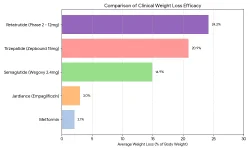
MedicationMechanismAverage Weight Loss (%)Trial Duration
MetforminBiguanide~2.1%~3 years
JardianceSGLT2 Inhibitor~3.0%~3.1 years (median)
SemaglutideGLP-1 RA~14.9%68 weeks (~1.3 years)
TirzepatideGLP-1/GIP RA~20.9%72 weeks (~1.4 years)
RetatrutideTriple Agonist~24.2%48 weeks (~11 months)

1778718736104.webp
 
Last edited:
The side effects of metformin were to much for me. It gave me muscle cramps that made my daily runs uncomfortable. I have a couple years worth from my prior struggle with high blood sugar.

There is recent research on metformin negating some of the benefits of aerobic exercise for diabetics.

https://share.google/ZXsfaOQYOm1iwwuNu
 
Is that 2.1% placebo adjusted?
Technically no, but placebo group had less than 0.1% weight loss [PubMed: 22442396]:

After 2 years, weight loss was 2.1 ± 5.7% in the metformin group compared with 0.02 ± 5.5% (P < 0.001) in the placebo group.

Argument for metformin and stacking metformin with GLPs:
Gemini said:
  • The "Adherence" Factor: The 2.1% is a broad average. For participants who were highly adherent (consistently taking their prescribed dose), the mean weight loss was significantly higher at 3.5%.

  • The "Responder" Group: About 28.5% of the metformin group were "high responders," losing 5% or more of their body weight. These individuals were the most likely to maintain that loss for the full 15-year follow-up period.

  • Durability over Intensity: The study's main takeaway was that while metformin doesn't cause the massive initial drop seen with lifestyle changes (or modern GLP-1s), the weight lost is highly sustainable. Metformin users kept their weight off for 10–15 years, whereas lifestyle-only participants tended to regain weight over time.

Why this makes Metformin the top choice for "Stacking"​

Because the study shows Metformin provides a durable "metabolic floor," it is often considered the best oral drug to pair with a GLP-1 for these reasons:

  1. Combating Resistance: If you hit a plateau on a GLP-1, the DPPOS data suggests Metformin helps by maintaining insulin sensitivity over the long haul, potentially "re-sensitizing" the body to weight loss.

  2. Maintenance Protocol: Given the high regain rates after stopping GLP-1s, the long-term safety and durability data from the DPPOS make Metformin a prime candidate for a "taper" or maintenance phase.

  3. Cost-Benefit Profile: Unlike SGLT2s or Contrave, Metformin is widely accessible and has the longest-running safety data (as evidenced by this 15+ year study) for weight management.
 
Last edited:
A Dr a saw was a big fan of Glps he said take the Glp then use metformin to maintain.

I have tried it previously & did not lose weight on it, but it did help me sleep very well & helped with pain
 
A lot of things here I've never heard - metformin being muscle sparing on a deficit, didn't know about stomach issues or diarrhea, or using it as a senolytic. Also never heard of jardiance, but on first glance seems interesting, it makes you pee out sugar? So it looks like I have a bunch of rabbit holes to go down.

Personally I just used metformin years ago to control my blood sugar when I was fatter and started HGH. It worked well I guess, I can only assume it helped keep my blood sugar normal, and I had no noticeable side effects. I don't need it anymore, especially when I'm taking reta, combining these two would lower blood sugar a lot.

According to the bro science, you should try it. Metformin is cheap, safe, and as far as I knew until now, well tolerated. It's a low risk high reward bet.
 
Hi everyone, I’m currently talking with my doctor to decide which medication would be best for me. I’m significantly overweight (224lbs, 5'4F) and have hiigh HOMA score (7.9), but my fasting glucose, A1C, cholesterol, no fatty liver and other test results are all within normal ranges (perks of having tons of muscle mass tho). I’ve been reading a bit about combined therapy, and it seems to yield good results: you don’t lose as much muscle mass, taking less metformin means fewer side effects, low ozempic doses, and it targets different mechanisms in terms of hormones. I actually found it very interesting, so I’d like to know if anyone has tried this method before, if you could share your experience it would be great, thanks! 🙂
A HOMA of 7.9 is actually a pretty significant marker of insulin resistance, even with normal fasting glucose and A1C. A lot of people are missing this piece because they're focused only on whether youre “diabetic” or if metformij a good choice for weight loss.

The reason your doctor is considering something like metformin isn’t necessarily because it’s a powerful weight-loss medication by itself. It’s because it targets the underlying insulin resistance that your labs are showing.

HOMA basically looks at the relationship between your fasting glucose and fasting insulin levels. You can still have normal glucose while your body is producing a LOT of insulin behind the scenes to keep it there. That elevated insulin all thentikenspace can make fat loss harder, increase hunger/cravings for some people, and over time may progress toward prediabetes or metabolic dysfunction.

So when people say, “metformin won’t make you lose weight,” they’re kind of missing the point of why it’s being prescribed in cases like yours. The goal is often improving insulin sensitivity and lowering the amount of insulin your body has to produce.... not just chasing scale loss alone but also so that you CAN lose weight.

And honestly, your doctor’s thought process about combination therapy is not unusual at all anymore. Lower-dose GLP1s combined with metformin can sometimes:

improve insulin sensitivity from multiple angles
help appetite/satiety
allow lower doses and fewer side effect
support mpre metabolic improvement
help preserve lean mass better when paired with adequate protein and resistance training


Also, your point about muscle mass matters more than people realize. Someone with higher muscle mass can absolutely have normal looking glucose and A1C for a long time because muscle helps buffer glucose effectively... Mmwhile insulin resistance is still developing underneath. That’s exactly why fasting insulin and HOMA can be so helpful clinically.

You’re asking smart questions and looking beyond “which drug causes the fastest weight loss,” which is honestly the more important long term conversation with that HOMA.
 
Last edited:
If tirzepatide is an option available to you as well as semaglutide, I think picking it is a better option than semaglutide. Given you would like to lose a lot of weight, it is simply more effective for weight loss, and typically causes less side effects at the same time. Both of these reduce the odds of developing diabetes dramatically, and one of the reasons for using them in your case is to prevent type 2 diabetes, I believe tirzepatide is also more effective at that than semaglutide.

Metformin also causes a little bit of weight loss, reduces the odds of developing diabetes, but not as much as GLP drugs, and combining it with GLPs is reasonable, but as metformin and GLPs both have high rates of gastrointestinal side effects, do not start them both at the same time.

The main advantage of tirz over sema is more long term weight loss.
 
A HOMA of 7.9 is actually a pretty significant marker of insulin resistance, even with normal fasting glucose and A1C. A lot of people miss that piece because they focus only on whether someone is “diabetic” or not.

The reason your doctor is considering something like metformin isn’t necessarily because it’s a powerful weight-loss medication by itself. It’s because it targets the underlying insulin resistance that your labs are showing.

HOMA basically looks at the relationship between your fasting glucose and fasting insulin levels. You can still have normal glucose while your body is producing a LOT of insulin behind the scenes to keep it there. That elevated insulin all thentikenspace can make fat loss harder, increase hunger/cravings for some people, and over time may progress toward prediabetes or metabolic dysfunction.

So when people say, “metformin won’t make you lose weight,” they’re kind of missing the point of why it’s being prescribed in cases like yours. The goal is often improving insulin sensitivity and lowering the amount of insulin your body has to produce.... not just chasing scale loss alone but also so that you CAN lose weight.

And honestly, your doctor’s thought process about combination therapy is not unusual at all anymore. Lower-dose GLP1s combined with metformin can sometimes:

improve insulin sensitivity from multiple angles
help appetite/satiety
allow lower doses and fewer side effect
support mpre metabolic improvement
help preserve lean mass better when paired with adequate protein and resistance training


Also, your point about muscle mass matters more than people realize. Someone with higher muscle mass can absolutely have normal looking glucose and A1C for a long time because muscle helps buffer glucose effectively... Mmwhile insulin resistance is still developing underneath. That’s exactly why fasting insulin and HOMA can be so helpful clinically.

You’re asking smart questions and looking beyond “which drug causes the fastest weight loss,” which is honestly the more important long term conversation with that HOMA.

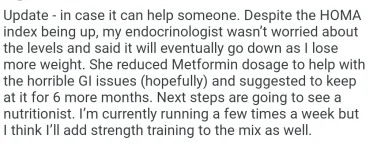
"6 months Metformin - weight down but HOMA up?"

1778723368753.webp

So another reason I would focus on Zepbound/tirz more than anything. Or maybe grey reta.

I don’t know what my fasting insulin was when I started, but my A1c went from 6.1 to 5.3 in a year, mostly from tirz by itself. Fasting insulin is normal/great now.
 
Last edited:

View attachment 23112
I’d be careful applying someone else’s experience directly to the OP here. This commenter is an entirely different person with a different metabolic profile, different labs, different symptoms, different body composition, and a different medical history.

The OP’s doc is making recommendations based on their actual clinical picture and there’s science behind that approach. A random Reddit anecdote isn’t really enough information to say what the OP should or shouldn’t do.

Also, not every elevated HOMA situation automatically means ‘just use tirzepatide instead.’ Medicine is a little more nuanced than that.
I’d be careful applying one person’s Reddit experience directly to the OP here. They’re completely different individuals with different metabolic profiles, labs, symptoms, body composition, medical histories, and treatment goals.

The OP’s doc is making recommendations based on their specific clinical picture, and there’s actual evidence behind that approach. A single anecdote from someone else online really isn’t enough to conclude what will or won’t work for the OP.

Side effects are also highly individual. Some people tolerate metformin perfectly, others do better with extended release, slower titration, dose adjustments, or simply giving their body time to adapt. And yes, for some people it ultimately isn’t the right medication.... that’s valid too. But deciding it will definitely be awful or useless before even trying it feels unnecessarily defeatist.

And not every elevated HOMA case automatically means ‘skip everything and go straight to tirzepatide.’ Medicine is more nuanced than reducing every metabolic issue to one medication.
 
Why is the doc recommending semaglutide instead of tirzepatide? Is it insurance, availability, or something else? Tirz also has less incidence of nausea/vomiting.

Or did the OP (@Cluni0n) simply use Ozempic as an example? The OP has reta on the way, anyway:


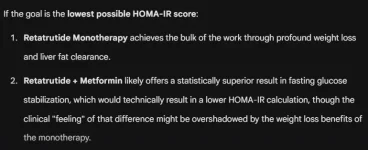
So to be more specific, perhaps we need to compare reta + metformin vs. reta alone for things like HOMA:
Gemini said:

And perhaps the OP needs to be more honest with their doctor about any future reta use, if wanting the best results for her specific situation. Given that reta is considered more effective than Ozempic/sema for insulin resistance, the need for adding metformin may be less.
 
Last edited:
A lot of things here I've never heard - metformin being muscle sparing on a deficit, didn't know about stomach issues or diarrhea, or using it as a senolytic. Also never heard of jardiance, but on first glance seems interesting, it makes you pee out sugar? So it looks like I have a bunch of rabbit holes to go down.

Personally I just used metformin years ago to control my blood sugar when I was fatter and started HGH. It worked well I guess, I can only assume it helped keep my blood sugar normal, and I had no noticeable side effects. I don't need it anymore, especially when I'm taking reta, combining these two would lower blood sugar a lot.

According to the bro science, you should try it. Metformin is cheap, safe, and as far as I knew until now, well tolerated. It's a low risk high reward bet.
Metaformin has a lot of side benefits, too. A lot of people that took with HGH just continue to take it. Particularly anybody that might have had high blood pressure. Lots of data on it.
 
Why is the doc recommending semaglutide instead of tirzepatide? Is it insurance, availability, or something else? Tirz also has less incidence of nausea/vomiting.

Or did the OP (@Cluni0n) simply use Ozempic as an example? The OP has reta on the way, anyway:


So to be more specific, perhaps we need to compare reta + metformin vs. reta alone for things like HOMA:


And perhaps the OP needs to be more honest with their doctor about any future reta use, if wanting the best results for her specific situation. Given that reta is considered more effective than Ozempic/sema for insulin resistance, the need for adding metformin may be less.
OP here, I have 2 options, ordering some grey Reta, oooor metformin+ozempic, I still haven't bought reta bc i wanted to receive all my lab results+abdominal ultrasound first, and also bc I'm waiting for the EU restock to decide lol, so yes just doing as much research as I can to see what would work best in my case 🙂, I started reading more about this combined therapy a few days ago so that's why I posted this thread.
OG tirz isn't an option, totally out of my budget, grey tirz could be an option yes, but in that case i think i'd prefer reta.
Hope it's clearer now!
 
Choose the option that allows you to both lower A1c, fasting insulin, and lose weight.
 
A HOMA of 7.9 is actually a pretty significant marker of insulin resistance, even with normal fasting glucose and A1C. A lot of people are missing this piece because they're focused only on whether youre “diabetic” or if metformij a good choice for weight loss.

The reason your doctor is considering something like metformin isn’t necessarily because it’s a powerful weight-loss medication by itself. It’s because it targets the underlying insulin resistance that your labs are showing.

HOMA basically looks at the relationship between your fasting glucose and fasting insulin levels. You can still have normal glucose while your body is producing a LOT of insulin behind the scenes to keep it there. That elevated insulin all thentikenspace can make fat loss harder, increase hunger/cravings for some people, and over time may progress toward prediabetes or metabolic dysfunction.

So when people say, “metformin won’t make you lose weight,” they’re kind of missing the point of why it’s being prescribed in cases like yours. The goal is often improving insulin sensitivity and lowering the amount of insulin your body has to produce.... not just chasing scale loss alone but also so that you CAN lose weight.

And honestly, your doctor’s thought process about combination therapy is not unusual at all anymore. Lower-dose GLP1s combined with metformin can sometimes:

improve insulin sensitivity from multiple angles
help appetite/satiety
allow lower doses and fewer side effect
support mpre metabolic improvement
help preserve lean mass better when paired with adequate protein and resistance training


Also, your point about muscle mass matters more than people realize. Someone with higher muscle mass can absolutely have normal looking glucose and A1C for a long time because muscle helps buffer glucose effectively... Mmwhile insulin resistance is still developing underneath. That’s exactly why fasting insulin and HOMA can be so helpful clinically.

You’re asking smart questions and looking beyond “which drug causes the fastest weight loss,” which is honestly the more important long term conversation with that HOMA.
Thank you for this! I think you're the person who understood my point the best. That's exactly what I'm aiming for: using (small dose) Metformin to directly activate the AMPK pathway and target that cellular sensitivity + a small dose of a GLP so it can handle the hunger hormones. I have no intention of using high doses of either medication; I just want to give my body that little push so the machine can start working properly again.

I'm 23 years old, which I hope plays in my favor. I have a high amount of muscle mass bc of genetics + I was very active during my teenage years, did strength training for years, and always kept a relatively high-protein diet. But in the last few years, my cortisol levels went completely out of control, antidepressants made it worse. It was crazy to see how I started accumulating fat and gaining weight, even though my daily habits weren't thaaat much worse than when I weighed 30 kg/66 lbs less.

Since September 2025, I managed to lower my fasting glucose (it was 99 before, now 88), cut my total and LDL cholesterol in half, and reduced my inflammation (ESR) to the bare minimum (thanks berberine+myo-inositol combo), but despite all that internal progress, I only lost about 3 kg (7 lbs). That's why I'm considering these combined options now to finally see the physical results of that effort while healing insulin resistance 🙂)
 
OP here, I have 2 options, ordering some grey Reta, oooor metformin+ozempic, I still haven't bought reta bc i wanted to receive all my lab results+abdominal ultrasound first, and also bc I'm waiting for the EU restock to decide lol, so yes just doing as much research as I can to see what would work best in my case 🙂, I started reading more about this combined therapy a few days ago so that's why I posted this thread.
OG tirz isn't an option, totally out of my budget, grey tirz could be an option yes, but in that case i think i'd prefer reta.
Hope it's clearer now!
I don't personally know anyone who would prefer sema, metformin, or their combination over reta, unless they could not tolerate some of the glucagon sides from reta. Everyone I know is on tirz, reta, or some combination of both, as with most of the grey GLP users.
 
Last edited:
I would have to agree with reta or tirz over sema with metformin. I suggested tirzepatide as it sounded like something you were discussing with your doctor, and assumes he or she is not going to recommend an unapproved drug. Sema plus metformin sounds like it would have pretty high rates of gut side effects.

And given it sounds like you want to lose a fair bit of weight BMI of 22.5 is about 58-59kg, or BMI of 25 is 65kg and current weight is 102kg ( sorry but I do not think in pounds ), , assuming you want to get to the top of the normal weight range at a BMI of 25 , requires losing 37kg. This sounds like a task better suited to reta, given its best average weight loss is 29%. Getting to normal weight is not critical for health, getting somewhere near there is a reasonable goal and carries most of the health benefits, and is actually realistically achievable with reta or tirz.

I realise you are saying you would like to use a low dose of GLP drug, but I would like to argue against that. Obviously if you end up being a super responder and can get away with a low dose great, but for many reasons including long term health and quality of life, using GLP drugs to get the maximum benefit , which is maximum weight loss, the dose you are likely to need to get towards the normal weight range is fairly likely to be a higher rather than a lower dose, assuming side effects are not a problem. And at the start you start on low doses anyway and just adjust the dose as needed. I can guarantee that if I had the option of these drugs 35 years ago I would have jumped at the chance.

My guess is there is probably not enough added benefit from metformin to justify the fairly high rate of gut side effects, if you are taking reta or tirz, which mostly have the same or similar long term health benefits except they are better at it.
 
Thank you for this! I think you're the person who understood my point the best. That's exactly what I'm aiming for: using (small dose) Metformin to directly activate the AMPK pathway and target that cellular sensitivity + a small dose of a GLP so it can handle the hunger hormones. I have no intention of using high doses of either medication; I just want to give my body that little push so the machine can start working properly again.

I'm 23 years old, which I hope plays in my favor. I have a high amount of muscle mass bc of genetics + I was very active during my teenage years, did strength training for years, and always kept a relatively high-protein diet. But in the last few years, my cortisol levels went completely out of control, antidepressants made it worse. It was crazy to see how I started accumulating fat and gaining weight, even though my daily habits weren't thaaat much worse than when I weighed 30 kg/66 lbs less.

Since September 2025, I managed to lower my fasting glucose (it was 99 before, now 88), cut my total and LDL cholesterol in half, and reduced my inflammation (ESR) to the bare minimum (thanks berberine+myo-inositol combo), but despite all that internal progress, I only lost about 3 kg (7 lbs). That's why I'm considering these combined options now to finally see the physical results of that effort while healing insulin resistance 🙂)
You’re actually describing something a lot more nuanced than “I just want appetite suppression and fast weight loss,” and I think that’s why some people are misunderstanding your approach.

At 23, with a strong muscle base and years of resistance training history, you probably do have a lot working in your favor metabolically. And the fact that you’ve already improved fasting glucose, LDL, inflammation markers, etc. tells me your body is responding to the changes you’ve made internally.... even if the scale hasn’t reflected it much yet.

That disconnect between “my biomarkers improved” and “why does my body composition still feel stuck?” is actually really common in significant insulin resistance and chronic stress states. Elevated cortisol, antidepressants, disrupted sleep/stress signaling, and hyperinsulinemia can absolutely shift where and how the body stores fat, independent of someone suddenly becoming sedentary or eating wildly differently.

And honestly, a HOMA-IR of 7.9 at your age is exactly why your doctor is looking at this proactively instead of waiting until your A1C becomes abnormal years from now.

Your explanation about using:
metformin more for insulin signaling/AMPK activation and improving sensitivity
GLP-1 more for appetite and hormonal regulation
while keeping doses conservative


…is a very reasonable framework medically. Especially since you’re pairing it with lifestyle changes you’ve already proving you can sustain.

Also, people can tend to oversimplify weight regulation into calories in/calories out, but endocrine signaling matters a lot. Two people can eat the same and respond very differently depending on insulin levels, stress hormones, medications, sleep, inflammation, muscle mass, and genetics.

The other thing I’d point out is this: losing only 7ish lbs while dramatically improving metabolic markers does not mean your efforts failed. In many cases, it means you’ve been improving the underlying physiology first. Sometimes the visible body comp changes lag behind the internal metabolic improvements.

And honestly? The fact that you’re approaching this thoughtfully, conservatively, and with long term metabolic health in mind at 23 probably gives you a much better chance of success than people who jump straight into aggressive dosing without addressing the underlying picture.

 
A HOMA of 7.9 is actually a pretty significant marker of insulin resistance, even with normal fasting glucose and A1C. A lot of people are missing this piece because they're focused only on whether youre “diabetic” or if metformij a good choice for weight loss.

The reason your doctor is considering something like metformin isn’t necessarily because it’s a powerful weight-loss medication by itself. It’s because it targets the underlying insulin resistance that your labs are showing.
It's not that we missed it so much as it's just not that relevant. You might as well be encouraging someone to take garlic with their antibiotic because garlic can also help fight the infection. While true, it's going to be a drop in the bucket, relatively speaking.

The GLP on its own (assuming OP has a normal response to it) will significantly improve insulin resistance (both directly and via weight loss). That's not to say OP shouldn't take metformin (this is a complex decision), but an indication of insulin resistance is hardly a slam dunk case for combination therapy vs mono therapy here.

I guess if I were paying for both, prescription metformin is certainly less expensive than prescription GLP and I could lean towards metformin from a cost perspective, but even that logic fails for combination therapy since the way GLPs are priced at the pharmacy, it's usually per month rather than per mg.
 
It's not that we missed it so much as it's just not that relevant. You might as well be encouraging someone to take garlic with their antibiotic because garlic can also help fight the infection. While true, it's going to be a drop in the bucket, relatively speaking.

The GLP on its own (assuming OP has a normal response to it) will significantly improve insulin resistance (both directly and via weight loss). That's not to say OP shouldn't take metformin (this is a complex decision), but an indication of insulin resistance is hardly a slam dunk case for combination therapy vs mono therapy here.

I guess if I were paying for both, prescription metformin is certainly less expensive than prescription GLP and I could lean towards metformin from a cost perspective, but even that logic fails for combination therapy since the way GLPs are priced at the pharmacy, it's usually per month rather than per mg.
The point is more that the OP’s doctor isn’t looking only at “which medication causes the most pounds lost fastest.” They’re looking at the OP’s specific metabolic picture: a HOMA of 7.9 at age 23, preserved muscle mass, normal A1C/glucose despite significant hyperinsulinemia, cortisol history, antidepressant associated weight gain, and evidence that they’ve already improved metabolic markers substantially through lifestyle interventions.

In that context, metformin isn’t necessarily being viewed as a “mini weight loss drug.” It’s being considered as a targeted insulin sensitizing therapy alongside a lower dose GLP approach.

And honestly, medicine is full of situations where two therapies overlap mechanistically but are still combined because they target different parts of the physiology or improve tolerability/adherence. We do that all the time in hypertension, diabetes, lipids, autoimmune disease, etc.

Also, saying insulin resistance “isn’t that relevant” in someone with a HOMA near 8 feels a little dismissive of what the doctor is actually trying to treat. The OP’s glucose is normal because their pancreas is producing large amounts of insulin to maintain it. That compensatory phase can exist for years before overt glucose abnormalities show up.

Could a GLP alone improve that with his metabolic picture? Maybe, with time. Could metformin ultimately add only modest benefit? Also possible. But that’s different from saying the rationale behind combination therapy is pointless or medically irrational.

I actually think the more important thing here is that the OP is approaching this thoughtfully instead of treating these medications like a race to the most aggressive stack possible.
 
The point is more that the OP’s doctor isn’t looking only at “which medication causes the most pounds lost fastest.” They’re looking at the OP’s specific metabolic picture: a HOMA of 7.9 at age 23, preserved muscle mass, normal A1C/glucose despite significant hyperinsulinemia, cortisol history, antidepressant associated weight gain, and evidence that they’ve already improved metabolic markers substantially through lifestyle interventions.

In that context, metformin isn’t necessarily being viewed as a “mini weight loss drug.” It’s being considered as a targeted insulin sensitizing therapy alongside a lower dose GLP approach.

And honestly, medicine is full of situations where two therapies overlap mechanistically but are still combined because they target different parts of the physiology or improve tolerability/adherence. We do that all the time in hypertension, diabetes, lipids, autoimmune disease, etc.

Also, saying insulin resistance “isn’t that relevant” in someone with a HOMA near 8 feels a little dismissive of what the doctor is actually trying to treat. The OP’s glucose is normal because their pancreas is producing large amounts of insulin to maintain it. That compensatory phase can exist for years before overt glucose abnormalities show up.

Could a GLP alone improve that with his metabolic picture? Maybe, with time. Could metformin ultimately add only modest benefit? Also possible. But that’s different from saying the rationale behind combination therapy is pointless or medically irrational.

I actually think the more important thing here is that the OP is approaching this thoughtfully instead of treating these medications like a race to the most aggressive stack possible.
If it's all about insulin resistance for her, then why call on a GLP1 anyway? Metformin, SGLT2 will work pretty well. Why is she bothering with GLP1?
 
Also, saying insulin resistance “isn’t that relevant” in someone with a HOMA near 8 feels a little dismissive of what the doctor is actually trying to treat. The OP’s glucose is normal because their pancreas is producing large amounts of insulin to maintain it. That compensatory phase can exist for years before overt glucose abnormalities show up.
I'm not sure why you're being purposely dense here. Obviously insulin resistance is very relevant (that's why we're discussing it). It's just not a relevant factor in deciding between GLP alone VS GLP + metformin, as both generally improve it. It appears you just read the first sentence of my post and skipped the rest... and then proceeded to write a long monologue arguing against a point I never made. 🤣
 
To be clear, my position is that OP should do something, but that something would most likely be starting with either a GLP OR metformin rather than immediately jumping to both a GLP AND metformin at the same time, unless there's something unique about their situation that justifies dual treatment.

Not directly relevant to OP, but there's a separate mono-therapy VS dual-therapy debate/controversy within the endocrinology space in regards to what is best for treating new diabetics that I'll unpack here, since it's kind of interesting. Historically, a new diabetic was started on metformin alone, to see if lifestyle + metformin was sufficient treatment. Recently the ADA has published arguments from doctors suggesting that starting those patients on metformin + GLP (or SGLT2 or others) right off the bat makes more sense than metformin alone. I don't personally agree with their positions, but I understand why they're making them, since many (perhaps even most) diabetics don't find long-term resolution through metformin alone.

I think such doctors are committing a logical fallacy in advancing that position. It is based on the traditional approach to treating diabetes, which is to start with metformin and keep adding on additional other drugs as the disease progresses, which historically was a sensible way to treat diabetes. Those doctors are assuming a certain inevitability for diabetes that simple doesn't exist anymore with the advent of modern GLP drugs. By being trapped in the thinking that new drugs should be added rather than replaced, pharma benefits through more prescriptions being filled, but many patients will be taking a larger number of different drugs when a modern GLP might very well be sufficient on its own. Although in this case it's not a cash grab (nobody is getting rich off of metformin), but just "we've always done it this way" being mistakenly applied to clinical decision making by a large medical organization.
 
I read your post just fine. 😉
You said insulin resistance “isn’t that relevant” to the decision because GLPs already improve it. My point was that the severity and nature of the OP’s insulin resistance is exactly why their doctor may still consider combination therapy reasonable instead of viewing every case as “just use the strongest GLP possible.”

That’s not me misunderstanding you.

That’s us disagreeing. 🙄

Also, reducing the discussion to “GLP fixes insulin resistance anyway” kind of ignores the entire nuance of why clinicians sometimes combine therapies that overlap mechanistically but act through different pathways, have different cost/access profiles, or allow lower dosing strategies.

And a Reddit analogy about garlic and antibiotics probably oversimplifies the situation more than my monologue did. 😂
I'm not sure why you're being purposely dense here. Obviously insulin resistance is very relevant (that's why we're discussing it). It's just not a relevant factor in deciding between GLP alone VS GLP + metformin, as both generally improve it. It appears you just read the first sentence of my post and skipped the rest... and then proceeded to write a long monologue arguing against a point I never made. 🤣
 

Trending Topics

Forum Statistics

Threads
17,587
Posts
182,550
Members
59,180
Newest
vexus
Back
Top Bottom