Well if you push it to the extreme, it won't go into solution. Also the higher the concentration, the less accurate your dose is because minor volume errors creat much higher mass errors.
Well if you push it to the extreme, it won't go into solution. Also the higher the concentration, the less accurate your dose is because minor volume errors creat much higher mass errors.
Yeah, I like to recon most things so that my volume is under forty units. I just get a gross out thinking about higher volume that is wholly in my head, imagining a big, warm pocket of watery soup hanging out in my fat.
There are things that doesn't work for everything, and I read up on what the typical concentration of something is, and whether it's likely to cause ISR's (anything spicy, I recon weaker), but my tirz from Brello was 22 mg/ml and that's what I use for mine.
Like others have said, recon to a strength that you can accurately measure. I haven't pinned more than 0.2ml yet. So I don't know what a larger volume feels like.
Also, when talking syringe units you need to mention the total volume of the syringe you're using. They come in different total volumes with varying scale markings.
Like others have said, recon to a strength that you can accurately measure. I haven't pinned more than 0.2ml yet. So I don't know what a larger volume feels like.
Also, when talking syringe units you need to mention the total volume of the syringe you're using. They come in different total volumes with varying scale markings.
Yeah, I like to recon most things so that my volume is under forty units. I just get a gross out thinking about higher volume that is wholly in my head, imagining a big, warm pocket of watery soup hanging out in my fat.
There are things that doesn't work for everything, and I read up on what the typical concentration of something is, and whether it's likely to cause ISR's (anything spicy, I recon weaker), but my tirz from Brello was 22 mg/ml and that's what I use for mine.
Bahahaha I couldnt have said it better myself! I give 2 fks about jabbing myself with a needle, but a self inflicted liquid filled pocket under my fat is just eww...lol
Yeah, I like to recon most things so that my volume is under forty units. I just get a gross out thinking about higher volume that is wholly in my head, imagining a big, warm pocket of watery soup hanging out in my fat.
Yeah, I don't like to injecting a lot of units either, kind of grosses me out. But it's definitely all in my mind.
I think these insulin syringes are kind of deceiving because we're talking about very small amounts of liquid that we're injecting. 1mL is only .20 a teaspoon. It seems like so much when you're injecting, but in reality it's very small amounts. I injected 100 units this past week and was thinking the entire time, "will this injection ever end...." 🙃
I remember when a compound pharmacy sent me some 3mL syringes. I'm like what the hell, these are for a horse.
Yeah, I don't like to injecting a lot of units either, kind of grosses me out. But it's definitely all in my mind.
I think these insulin syringes are kind of deceiving because we're talking about very small amounts of liquid that we're injecting. 1mL is only .20 a teaspoon. It seems like so much when you're injecting, but in reality it's very small amounts. I injected 100 units this past week and was thinking the entire time, "will this injection ever end...." 🙃
I remember when a compound pharmacy sent me some 3mL syringes. I'm like what the hell, these are for a horse.
Disposable 3mL mixing syringe is quite handy for measuring BAC water to reconstitute contents of 3mL vial of dry powder…. Not just for your overweight horse.
I just use 0.3ml insulin syringes, and try to use about 0.1ml per dose , assuming I can get a reasonably round number for dosing from a simple number when diluting. I also print a sticker with the drug, the total amount, the dilution amount, the amount per 0.1ml and put it on the vial so I don't mess up the doses, get confused or forget how I did it. Such as tr60 2.4ml 2.5mg 0.1ml. Unless the substance is irritating or causes a reaction smaller volumes hurt less. And if the peptides do not obviously interact you can use one syringe for 2 peptides at once.
I like each tick to be 1 unit, so I avoid the 1mL syringes. 0.5 mL is my sweet spot.
@MakeNoPeaceWithEvil, you seem to understand this... But for future readers of this thread: there's no standard concentration ...
concentration isn't a great way to look at it. What's been discussed here, plus a reverse calculator (see my signature). Plus be sure to know the tested mass of your vial, not just the nominal number of milligrams.
Disposable 3mL mixing syringe is quite handy for measuring BAC water to reconstitute contents of 3mL vial of dry powder…. Not just for your overweight horse
Absolutely. But at the time I was on compounded tirzepatide and I was like
I promptly put them into my lab supply cabinet and knew that one day that they would come in handy. In my mind I thanked them. But was like, what fool would use these to pin tirzepatide. The concentration was low, so you would need 150 units to get a full dose. I felt bad for the fool that would pin using a 3mL syringe and
a 25g 1.5” needle, but knew that my “role” wasn’t to educate the uniformed….
it has been reported that the best concentration for storage of reta in the fridge is 7.5-10mg/ml. At very high concentrations, electrostatic forces come into play when stored over a month whereas it's been known for years the very dilute concentrations degrade much faster.
it has been reported that the best concentration for storage of reta in the fridge is 7.5-10mg/ml. At very high concentrations, electrostatic forces come into play when stored over a month whereas it's been known for years the very dilute concentrations degrade much faster.
ETA: I missed that you were talking about reta. My comments were about tirzepatide, which is somewhat anagolous. But still wondering if there is any science...
Is this just anecdotal or is there some science behind this? I can’t imagine Lilly using a 30mg/mL concentration for their vials if that concentration degrades faster and not shorten the BUD on those vials. I have a fresh batch of 15mg vials and going to look at BUD compared to prior BUDs of brand.
Because 30mg/mL is the highest concentration of tirzepatide produced by Lilly, I personally wouldn’t concentrate over that level right now, but for me that’s more about dose precision than stability. It will be interesting if Lilly gets approval for higher doses of tirzepatide if they continue with the .5mL dosing regime. A 20mg shot at .5mL would be 40mg/mL and a 25 shot would be 50mg/mL. I bet they do it, “trying” to save the masses…
Lilly adds excipients to prevent degradation so they can use higher concentrations than recommended for gray. These include: Key Excipients and Functions in tirzepatide:
Sodium Chloride: Provides tonicity, making the injection less painful.
Lilly adds excipients to prevent degradation so they can use higher concentrations than recommended for gray. These include: Key Excipients and Functions in tirzepatide:
Sodium Chloride: Provides tonicity, making the injection less painful.
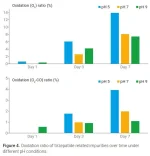
The graphs attached were from a study examining the effects of ph level on oxidation of tirzepatide, not the effects of concentration on oxidation. So, what looks like an AI generated response is helpful, it doesn't connect those items to the abililty to have the medication at higher concentrations.
The sample concentration used in the study were 2mg/mL which were futher diluted to 50 ng/μL, which is an extremely low concentration which made it easier for the researchers to detect impurties. And again, nothing to do with concentration.
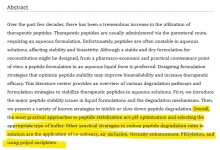
Over the past few decades, there has been a tremendous increase in the utilization of therapeutic peptides. Therapeutic peptides are usually administered via the parenteral route, requiring an aqueous formulation. Unfortunately, peptides are often ...
pmc.ncbi.nlm.nih.gov
None of the approaches to increase peptide stability are about optimizing concentration. But pH is the first one. And makes me want to get some pH testing strips. Or can I use the ones that I use for my pool? 🤣
Lilly adds excipients to prevent degradation so they can use higher concentrations than recommended for gray. These include: Key Excipients and Functions in tirzepatide:
Sodium Chloride: Provides tonicity, making the injection less painful.
Over the past few decades, there has been a tremendous increase in the utilization of therapeutic peptides. Therapeutic peptides are usually administered via the parenteral route, requiring an aqueous formulation. Unfortunately, peptides are often ...
pmc.ncbi.nlm.nih.gov
None of the approaches to increase peptide stability are about optimizing concentration. But pH is the first one. And makes me want to get some pH testing strips. Or can I use the ones that I use for my pool? 🤣
I picked up some new/fresh strips, but ph is ph. I figured it to be a last pass/fail point to some jippy shit I buy. Some of the jippy bac water was coming in @ 5. Still pinned it. 😺
I can't personally confirm or refute the key claim (degradation significantly varies as a function of concentration) so will have to wait for OP to chime in on that. The claim sounds like it could be reasonable (intermolecular forces affecting stability of complex organic molecules), but would need data on how much of a difference it makes at different concentration levels to know if it's an effect that's even worth considering.
This isn't going to be included in Lilly's inserts or anything like that since they're not creating a product that they intend for users to change the concentration of, but I could see someone like Janoshik having gotten bored on a slow day at the office and played around with at some point.
The pH charts are interesting, but that's kind of a moot point since (hopefully) nobody here is going to be crazy enough to try to make their own pH adjustments on vials of reconstituted lyophilized powder (short of risking it in hopes of saving gelled vials of other products) and it's not clear to me what the Y-axis represents on those charts or if the conditions under which the testing was done would even be similar to the vials most here are working with. Also, Lilly is trying to solve a very different problem (keeping liquid solutions stable for years) than most people here (keeping liquid solutions stable for 1-3 months).
That definition is probably a little too concise. A buffer is a compound that is added to a solution to stabilize the pH of that solution. Think of it like the small indentation on the tray table of an airplane that holds your drink cup. It's not going to stop your drink from tipping over if it's knocked hard, but if there's a weak tap, it will ensure the drink stays put rather than sliding. It's added to better maintain the pH of a solution within a specific range rather than fluctuating from batch to batch. That doesn't rule out that a particular compound could stabilize a substance in other ways, of course, but then a word other than buffer would probably be used.
Also, since the mg is sort of irrelevant (pretty sure a 60 mg and a 30 mg vials have essentially the same amount of powder, sorbitol or saccharine or whatever it they use), you may not necessarily need a greater amount of bac to dissolve whatever's in a t-60 vial than you would a t-10. NAD+ comes with 500some mg, and it's still just 3 ml to dissolve it.
Disposable 3mL mixing syringe is quite handy for measuring BAC water to reconstitute contents of 3mL vial of dry powder…. Not just for your overweight horse.
30mL syringes would be for an elephant or some other large game 😂, do you mean 3mL?
If so, there are lots of good places to get reliable and sterile supplies. I bought some stuff off peptidetest.com and some things from Diabetic Warehouse. Some people like Undergound Supply.
30mL syringes would be for an elephant or some other large game 😂, do you mean 3mL?
If so, there are lots of good places to get reliable and sterile supplies. I bought some stuff off peptidetest.com and some things from Diabetic Warehouse. Some people like Undergound Supply.
We use cookies to ensure the proper functioning of this site, improve performance, personalize content,
tailor your experience, keep you logged in if you register, and provide security services such as Cloudflare.
For more information, please see our Cookie Policy.
By continuing to use the site, you consent to our use of cookies.