When Weight-Loss Drugs Don’t Work

Same thing on that second try.
I am sure you don't get all your news from the NY times (wink wink) 😛
Worked for me, do you use an ad blocker or vpn? Mine blocks certain sites at times.
 
More accurately, one in ten people who were accepted for a clinical trial were deemed "non-responders" -- which didn't even mean zero response, just less response. This is not the same thing as what the catchy subhead claims: 'But one in 10 people are what scientists call “non-responders.”' That suggests that 1 in 10 people in the population of the world are what they would call "non-responders".
This kind of lazy science reporting perpetuates false claims, but I guess it sells papers.
If you think about it, people who were accepted for the clinical trial are not necessarily "average" folks. They had to meet a bunch of qualifications, assumedly. And those qualifications mean that the clinical trial population probably had a higher percentage than the general population of people who were a) obese and b) had tried to lose weight in other ways/maybe with other meds and had failed. (I do not mean to use the word 'failed' as a judgment, btw.)
Anyhow, it's an interesting article, and it links to some other interesting articles (like the one about retatrutide clinical study participants dropping out because the were losing "too much" weight). I just get really annoyed by science reporting that makes to easy-breezy statements without much apparent critical thinking.
 
Link didn't work for me. I think it's unlikely to say much I don't already know though; there is a certain number of people who don't feel much or eat through it. Which I'm betting we'll find out years later is because people overeat for different reasons, and 90% of them overeat for reasons that are treated with the two receptors tirz treats, but 10% of them overeat for reasons that hitting some other receptor will turn out to work on.
 
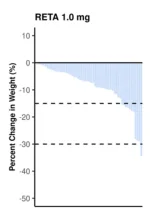
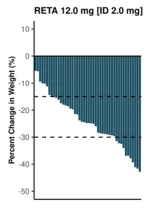
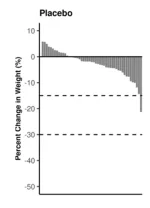
For perspective, here are some waterfall plots from the reta phase 2 trial data supplement.

At 1mg you can see there was a decent percentage of folks that were still pretty close to that 0% line 48 weeks out.

1773360279415.webp

But I'd dare say the 12mg group didn't have anyone who hadn't lost significant weight 48 weeks out.

I'd imagine data from other GLPs show similar results at low vs high dosing.

As usual, I wouldn't take a NY Times article (or really any "news" article) that attempts to cover a scientific topic very seriously, unless your goal is to gain a superficial (and generally incorrect) understanding of the topic.
 
https://share.google/jTyQpIy8C6fxuSXq5

Based on this article it seems 1 of 10 people don't respond the GLP1s at all.

Does anyone know someone that has had zero response?
Reta does not work for me. Went as high as 10mg. Nothing on Tirz. Used Cagri w/ Reta and still zero hunger suppression.

Now check this out. Went on Melanotan ll. Zero hunger.

Ain't that something.
 
For perspective, here are some waterfall plots from the reta phase 2 trial data supplement.

At 1mg you can see there was a decent percentage of folks that were still pretty close to that 0% line 48 weeks out.

View attachment 17432

But I'd dare say the 12mg group didn't have anyone who hadn't lost significant weight 48 weeks out.

I'd imagine data from other GLPs show similar results at low vs high dosing.

As usual, I wouldn't take a NY Times article (or really any "news" article) that attempts to cover a scientific topic very seriously, unless your goal is to gain a superficial (and generally incorrect) understanding of the topic.
Really like those graphs. I had not seen them. The other end is just as interesting with maybe 20% losing 15% or more on 1mg and nearly 10% losing close to 30% on 1mg, there really are some super responders.
At 12mg even the worst responders still lost 5% and that looks like about 5% and another 10% only losing 10%. And about 40% lost high 20% weight. and 48 weeks is probably a bit early for everyone to have stopped losing weight so might be a bit better a few months later.
 
I thought the trials started at 2mg?
 
One of the most interesting bits of data out there is that a year of 1mg of reta is surprisingly effective, as seen in the first graph, with an average weight loss of 9%. The other GLP's are nowhere near that effective at low doses. For someone who is mildly obese or just overweight low dose reta is probably a good option. I would even guess they might end up using this in their marketing once reta is finally approved. The obvious advantage is side effects at 1mg are most often going to be pretty minor. It may even have the best side effect to weight loss ratio of all the GLP's, though I would have to look that up to confirm it.
 
Really like those graphs. I had not seen them. The other end is just as interesting with maybe 20% losing 15% or more on 1mg and nearly 10% losing close to 30% on 1mg, there really are some super responders.
At 12mg even the worst responders still lost 5% and that looks like about 5% and another 10% only losing 10%. And about 40% lost high 20% weight. and 48 weeks is probably a bit early for everyone to have stopped losing weight so might be a bit better a few months later.
Here's another one you might enjoy.

1773367176337.webp
 
https://share.google/jTyQpIy8C6fxuSXq5

Based on this article it seems 1 of 10 people don't respond the GLP1s at all.

Does anyone know someone that has had zero response?

I started Reta at 2mg. Worked my way upto 7.5 and had to quit because of the negative side effects. Didn’t lose any weight.

So technically not a non-responder but not in the intended way.

I did escalate my dose quicker than in the studies. So maybe I messed it up. I let it clear my system and am back on now at 2mg. Going strictly by the titration schedule described in the studies this time. Three weeks in and I’m up a couple pounds.

Still need to do bloodwork. But will give it a solid 8 weeks of use first.

Haven’t had any sides so far. But I didn’t feel anything the first go until 5mg.

Also on test, growth, BPC, and TB500. Figure even if it doesn’t help me lose weight, it should help with negating sides from the growth.
 
Last edited:
I started at 2mg. Worked my way upto 7.5 and had to quit because of the negative side effects. Didn’t lose any weight.

So technically not a non-responder but not in the intended way.

I did escalate my dose quicker than in the studies. So maybe I messed it up. I let it clear my system and am back on now at 2mg. Going strictly by the titration schedule described in the studies this time. Three weeks in and I’m up a couple pounds.

Still need to do bloodwork. But will give it a solid 8 weeks of use first.

Haven’t had any sides so far. But I didn’t feel anything the first go until 5mg.

Also on test, growth, BPC, and TB500. Figure even if it doesn’t help me lose weight, it should help with negating sides from the growth.
Are you using tirz or reta ?
 
I started Reta at 2mg. Worked my way upto 7.5 and had to quit because of the negative side effects. Didn’t lose any weight.

So technically not a non-responder but not in the intended way.

I did escalate my dose quicker than in the studies. So maybe I messed it up. I let it clear my system and am back on now at 2mg. Going strictly by the titration schedule described in the studies this time. Three weeks in and I’m up a couple pounds.

Still need to do bloodwork. But will give it a solid 8 weeks of use first.

Haven’t had any sides so far. But I didn’t feel anything the first go until 5mg.

Also on test, growth, BPC, and TB500. Figure even if it doesn’t help me lose weight, it should help with negating sides from the growth.
Yes keep us in the loop on how Teas and that HGH goes. I have some Tesa on the way now.
 

Attachments

  • Harry DR.webp
    Harry DR.webp
    75.3 KB · Views: 6
More accurately, one in ten people who were accepted for a clinical trial were deemed "non-responders" -- which didn't even mean zero response, just less response. This is not the same thing as what the catchy subhead claims: 'But one in 10 people are what scientists call “non-responders.”' That suggests that 1 in 10 people in the population of the world are what they would call "non-responders".
This kind of lazy science reporting perpetuates false claims, but I guess it sells papers.
If you think about it, people who were accepted for the clinical trial are not necessarily "average" folks. They had to meet a bunch of qualifications, assumedly. And those qualifications mean that the clinical trial population probably had a higher percentage than the general population of people who were a) obese and b) had tried to lose weight in other ways/maybe with other meds and had failed. (I do not mean to use the word 'failed' as a judgment, btw.)
Anyhow, it's an interesting article, and it links to some other interesting articles (like the one about retatrutide clinical study participants dropping out because the were losing "too much" weight). I just get really annoyed by science reporting that makes to easy-breezy statements without much apparent critical thinking.
The article itself opens with an example of a person that has been on Zepbound for 15 months and and may have lost a pound or two at most. Forty-Seven jumps right over that in a quest to call the contents of the article "lazy science." New York Times has a liberal bias to be sure, but that is way different than "lazy science." Everything in the New York Times is cross-checked. I take NY Times and find its science articles to be solid. I for one have been a low-responder. I got diarhea when I jumped up to approximately 5 mg sub per week. I had to drop down to a lower dose to prevent this effect, 2mg split into two subs weekly. I have gradually been working up again at the rate of 0.5 mg every four weeks. Didn't lose any weight at all for about five months. I got really sick and evidently between my sickness and tirz, I suddenly lost 4-5 pounds. There are most likely two ends to the stick. On one end, are the people who are extremely responsive, .i.e. I know of someone who takes 2.5 mg of tirz every 3-4 weeks to maintain his weight and the other end of the stick where some people are non-responsive. Some of the previous replies were from folks who had little to no reponse. Evidently, the writer is/was to busy writing to read those other responses.
 
https://share.google/jTyQpIy8C6fxuSXq5

Based on this article it seems 1 of 10 people don't respond the GLP1s at all.

Does anyone know someone that has had zero response?

Someone had posted a claim some time ago (late last year maybe?) they didn’t get any loss until they hit 15mg of tirz.

I asked how they mixed their vial and they never responded. 🤷‍♀️ It’s easy to get off by a decimal point, but it could be they were indeed a low-responder.

The “normal curve” applies in so many places. It’s not a surprise that as varied as humans are, a few won’t respond much if at all, and a few will have a hyper response. Or maybe they’re sensitive to sides. The hard part is no one knows how they will - or won’t- respond so low and slow is best.
 
The article itself opens with an example of a person that has been on Zepbound for 15 months and and may have lost a pound or two at most. Forty-Seven jumps right over that in a quest to call the contents of the article "lazy science." New York Times has a liberal bias to be sure, but that is way different than "lazy science." Everything in the New York Times is cross-checked. I take NY Times and find its science articles to be solid. I for one have been a low-responder. I got diarhea when I jumped up to approximately 5 mg sub per week. I had to drop down to a lower dose to prevent this effect, 2mg split into two subs weekly. I have gradually been working up again at the rate of 0.5 mg every four weeks. Didn't lose any weight at all for about five months. I got really sick and evidently between my sickness and tirz, I suddenly lost 4-5 pounds. There are most likely two ends to the stick. On one end, are the people who are extremely responsive, .i.e. I know of someone who takes 2.5 mg of tirz every 3-4 weeks to maintain his weight and the other end of the stick where some people are non-responsive. Some of the previous replies were from folks who had little to no reponse. Evidently, the writer is/was to busy writing to read those other responses.
I didn’t say “lazy science”, I said, “lazy science reporting.” Two verrrrrrrry different things. All I was pointing out is that one in 10 people in a scientific study population is not the same thing as one in 10 people in the general population. That’s it. It’s a subtle issue of semantics, but it’s the sort of misinformation that gets perpetuated. I don’t think you even read my response closely enough to understand what I was saying, which is not questioning the validity of the study—nor its results—but rather questioning the translation of the study’s findings into the subheading of the article.
1:10 clinical trial participants does not equal 1:10 people. It’s not my opinion—it’s statistics.
I am a NYT subscriber. Their reporting is generally exceptional.
I didn’t jump over anything, and I’m certainly not on any sort of quest. I am, however, a critical thinker, and I encourage others to be as well.
 
I didn’t say “lazy science”, I said, “lazy science reporting.” Two verrrrrrrry different things. All I was pointing out is that one in 10 people in a scientific study population is not the same thing as one in 10 people in the general population. That’s it. It’s a subtle issue of semantics, but it’s the sort of misinformation that gets perpetuated. I don’t think you even read my response closely enough to understand what I was saying, which is not questioning the validity of the study—nor its results—but rather questioning the translation of the study’s findings into the subheading of the article.
1:10 clinical trial participants does not equal 1:10 people. It’s not my opinion—it’s statistics.
I am a NYT subscriber. Their reporting is generally exceptional.
I didn’t jump over anything, and I’m certainly not on any sort of quest. I am, however, a critical thinker, and I encourage others to be as well.

I’ve been thinking about your point about the generalizability of clinical study results when the study participant selection criterion is constrained and if the results from most (if not all) the clinical trials on glp-1 medications can be imputed upon the general population.

I looked at the SURMOUNT-1 participant criterion and it’s fairly restrictive. More restrictive than I originally remembered. But most of the protocol appears to be centered on finding generally healthy folks who meet the treatment criteria and don’t have confounding medical conditions which could affect the results or cause harm to the participant. For example, excluding people with a medical history of MTC or MEN or lifetime history of suicide attempt is probably because these are low in the general population. These two are clearly about no harm to the participant. But I’m sure that study researchers spend significant amount of time on these decisions so that the results are generalizable, otherwise the FDA wouldn’t accept the results. They probably have to justify the criterion with science.

TL/DR, just because there is a participant selection criterion and that everyone isn’t eligible to participate in the study doesn’t mean that the results can’t be extrapolated to the population.
 
Last edited:
I didn’t say “lazy science”, I said, “lazy science reporting.” Two verrrrrrrry different things. All I was pointing out is that one in 10 people in a scientific study population is not the same thing as one in 10 people in the general population. That’s it. It’s a subtle issue of semantics, but it’s the sort of misinformation that gets perpetuated. I don’t think you even read my response closely enough to understand what I was saying, which is not questioning the validity of the study—nor its results—but rather questioning the translation of the study’s findings into the subheading of the article.
1:10 clinical trial participants does not equal 1:10 people. It’s not my opinion—it’s statistics.
I am a NYT subscriber. Their reporting is generally exceptional.
I didn’t jump over anything, and I’m certainly not on any sort of quest. I am, however, a critical thinker, and I encourage others to be as well.
I'll disagree with you on NYT being exceptional at anything other than narrow framing and strawmanning complex discussions, while remaining remarkably smug. At the same time, I agree with everything else you said and I'm glad to see someone else here honing in on the dishonest manipulations pharma regularly engaged in by shaping their study groups in clever ways to game drug approval and results.

At this point, I wouldn't be surprised to see a study constructed where they focused on a group that would have just come off of prednisone treatment (which is known to cause weight gain) where a placebo group stayed on prednisone (via specialized prednisone injections perhaps) and the intervention group was switched to a GLP (for both weight loss and to reduce inflammation), as a means of juicing their weight loss results. And if any drug company reps are monitoring these forums, forward this suggestion to your study design team and they'll generously reward you for the idea. 😉
 
Reta does not work for me. Went as high as 10mg. Nothing on Tirz. Used Cagri w/ Reta and still zero hunger suppression.

Now check this out. Went on Melanotan ll. Zero hunger.

Ain't that something.

Really interesting, thank you.
From Wikipedia on melanotan II:
"Other effects of melanotan II... loss of appetite (the last via activation of MC4)"

Melanocortin 4 receptor:
"The melanocortin 4 receptor (MC4R) is a G protein-coupled receptor involved in regulating energy homeostasis, appetite, and sexual function. It plays a key role in metabolic processes and is predisposes to certain forms of obesity in humans."
 

Trending Topics

Forum Statistics

Threads
17,653
Posts
183,233
Members
59,370
Newest
Claris332
Back
Top Bottom