When Weight-Loss Drugs Don’t Work

I’ve been thinking about your point about the generalizability of clinical study results when the study participant selection criterion is constrained and if the results from most (if not all) the clinical trials on glp-1 medications can be imputed upon the general population.

I looked at the SURMOUNT-1 participant criterion and it’s fairly restrictive. More restrictive than I originally remembered. But most of the protocol appears to be centered on finding generally healthy folks who meet the treatment criteria and don’t have confounding medical conditions which could affect the results or cause harm to the participant. For example, excluding people with a medical history of MTC or MEN or lifetime history of suicide attempt is probably because these are low in the general population. These two are clearly about no harm to the participant. But I’m sure that study researchers spend significant amount of time on these decisions so that the results are generalizable, otherwise the FDA wouldn’t accept the results. They probably have to justify the criterion with science.

TL/DR, just because there is a participant selection criterion and that everyone isn’t eligible to participate in the study doesn’t mean that the results can’t be extrapolated to the population.
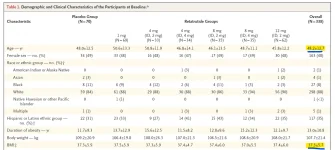
Thanks for your thoughtful response. In the participant data, did you find if any of the test subjects were under 48yo? (I could honestly be reading the table wrong, but it seems like that’s the lowest age.) And if I’m reading it correctly, 100% of the participants were “overweight or obese”.
Out here in the wild Wild West of rat experiments, we have folks (including me) whose BMIs have never been above a high “normal”.

I honestly did not mean to criticize the experiments because I don’t consider myself a scientist (nor do I have any degree that would suggest that I am one.) So I am happy to be corrected by people who are better at reading study summaries (you are probably one of those people).

All I am saying is that the New York Times took a statistic and reduced it to a false claim by using the broad stroke “people”.

It may well be true that 10% of the population Eli Lilly hopes will be future consumers (overweight/obese people) are what the science refers to as non-responders. I don’t know. (As I said, were they really all over 48 years old?) I think the FDA would actually want the study to focus on the intended audience for the treatment being studied, which it did.

I just don’t think that the study proved that 10% of “people” are non-responders. It wasn’t the intent of the study. I’m not picking on the study. Shoot, for all we know, if you took the entire population of the world that are called “people” (and that would have to include babies and children and gym bros looking to cut for a show and folks like me who wanna lose 15 pounds), 30% could be non-responders. And no, I’m not advocating that studies be conducted on babies. All I’m saying is that “people” is a very, very big word. It’s the whole circle in the Venn diagram of things right?

I think there’s a suspicious trend in trying to extrapolate meaning from data sets involved in studies that had one intention (in this case, “assess the efficacy and safety of retatrutide in obese patients with or without diabetes”), and making secondary conclusions.

If a study were conducted to determine the percentage of the population of people as a whole who are non-responders to retatrutide, the study population would have to be expanded, no?

Again, I’m not a scientist, but… I’m not really criticizing the science here. I’m just criticizing the use of the English language. Because if the New York Times is willing to be that lazy with the English language in this instance, then what other headlines don’t really match up to reality? And I think we all know that that is a slippery slope in media and hate to see it perpetuated. I also feel like I’ve stood on my soapbox for long enough and then I never meant this to become such a point of contention. 😂
 
Thanks for your thoughtful response. In the participant data, did you find if any of the test subjects were under 48yo? (I could honestly be reading the table wrong, but it seems like that’s the lowest age.) And if I’m reading it correctly, 100% of the participants were “overweight or obese”.
Out here in the wild Wild West of rat experiments, we have folks (including me) whose BMIs have never been above a high “normal”.

Your post gave me a lot to think about.

In the phase 2 retatrutide clinical trial the average age was 48.2 (last column) but the number next to it is the +/- standard deviation. The 12.7 is in years and this is one standard deviation from the mean (average). Two standard deviations capture about 95% of a given population. So, 95% of the participants were between the age of 22.8 and 73.6. So, there were definitely some people younger than 48. Same for BMI. Average BMI was 37.3, but with a 5.7 standard deviation, there were definitely folks with a BMI in the high 20s. But remember that these medication were designed for the clinically obese and those overweight with commorbidities.

1773536687524.webp


If a study were conducted to determine the percentage of the population of people as a whole who are non-responders to retatrutide, the study population would have to be expanded, no?

You'd be surprised how small a sample needs to be to draw conclusions about a population, if proper statistical methods are followed. It could be as low as 30. But I don't think anyone would ever design a sample to test a population that the medication was never designed to treat. That makes no sense at all.

All I am saying is that the New York Times took a statistic and reduced it to a false claim by using the broad stroke “people”.

The NYT article says, "....But one in 10 people are what scientists call “non-responders."

The implication is that it's 1 in 10 people (who take the medication) will be non-responders. Because you can't be a non-responder if you don't take the medication. And the only people who are supposed to be taking the medication are those with the clinical indications. And hence why the study was designed to select a sample of that population.

They never said 1 in 10 people in the world, because the entire general public shouldn't be taking the medication.
 
I have a lot of patients who never respond to Wegovy, the one we use mostly in Denmark.
It was the same for me, Wegovy gave me nothing.
Me too. Was going out of pocket on prescription Sema, and actually gained weight. Gave that up pretty quick.

Someone had posted a claim some time ago (late last year maybe?) they didn’t get any loss until they hit 15mg of tirz.

I asked how they mixed their vial and they never responded.
Good question to ask! Easy to make a mistake. Other variables, too. For example, I just discovered today that my knock-off Amazon-sourced pen was consistently giving me 3.5 to 4 units when the dial was set to 10. Had that continued, I might have been unhappy with my results for that particular peptide (GHK-Cu in this case).
 
Your post gave me a lot to think about.

In the phase 2 retatrutide clinical trial the average age was 48.2 (last column) but the number next to it is the +/- standard deviation. The 12.7 is in years and this is one standard deviation from the mean (average). Two standard deviations capture about 95% of a given population. So, 95% of the participants were between the age of 22.8 and 73.6. So, there were definitely some people younger than 48. Same for BMI. Average BMI was 37.3, but with a 5.7 standard deviation, there were definitely folks with a BMI in the high 20s. But remember that these medication were designed for the clinically obese and those overweight with commorbidities.

View attachment 17561


You'd be surprised how small a sample needs to be to draw conclusions about a population, if proper statistical methods are followed. It could be as low as 30. But I don't think anyone would ever design a sample to test a population that the medication was never designed to treat. That makes no sense at all.


The NYT article says, "....But one in 10 people are what scientists call “non-responders."

The implication is that it's 1 in 10 people (who take the medication) will be non-responders. Because you can't be a non-responder if you don't take the medication. And the only people who are supposed to be taking the medication are those with the clinical indications. And hence why the study was designed to select a sample of that population.

They never said 1 in 10 people in the world, because the entire general public shouldn't be taking the medication.
Okay I love learning new stuff, and I learned a lot from your post! Thank you!
 
Okay I love learning new stuff, and I learned a lot from your post! Thank you!

I do see your point about using the word “people”, maybe “users” or “patients” would have been a better word.

I guess I just wanted to address the generalizability concern, statistics, and study validity.

TBH, I’ve read the tirzepatide clinical studies in depth (less so for retatrutide) and the studies are incredibly well designed and executed. I’ve read a lot of medical research over the years for may various ailments 😂, and some of the stuff is sloppy because most doctors conducting medical research aren’t trained in statistical methods. The principal investigator on both the tirzepatide and retatrutide studies (Dr. Jastreboff) is a MD and PhD and she has backing of EL. The studies are super solid.
 
I appreciate your explanation of the data and its presentation—and I love that you have done a deep dive analysis of the study’s construction and methodology! I’m here on this forum to learn from folks like you! 😄
 
I didn’t say “lazy science”, I said, “lazy science reporting.” Two verrrrrrrry different things. All I was pointing out is that one in 10 people in a scientific study population is not the same thing as one in 10 people in the general population. That’s it. It’s a subtle issue of semantics, but it’s the sort of misinformation that gets perpetuated. I don’t think you even read my response closely enough to understand what I was saying, which is not questioning the validity of the study—nor its results—but rather questioning the translation of the study’s findings into the subheading of the article.
1:10 clinical trial participants does not equal 1:10 people. It’s not my opinion—it’s statistics.
I am a NYT subscriber. Their reporting is generally exceptional.
I didn’t jump over anything, and I’m certainly not on any sort of quest. I am, however, a critical thinker, and I encourage others to be as well.
I didn’t say “lazy science”, I said, “lazy science reporting.” Two verrrrrrrry different things. All I was pointing out is that one in 10 people in a scientific study population is not the same thing as one in 10 people in the general population. That’s it. It’s a subtle issue of semantics, but it’s the sort of misinformation that gets perpetuated. I don’t think you even read my response closely enough to understand what I was saying, which is not questioning the validity of the study—nor its results—but rather questioning the translation of the study’s findings into the subheading of the article.
1:10 clinical trial participants does not equal 1:10 people. It’s not my opinion—it’s statistics.
I am a NYT subscriber. Their reporting is generally exceptional.
I didn’t jump over anything, and I’m certainly not on any sort of quest. I am, however, a critical thinker, and I encourage others to be as well.
I wanted to apologize. You are correct in that I did misread your response last week. I stand corrected.
 
I’m currently transitioning from tirzepatide (Eli Lilly’s Mounjaro) to grey retatrutide.

I was running a split dosing protocol—2 × 3.75 mg per week—and I’ve now swapped out my Monday evening dose for 2.5 mg of retatrutide. By Wednesday, I notice the appetite suppression dropping off pretty hard, and my Friday morning Mounjaro shot is just barely on time to get me through the weekend.

Plan is to slowly titrate the retatrutide up and see if I can get stronger, more stable appetite control from it. Once this feels more or less stable across the full week, I’ll fully transitioning over to retatrutide

Upside so far: zero negative side effects from either compound.

Has anyone made a similar transition, and what were your experiences?
 
The limiting factor with any GLP is the sides for me at higher doses, and reta has just as many for me. So though reta is better on paper for weight loss, I think tirz and reta have more in common than not.

The mistake people make when switching to reta is too agressive with reta or they lower the tirz too soon.

Since you haven't had any sides yet, you seem to be doing well for the long-term.
 
Last edited:
GLP1s never ever helped me lose weight... I lost weight more easily, more quickly and more consistently with Keto... it was so so much eaiser on keto... could always lose 14lbs a month on keto

What GLP1s did thought was absolutely make it more difficult to gain weight... that much is true... overall my journey on GLP1s has been a nightmare tbh... constanty god damned stalls... like I can eat far less or eat far more and I don't gain or lose weight either way... fucking weird... feel trapped tbh cause while the lack of weight gain is nice I desperately want to lose another 25lbs minimum... and it simply will not happen... it seems like the only way I can lose weight, although slowly on GLP1s is cutting out carbs and introducing carbs... and doing this cycle back and forth... only problem is not eating carbs on GLP1s is a hellscape of constant hunger and the worst sleep one can dream of and low blood sugar
 
GLP1s never ever helped me lose weight... I lost weight more easily, more quickly and more consistently with Keto... it was so so much eaiser on keto... could always lose 14lbs a month on keto

What GLP1s did thought was absolutely make it more difficult to gain weight... that much is true... overall my journey on GLP1s has been a nightmare tbh... constanty god damned stalls... like I can eat far less or eat far more and I don't gain or lose weight either way... fucking weird... feel trapped tbh cause while the lack of weight gain is nice I desperately want to lose another 25lbs minimum... and it simply will not happen... it seems like the only way I can lose weight, although slowly on GLP1s is cutting out carbs and introducing carbs... and doing this cycle back and forth... only problem is not eating carbs on GLP1s is a hellscape of constant hunger and the worst sleep one can dream of and low blood sugar
It does seem like results are all over the board on people trying to mix keto and GLPs. Safe to assume you've tried keto again after letting your body acclimate to GLPs for several months (VS bad experience early on making you gun-shy)?

I mean it is claimed that gluconeogenesis is demand-driven (which I personally question, but I digress) so I guess it shouldn't be a total surprise that simulating the "hey there are some carbs coming in" hormone could throw a wrench into the mix there.
 
I’m currently transitioning from tirzepatide (Eli Lilly’s Mounjaro) to grey retatrutide.

I was running a split dosing protocol—2 × 3.75 mg per week—and I’ve now swapped out my Monday evening dose for 2.5 mg of retatrutide. By Wednesday, I notice the appetite suppression dropping off pretty hard, and my Friday morning Mounjaro shot is just barely on time to get me through the weekend.

Plan is to slowly titrate the retatrutide up and see if I can get stronger, more stable appetite control from it. Once this feels more or less stable across the full week, I’ll fully transitioning over to retatrutide

Upside so far: zero negative side effects from either compound.

Has anyone made a similar transition, and what were your experiences?
I have a single data point.

A friend tritrated up to 10mg Tirz and lost almost nothing. She said she never felt any hunger supression. She stopped about 6 months ago.

She's now on 2mg Reta and is feeling food sizing control - actually eating half a meal and deciding she's full. Fingers crossed it continues to work for her.
 
GLP1s never ever helped me lose weight... I lost weight more easily, more quickly and more consistently with Keto... it was so so much eaiser on keto... could always lose 14lbs a month on keto

What GLP1s did thought was absolutely make it more difficult to gain weight... that much is true... overall my journey on GLP1s has been a nightmare tbh... constanty god damned stalls... like I can eat far less or eat far more and I don't gain or lose weight either way... fucking weird... feel trapped tbh cause while the lack of weight gain is nice I desperately want to lose another 25lbs minimum... and it simply will not happen... it seems like the only way I can lose weight, although slowly on GLP1s is cutting out carbs and introducing carbs... and doing this cycle back and forth... only problem is not eating carbs on GLP1s is a hellscape of constant hunger and the worst sleep one can dream of and low blood sugar
I am really sorry, that is rough. Have you gotten any lab work such as thyroid hormone levels checked? You’d want to rule out metabolic adaptation, hormonal issues, and glucose regulation problems.
 

Trending Topics

Forum Statistics

Threads
17,657
Posts
183,271
Members
59,375
Newest
Hhhehehshshshs
Back
Top Bottom