FortySeven
GLP-1 Apprentice

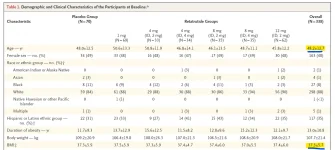
Thanks for your thoughtful response. In the participant data, did you find if any of the test subjects were under 48yo? (I could honestly be reading the table wrong, but it seems like that’s the lowest age.) And if I’m reading it correctly, 100% of the participants were “overweight or obese”.I’ve been thinking about your point about the generalizability of clinical study results when the study participant selection criterion is constrained and if the results from most (if not all) the clinical trials on glp-1 medications can be imputed upon the general population.
I looked at the SURMOUNT-1 participant criterion and it’s fairly restrictive. More restrictive than I originally remembered. But most of the protocol appears to be centered on finding generally healthy folks who meet the treatment criteria and don’t have confounding medical conditions which could affect the results or cause harm to the participant. For example, excluding people with a medical history of MTC or MEN or lifetime history of suicide attempt is probably because these are low in the general population. These two are clearly about no harm to the participant. But I’m sure that study researchers spend significant amount of time on these decisions so that the results are generalizable, otherwise the FDA wouldn’t accept the results. They probably have to justify the criterion with science.
TL/DR, just because there is a participant selection criterion and that everyone isn’t eligible to participate in the study doesn’t mean that the results can’t be extrapolated to the population.
Out here in the wild Wild West of rat experiments, we have folks (including me) whose BMIs have never been above a high “normal”.
I honestly did not mean to criticize the experiments because I don’t consider myself a scientist (nor do I have any degree that would suggest that I am one.) So I am happy to be corrected by people who are better at reading study summaries (you are probably one of those people).
All I am saying is that the New York Times took a statistic and reduced it to a false claim by using the broad stroke “people”.
It may well be true that 10% of the population Eli Lilly hopes will be future consumers (overweight/obese people) are what the science refers to as non-responders. I don’t know. (As I said, were they really all over 48 years old?) I think the FDA would actually want the study to focus on the intended audience for the treatment being studied, which it did.
I just don’t think that the study proved that 10% of “people” are non-responders. It wasn’t the intent of the study. I’m not picking on the study. Shoot, for all we know, if you took the entire population of the world that are called “people” (and that would have to include babies and children and gym bros looking to cut for a show and folks like me who wanna lose 15 pounds), 30% could be non-responders. And no, I’m not advocating that studies be conducted on babies. All I’m saying is that “people” is a very, very big word. It’s the whole circle in the Venn diagram of things right?
I think there’s a suspicious trend in trying to extrapolate meaning from data sets involved in studies that had one intention (in this case, “assess the efficacy and safety of retatrutide in obese patients with or without diabetes”), and making secondary conclusions.
If a study were conducted to determine the percentage of the population of people as a whole who are non-responders to retatrutide, the study population would have to be expanded, no?
Again, I’m not a scientist, but… I’m not really criticizing the science here. I’m just criticizing the use of the English language. Because if the New York Times is willing to be that lazy with the English language in this instance, then what other headlines don’t really match up to reality? And I think we all know that that is a slippery slope in media and hate to see it perpetuated. I also feel like I’ve stood on my soapbox for long enough and then I never meant this to become such a point of contention. 😂