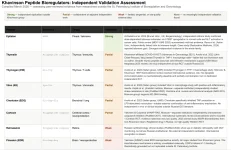
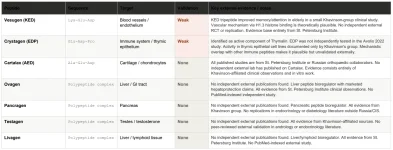
You beat me to it. No western research is likely to happen because there is no money in it for any western BP company. I was just looking at the patent landscape for the Khavinson bioregulators:Thanks for posting that, I must admit to being skeptical of highly localised , all from one researcher or one group science, which seems to often be a Russian or Eastern European thing, where the science was separate to the west during the cold war and I assume this is a long term hangover effect of that? Where the Russian science studies are mostly totally separate, and some of the peptides are used in clinical practice there but there are usually no western studies or replications. I have had discussions with chatgpt about this issue.
Without spending a long time looking up the references carefully most or all of the studies mentioned for epitalon are cell studies , not human clinical trials, so assuming the standard is safe and effective in humans , I am not sure you can say the evidence is strong, If only talking about replicating the basic science, I am not going to argue. But I think it is important to make those distinctions clear given that people do use these peptides. I am aware that there have been clinical trials by those researchers in Russia , but ideally you want clinical trial replication. There is unlikely to be a strong motive for that to happen , if the peptides are naturally occurring or developed in Russia there is likely no way to patent them, so no way for drug companies to make any money back after spending lots on expensive clinical trials, so is unlikely to happen.
damn! that's a lot of patents! You'd figure more testing to validate it all.Khavinson holds 196 patents, both Russian and international
exactly. Instead of just 'take this it will help'. I hope that in the next couple years, as Kennedy has been very enthusiastic regarding peptides, peptides will receive their due respect.I would love to see a proper scientific grade analysis of the quality of evidence for their use in humans,
tbh, vesugen worries me. FOXO1 is downregulated and NFkB upregulated by KED, aka Vesugen.I'm interested in Vesugen first because of its reported vascular effects.
In addition to Epitalon, I think Semax and Selank are also effective and what they are advertised to be, at least to me. They're aren't a bioregulator, but still qualify as Khavinson peptides.
My primary vendor has them for $30 less than Uther per kit. He is high on most things he offers. He does have most of them also, but has raised minimum orders to $800.Doesn't Uther sell most of these bioregulators in a box? idk I've not dealt with him, but I did notice it on that website.
Although not from the Khavinson group, they did also originate from Russia (good call!) They have also received independent studies from international institutions.
I think it would fit in with the eastern block peptides for sure, but it's different in that it's really a complex cocktail of brain proteins and not a short chain of aminos like most of the bioregulators. But it certainly fits with them in function.Wouldn't we lump Cerebrolysin in this group as well? It has the most independent research of anything that I've seen.
Cerebrolysin originated in Austria, where it was first developed in 1949 by neurologist Gerhart Harrer at the University of Innsbruck. I will have to look into this one some more.Wouldn't we lump Cerebrolysin in this group as well? It has the most independent research of anything that I've seen.
i didn't know any of this... good insert.Involvement of Vladimir Khavinson in Semax Development
this guide is not research, all the references are the ones we mentioned earlier, except for the ones that have nothing to do with vesugen and discuss sirt or other proteins, so yea, just off khavinson's research.but it appears to be based on just Khavinson findings as most are. https://guidetopeptide.com/product/vesugen/
I've been somewhat obsessed with the Khavinson peptides for a while now, and stocked p on Uther's offerings last year. He had Janoshik links for all of them except for Chonluten and Cortagen.In addition to Epitalon, I think Semax and Selank are also effective and what they are advertised to be, at least to me. They're aren't a bioregulator, but still qualify as Khavinson peptides.
I have 3 bioregulators penciled in that I want to research at some point: Chonluten, Vesugen and Pinealon. I'm interested in Vesugen first because of its reported vascular effects. I've recently read that peripheral artery disease and restless leg syndrome are probably related and I've been experiencing RLS over the past year. Of course, what I experience will only be anecdata, but we'll see what happens.
The other issue is that bioregulators don't appear to be tested nearly as much as other peptides. You can go to Janoshik and they won't have any test results for any of those there, at least. I have 3 vendors that can provide as many as 16 of the listed bioregulators, but I need to figure out if they can be tested properly.
I'll have to look at magnesium, although I do get some. B6, iron and Vit C have been no change.Cerebrolysin originated in Austria, where it was first developed in 1949 by neurologist Gerhart Harrer at the University of Innsbruck. I will have to look into this one some more.
i didn't know any of this... good insert.
this guide is not research, all the references are the ones we mentioned earlier, except for the ones that have nothing to do with vesugen and discuss sirt or other proteins, so yea, just off khavinson's research.
The fact that NFkB is upregulated when vesugen is used is an alarm for me. This is part of the inflammasome. I know it's related to mounting immune reactions, but why would you want that for? Chronic upregulation of nfkb is associated with disease. Also, concerning restless leg syndrome, are you using Magnesium and vitamin B6? Here is a bonafide review from a Western institution: Effects of Dietary Supplementation in Patients with Restless Legs Syndrome: A Systematic Review. Concerning peripheral artery disease, I implore you to look over my recent post on MT1 (linked). This is a game changer for artherosclerosis and has mechanistic and some academic backing.

Oh good. Thanks Yeddie. I searched Janoshik and they didn't come up. I forgot Uther keeps them all linked as well. I'm glad they aren't and afterthought as they probably aren't as popular as some of the others.
Have you done your own research on any of these? Any findings as to personal benefit or lack there of?
I tried Cartalax for a while and it seemed to reduce the knee pain I have. I also ran Prostamax for a couple of months and wasn't sure it was doing anything, but most treatments for BPH require six months or so to really show any benefit. (The urologist has me on a couple of meds and stressed that I won't be getting instant results.)Have you done your own research on any of these? Any findings as to personal benefit or lack there of?
I really like that site and have it bookmarked.I did find one study for Ovagen and a few for Pancragen that aren’t solely Khavinson studies (monkeys, more monkeys, and rats.)
I only spot checked a few using Neemio.com, which is one of my favorite resources as it gives all of the compound info, pharmacokinetics, links to research studies, etc.).
The first two studies you linked are from Khavinson's lab, and the other link is also a Russian study, although not Khavinson.I did find one study for Ovagen and a few for Pancragen that aren’t solely Khavinson studies (monkeys, more monkeys, and rats.)
I only spot checked a few using Neemio.com, which is one of my favorite resources as it gives all of the compound info, pharmacokinetics, links to research studies, etc.).
100% the research wasn't done up to current Western standards. Not even close. And much hasn't been replicated, but often because it seems no one tried.That Neemio.com site looks like it will be quite handy.
The table in the OP lists the Khavinson "Cytogens", i.e. synthetic short peptides. Several of the most promising early trials were done with the "Cytomax" animal-derived precursors, which have more than just the short sequence. For instance the Cytomaxes Epithalamin and Prostatilen compared to their Cytomax equivalents Epithalon and Prostamax. The Neemio pages for those show the similarities but also some differences.
We can't , its literally an AI job. Widespread, distributed , zero protocol,zero controls on dosage, completely blind since you don't really know what anyone's actually taking.100% the research wasn't done up to current Western standards. Not even close. And much hasn't been replicated, but often because it seems no one tried.
Legitimately, it is a guide to future research. And some has enough safety data to encourage individual "researchers" to take a whirl. Lol.
I wish there was a way to collect actionable data from the hundreds or thousands or people who are experimenting with this stuff. Can we imagine a research protocol to do that?
The AI part isn't hard. I am imaging a phone app Peptide Tracker. We make it handy enough people want to use it. We promise all the data is anonymized. Of course, that will still scare some people off. We capture what they are taking, method, amount, etc. We can even build in the math for vial mg and amount of dilution so we are less likely to get bad data as a result of their bad math. Lol. Occasionally (we ask a few questions about effects, side effects, etc.) we have to be friendly enough to let people skip the questions when they are not in the mood. Maybe just one question about bad side effectsWe can't , its literally an AI job. Widespread, distributed , zero protocol,zero controls on dosage, completely blind since you don't really know what anyone's actually taking.
Maybe someone could vibecode some clawbots to create a SETI@home style research program. We provide the data and the compute. I can't imagine that you would get much viable from it. But who knows.
Let's just imagine I could make a phone app that did peptide tracking. It could be made attractive enough that people would want to use it to help them keep track of what they were doing. We promise that any of the data we kept was appropriately anonymous. Of course, some people would feel uncomfortable with that and wouldn't want to use it. But let's suppose a lot of people would use it and we could even put some math in it about how many milligrams there were in vials and how much water they used so we didn't have to depend on their math to get everything correct That could be a feature to help people calculate their doses. And occasionally we'd ask people about how it was going what side effects they were experiencing what positive effects or negative effects they were experiencing. We'd have to keep the question short so people were inclined to answer them. But we could tailor the questions per peptide.We can't , its literally an AI job. Widespread, distributed , zero protocol,zero controls on dosage, completely blind since you don't really know what anyone's actually taking.
Maybe someone could vibecode some clawbots to create a SETI@home style research program. We provide the data and the compute. I can't imagine that you would get much viable from it. But who knows.