
You are using an out of date browser. It may not display this or other websites correctly.
You should upgrade or use an alternative browser.
You should upgrade or use an alternative browser.
Are reta and other weight loss drugs meant to be long term use? Whats it like coming off them?
- Thread starter bockscar
- Start date

BNLFL
GLP-1 Specialist

I've had no suppression in 4 weeks on my last 2 6mg, and 7mg was useless. I've still lost weight. Can you explain that?Why, thank you, kind sir. Flattery aside, My original point to your question remains. You can stay on GLp's until things like Mibavademab becomes accessible. The main reason why GLp's work is due to the hunger suppression that helps us obese folks manage food noise. All other effects are complementary. The food noise is often due to leptin resistance which will remain if GLp's are not around. So, until that can be permanently dealt with, we got to keep stabbing ourselves. But, hey, better to stab oneself with a GLp once a week, than with insulin every day, eh?

No clue, it could be anything from calorific deficit, increased TDEE, increased thermogenesis, etc.I've had no suppression in 4 weeks on my last 2 6mg, and 7mg was useless. I've still lost weight. Can you explain that?

You seem a little naive but well meaning. Why stop at 180-200? For someone 5'7 that is still obesity territory. If you were capable of maintaining the strict discipline of a bodybuilder then you wouldn't need these drugs. Accept the fact that you aren't and that you do.
lastresort
GLP-1 Enthusiast
I have battled with a very resistant plateau for years, so much that I badgered my endo to give me a referral for a university. medical geneticist.
Unless I find a definitive cause of my abnormal weight loss resistance, I can't imagine getting of retatrutide. Ozempic and Zepbound failed me, and this is the only drug that helped me lose weight.
Caving into ozmepic already took a hit on my self esteem, and being on a weight loss drug forever is such a bleak future for me. After all, retatrutide is a treatment, not a cure.
Unless I find a definitive cause of my abnormal weight loss resistance, I can't imagine getting of retatrutide. Ozempic and Zepbound failed me, and this is the only drug that helped me lose weight.
Caving into ozmepic already took a hit on my self esteem, and being on a weight loss drug forever is such a bleak future for me. After all, retatrutide is a treatment, not a cure.

lessthanhalf
GLP-1 Specialist

So from 260 lbs with a target of 180 to 200 lbs at 5'7" is start BMI of 42 and end 180 of 29. Could not find age other than a bit older so guessing 40's?
If you have not already , make sure you get a basic cardiovascular risk assessment, so blood pressure, blood sugars, hb1ac, lipids, liver function, kidney function. Mainly useful as the worse those numbers are, the more important it is to do something about it before damage occurs, and it argues for staying on GLP's long term. At a BMI of 42 the odds are you have metabolic syndrome, and are at high cardiovascular risk already, so you may or may not need statins as well.
I have yet to see convincing scientific evidence that lower doses or less frequent dosing works as a long term strategy for weight loss maintenance. In the context of a study with intensive support and follow up, you are going to get less weight regain after stopping or slowing down GLP's than in the real world without that extra support. And all the lower dose studies show weight regain, not as much as stopping it but still pretty substantial. The reality is much more long term studies on maintenance need to be done.
The only evidence I have seen for low dose weight loss maintenance is several people on this forum, and this is anecdotal, not clinical trial evidence and it is a highly selected, highly motivated group, and getting better than usual responses in such cherry picked data is not really surprising.
The long term, large scale follow up studies to the original studies on semaglutide and tirzepatide, show weight loss slowing , then stopping a bit more than a year after starting , and the weight loss being maintained on that dose for a further 4 years. My logic is further weight loss would happen if that maintenance dose was too high, and weight regain if that dose was too low, but with the dose used to lose the weight, weight was perfectly stable for 4 years. I think this is pretty solid evidence.
The other concerning bit of research was a mouse study where stopping and starting ozempic in mice produced much less weight loss than staying on it, suggesting that stopping and starting or the weight cycling process might make the drugs less effective in the long term. This needs to be replicated and shown in humans. study included. at this stage it is not obvious how to interpret this. If this turns out to be real in humans, which is not likely to be known for years, stopping and restarting after weight regain might be a bad idea.
The simplest approach is to lose the weight first, and once you have, then if you do not like the idea of being on them long term try reducing the dose very slowly, and keep an eye on weight, if it starts going back up, then if you do not want to regain the weight , then increase the dose.
I think staying on them long term is a good idea, especially at higher start BMI's like 40+, as diet and exercise are just not that good at maintaining weight loss in the long term, and GLP drugs are good at it, and at the same time reduce long term health problems like heart disease, stroke, diabetes and cancer. Trying to maintain weight loss long term by calorie restriction is hard and stressful, on GLP drugs it is not.
If you have not already , make sure you get a basic cardiovascular risk assessment, so blood pressure, blood sugars, hb1ac, lipids, liver function, kidney function. Mainly useful as the worse those numbers are, the more important it is to do something about it before damage occurs, and it argues for staying on GLP's long term. At a BMI of 42 the odds are you have metabolic syndrome, and are at high cardiovascular risk already, so you may or may not need statins as well.
I have yet to see convincing scientific evidence that lower doses or less frequent dosing works as a long term strategy for weight loss maintenance. In the context of a study with intensive support and follow up, you are going to get less weight regain after stopping or slowing down GLP's than in the real world without that extra support. And all the lower dose studies show weight regain, not as much as stopping it but still pretty substantial. The reality is much more long term studies on maintenance need to be done.
The only evidence I have seen for low dose weight loss maintenance is several people on this forum, and this is anecdotal, not clinical trial evidence and it is a highly selected, highly motivated group, and getting better than usual responses in such cherry picked data is not really surprising.
The long term, large scale follow up studies to the original studies on semaglutide and tirzepatide, show weight loss slowing , then stopping a bit more than a year after starting , and the weight loss being maintained on that dose for a further 4 years. My logic is further weight loss would happen if that maintenance dose was too high, and weight regain if that dose was too low, but with the dose used to lose the weight, weight was perfectly stable for 4 years. I think this is pretty solid evidence.
The other concerning bit of research was a mouse study where stopping and starting ozempic in mice produced much less weight loss than staying on it, suggesting that stopping and starting or the weight cycling process might make the drugs less effective in the long term. This needs to be replicated and shown in humans. study included. at this stage it is not obvious how to interpret this. If this turns out to be real in humans, which is not likely to be known for years, stopping and restarting after weight regain might be a bad idea.
The simplest approach is to lose the weight first, and once you have, then if you do not like the idea of being on them long term try reducing the dose very slowly, and keep an eye on weight, if it starts going back up, then if you do not want to regain the weight , then increase the dose.
I think staying on them long term is a good idea, especially at higher start BMI's like 40+, as diet and exercise are just not that good at maintaining weight loss in the long term, and GLP drugs are good at it, and at the same time reduce long term health problems like heart disease, stroke, diabetes and cancer. Trying to maintain weight loss long term by calorie restriction is hard and stressful, on GLP drugs it is not.
Attachments

This was a great read. I see people on here pretty regularly telling others they’ll need to be on these forever and I get where they come from but I don’t think the evidence is quite that clear cut yet. There was actually a real world study published just last month showing nearly half of people who stopped GLP-1s maintained their weight loss a year later, which is a lot more encouraging than the clinical trial data alone suggests.So from 260 lbs with a target of 180 to 200 lbs at 5'7" is start BMI of 42 and end 180 of 29. Could not find age other than a bit older so guessing 40's?
If you have not already , make sure you get a basic cardiovascular risk assessment, so blood pressure, blood sugars, hb1ac, lipids, liver function, kidney function. Mainly useful as the worse those numbers are, the more important it is to do something about it before damage occurs, and it argues for staying on GLP's long term. At a BMI of 42 the odds are you have metabolic syndrome, and are at high cardiovascular risk already, so you may or may not need statins as well.
I have yet to see convincing scientific evidence that lower doses or less frequent dosing works as a long term strategy for weight loss maintenance. In the context of a study with intensive support and follow up, you are going to get less weight regain after stopping or slowing down GLP's than in the real world without that extra support. And all the lower dose studies show weight regain, not as much as stopping it but still pretty substantial. The reality is much more long term studies on maintenance need to be done.
The only evidence I have seen for low dose weight loss maintenance is several people on this forum, and this is anecdotal, not clinical trial evidence and it is a highly selected, highly motivated group, and getting better than usual responses in such cherry picked data is not really surprising.
The long term, large scale follow up studies to the original studies on semaglutide and tirzepatide, show weight loss slowing , then stopping a bit more than a year after starting , and the weight loss being maintained on that dose for a further 4 years. My logic is further weight loss would happen if that maintenance dose was too high, and weight regain if that dose was too low, but with the dose used to lose the weight, weight was perfectly stable for 4 years. I think this is pretty solid evidence.
The other concerning bit of research was a mouse study where stopping and starting ozempic in mice produced much less weight loss than staying on it, suggesting that stopping and starting or the weight cycling process might make the drugs less effective in the long term. This needs to be replicated and shown in humans. study included. at this stage it is not obvious how to interpret this. If this turns out to be real in humans, which is not likely to be known for years, stopping and restarting after weight regain might be a bad idea.
The simplest approach is to lose the weight first, and once you have, then if you do not like the idea of being on them long term try reducing the dose very slowly, and keep an eye on weight, if it starts going back up, then if you do not want to regain the weight , then increase the dose.
I think staying on them long term is a good idea, especially at higher start BMI's like 40+, as diet and exercise are just not that good at maintaining weight loss in the long term, and GLP drugs are good at it, and at the same time reduce long term health problems like heart disease, stroke, diabetes and cancer. Trying to maintain weight loss long term by calorie restriction is hard and stressful, on GLP drugs it is not.
I like the approach of titrating down slowly and watching what happens. There’s also some emerging research around extended interval dosing, like stretching to every 10-14 days, as a potential maintenance strategy. Not a ton of long term data on it yet but it’s an interesting middle ground between staying on a full dose forever and stopping cold turkey.
For me the biggest unknown is what the food noise looks like when I start pulling back. That’s why I’m focused on building habits around eating better now so it’s not as big of a battle later. I’d like to see myself off them entirely at some point however.
lessthanhalf
GLP-1 Specialist
After reading the scientific literature on weight loss for the past 35 years or so, hoping they will finally find something that actually works, the reality is they have made some drugs now that really do work, and I am extremely happy to keep taking them. Every diet before now has resulted in me losing weight then putting it all back on. After losing 70kg without glp drugs and keeping it off for a year, I was permanently hungry, with GLP drugs I was able to lose another 10kg, and with much more tolerable levels of hunger and as a result improved quality of life.Caving into ozmepic already took a hit on my self esteem, and being on a weight loss drug forever is such a bleak future for me. After all, retatrutide is a treatment, not a cure.
I think the issue is almost entirely your cognitive framing of it. The vast majority of diseases do not have cures, a few can be cured by antibiotics or surgery, but most are managed with long term medication, and most metabolic and endocrine disorders are as well. The only difference really is that obesity is now something that can be treated, rather than something that cannot be treated, except with diet and exercise, with very very poor long term success.
The way I see it is that the big advantage of GLP drugs is that they remove guilt and willpower from the equation. And they work without those being needed, and make long term weight loss maintenance much easier , simpler and less stressful. Trying to maintain weight loss without them is very hard, and I had a year of that fairly recently and for me the bleakness was having to accept that keeping the weight off would require tolerating very high levels of hunger every day for the rest of my life, or put the weight back on. GLP drugs are an escape from that problem.
Ideally self esteem, needs to be based on making rational choices that benefit your current and future situations. Making a choice to improve long term health and quality of life, and achieving those aims are reasons for more self esteem not less. The idea that willpower alone can fix obesity is fundamentally flawed, the reality is diet and exercise work short term, but long term have very poor results. It is difficult to overcome societies' inherent biases against people with obesity , and everyone with obesity has absorbed those biases to some degree, but it is possible to not accept the unreasonable and inaccurate logic those biases are based on.
It is not like GLP drugs are addictive or bad for you, they rather uniquely have an amazing array of health benefits with long term use and very few downsides.
I personally an very happy these drugs exist and I can access them, they improve my quality of life and significantly reduce long term health risks for me. It is worth trying to argue yourself out of some of those viewpoints about long term GLP drugs, so that you get the physical and psychological benefits from them.

DinosaurSoftRocks
Recently Joined
🚫No Source Discussion🚫
Beautifully said!!!!The relevant questions are how overweight are you ?, and have you lost weight before and put it back on?
If you have significant obesity, and especially obesity with health consequences, like diabetes, pre diabetes, high blood pressure, high lipids, heart disease, even osteoarthritis, there are very good arguments to just stay on it long term, for the health benefits in the long term both from the drug itself and it weight loss effects.
The sad reality is most people who lose weight by any method, will put the weight back on if you stop doing whatever caused you to lose the weight, glp drugs included, GLP drugs are so far the best method of keeping weight off long term that has ever existed, except bariatric surgery.
Trying to stick to a calorie restricted diet to maintain weight loss is difficult, weight loss makes you hungrier, and weight loss makes you use less calories just to exist, and you need to maintain a less than average calorie intake to maintain the weight loss, which is hard. GLP drugs make this less hard, especially over the longer term.
I think in 5 or 10 years , once they are cheaper and preferably tablets rather than injections, Doctors are going to be wanting half their patients on them, and on them long term, like blood pressure pills or statins to prevent long term health problems caused by obesity with the bonus effect of making you lose weight.

CNCCurrency
GLP-1 Specialist
Sea
??? Who took it negatively? It's an excellent thing. But, if a joke offended you, though I usually wouldn't give a damn, you caught me in a charitable mood today. So, I will make recompense. Okay, listen close. Get a nice black marker and paper. Save the following name, and don't tell anybody, okay. You be on the lookout for the guy when he comes out. So here it comes.....
Mibavademab.
I know..It's too much...But I can be overkind sometimes. No thanks needed.


randompersonrandom
GLP-1 Specialist
You are so good at mild-toned, dry, pithy, remarks. Your posts make me smile so often.They're a medical workaround to an unsolved health problem. Like eyeglasses for myopia. Drive safely.

cloratheshadow
GLP-1 Enthusiast

SURMOUNT-MAINTAIN: Continuing Tirzepatide Maintains Weight Loss - American College of Cardiology
SURMOUNT-MAINTAIN trial shows continued tirzepatide use sustains weight loss and cardiometabolic benefits, while lower doses remain effective vs placebo.
DeeWizForever
Recently Joined
🚫No Source Discussion🚫
Is anyone doing any type of on off cycling on Reta? I wonder when i reach my goal weight if i can come off and maintain better lifestyle and diet choices if i will only need to come back on if i slip? Also I worry will my body ever recover from Reta use or will it permanently be altered? so many questions 😵
lessthanhalf
GLP-1 Specialist
In terms of long term weight loss maintenance, how important staying on the drug is is mainly determined by how severe the problem is. If you have a BMI of 40+ and have struggled with weight forever, the the most realistic option is to stay on it long term. If you are younger and a bit over weight it is not so critical.Is anyone doing any type of on off cycling on Reta? I wonder when i reach my goal weight if i can come off and maintain better lifestyle and diet choices if i will only need to come back on if i slip? Also I worry will my body ever recover from Reta use or will it permanently be altered? so many questions 😵
I think there is pretty good evidence that getting obese damages your body and worse damages the system that controls weight and appetite, and it is possible that staying at normal weights for quite a while might make it a bit better , I think in a lot of people it does not recover, so that staying in the normal weight range requires eating less calories than would be expected, plus putting up with extra hunger, which is hard to tolerate long term. I doubt very much that reta causes long term changes, but I think obesity itself does.
Given recent mouse research where weight cycling in between periods on semaglutide caused much less weight loss overall, I think, though this is very early research, it suggests that cycling on and off might not be a good idea. It is easy enough to slowly drop doses once you get to your target weight, and if you can maintain that weight on low doses great, just keep doing it, if not then you need to increase doses until weight is stable. At this point until further research is done on intermittent glp use , it would be safer to stay on low maintenance doses than stop and start. Overall , the evidence from the studies suggests that the dose needed to lose the weight is the dose needed to keep the weight off, but there is little harm in trying to reduce doses and see what happens.
Is anyone doing any type of on off cycling on Reta? I wonder when i reach my goal weight if i can come off and maintain better lifestyle and diet choices if i will only need to come back on if i slip? Also I worry will my body ever recover from Reta use or will it permanently be altered? so many questions 😵
SURMOUNT-MAINTAIN: Continuing Tirzepatide Maintains Weight Loss - American College of Cardiology
SURMOUNT-MAINTAIN trial shows continued tirzepatide use sustains weight loss and cardiometabolic benefits, while lower doses remain effective vs placebo.

domin8brix
GLP-1 Apprentice
No offense taken at all! @Smiter was just giving you shit.helllll yea! Thank you and gonna read those when i get off in a few 🙏 and apologies if you took any offense to my request. im just here trying to learn and I think to really get a decent understanding you should absorb material and not just parrot what folks who know more than you say. Im just like that with everything, so my apologies if it came off the wrong way which I didnt even think of until i read that reply that eluded to it
If there's empirical evidence, that should be available for anyone, and since this is intended to be a learning avenue, it's something I hope others find and read through.
These things have been around in some form for decades, so while each particular medication/compound evolves and new forms come along in time, these types of meds have been working for diabetics and other metabolic issues for many many years. My sister is diabetic and has been on some form for probably 25-30 years. I know there was one or two prior to this but I know she was on Byetta since mid 2000s til probably about 5 years ago when she was switched to Trulicity then Mounjaro, which she's currently on the highest dose of. But every time she would have a hangup with insurance and lose access, every ounce of progress evaporated.
domin8brix
GLP-1 Apprentice
BEST. MOVIE. EVER.I love that movie!
Eli Lilly just announced the results from 2 maintenance studies over a 2-year period. We now have some actual data from a placebo controlled study. Pretty stunning, actually.
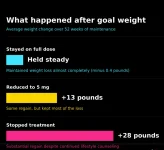
- SURMOUNT-MAINTAIN Trial: Patients who lost weight over 60 weeks on maximum doses of tirzepatide (Zepbound/Mounjaro) maintained significantly more weight reduction after another year of treatment. Participants who stayed on the maximum dose were seven times more likely to maintain their weight loss, and those who stepped down to a 5mg maintenance dose were four times more likely to maintain it, compared to stopping the drug.
- ATTAIN-MAINTAIN Trial: This study demonstrated that patients could successfully transition from injectable therapies (Wegovy or Zepbound) to Eli Lilly's once-daily oral pill, orforglipron. Patients transitioning from semaglutide (Wegovy) retained over 79% of their weight loss, regaining an average of only 0.9 kg. Patients transitions from tirzepatide regained an average of 5.0 kg over one year.
Big trouble in Little China???BEST. MOVIE. EVER.

bay_area_schizo
GLP-1 Apprentice
yup! classicBig trouble in Little China???

Quatroskin
GLP-1 Apprentice
I ran it for 13 weeks at 2mg a week. The last 2 weeks I ran 1.5mg and the last week I ran 1mg then went to SE Asia for 2 weeks. I initially started the Reta journey as a jumpstart to help me out getting healthy again and planned to get off it around the 3 month mark. I’ve heard horror stories about coming off it and the weight would come back on etc so I was nervous. But my experience is this , my cravings started coming back for fast food and alcohol so since I was on vacation I indulged in both but mostly eat street food. I did however keep up my gym routine while away as well and I didn’t step on a scale at all on vacation so when I got home I was nervous to see my weight after having a few beers and fast food abroad. To my surprise I was down another 1 1/2lb from when I left. I’m going to try to keep up my new lifestyle eating healthy and gym and see how I do without the Reta. If I feel I’m getting out of control with my cravings or gaining weight back I will start again. But once again , I only started the Reta journey as a tool to help me get back on track of being healthy. Started at 230lbs and currently at 189lbs.
domin8brix
GLP-1 Apprentice
The links I posted indicate why NOT to do that.Is anyone doing any type of on off cycling on Reta? I wonder when i reach my goal weight if i can come off and maintain better lifestyle and diet choices if i will only need to come back on if i slip? Also I worry will my body ever recover from Reta use or will it permanently be altered? so many questions 😵
Yes, the Dom has elucidated how breaks in usage can render the compound relatively ineffective.The links I posted indicate why NOT to do that.

Sea
??? Who took it negatively? It's an excellent thing. But, if a joke offended you, though I usually wouldn't give a damn, you caught me in a charitable mood today. So, I will make recompense. Okay, listen close. Get a nice black marker and paper. Save the following name, and don't tell anybody, okay. You be on the lookout for the guy when he comes out. So here it comes.....
Mibavademab.
I know..It's too much...But I can be overkind sometimes. No thanks needed.
MABs are miraculous drugs even more so than glp1s but also orders of magnitude more difficult to manufacture than peptides. You aren't likely to find a quality MAB on the black market in the next decade.
Operation: Instill Despair SuccessfulMABs are miraculous drugs even more so than glp1s but also orders of magnitude more difficult to manufacture than peptides. You aren't likely to find a quality MAB on the black market in the next decade.
Just feel lucky you can stock up on reta. Current prices are ~$150 for a years supply at a fairly high dose. Buy a decades worth and keep an eye out for something better in 5 years.Operation: Instill Despair Successful
chest rockwell
GLP-1 Apprentice
But, hey, better to stab oneself with a GLp once a week, than with insulin every day, eh?
some of us do both

Flash-BCR
GLP-1 Apprentice
This is my plan for tirz and reta both... 👍Just feel lucky you can stock up on reta. Current prices are ~$150 for a years supply at a fairly high dose. Buy a decades worth and keep an eye out for something better in 5 years.
Hey zpped, i wanted to message you this but dont think i can cuz how new my account is.MABs are miraculous drugs even more so than glp1s but also orders of magnitude more difficult to manufacture than peptides. You aren't likely to find a quality MAB on the black market in the next decade.
I understand my permissions are a bit limited but can i make a post asking about peoples opinions on endotoxin testing and how essential it is? and ask for peoples opinion on MZ biolabs and to see if they have other budget but reliable options?
I finally got my peptides a couple days away from me (from a board sponsor) and im hoping to send for testing pretty much immediately since the vial im currently using is already a month old and figure i got another 2-4 weeks on it before i need a new vial. So want to get this done asap so i can start using the new stuff asap too. im set on testing for ID/Purity and content but that endotoxin is not cheap....so wondering if folks see it as a must since from my understanding you wont IMMEDIATELY die (LOL) from endotoxins 🤔


