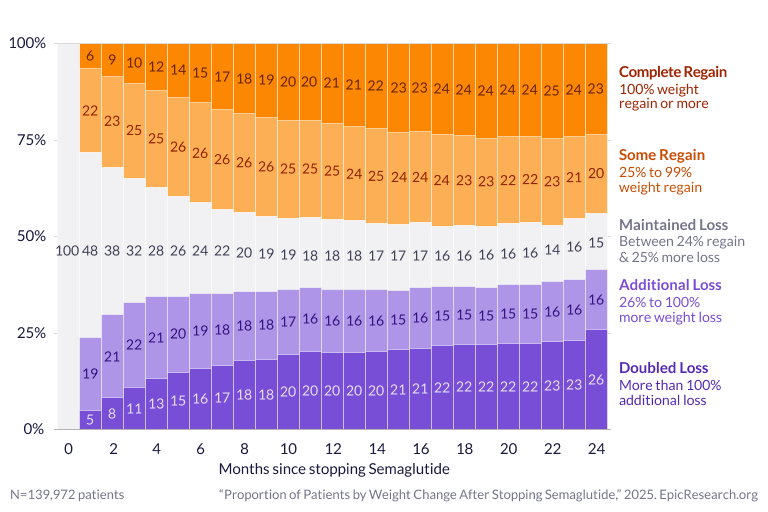
40,000 Patient Records Reflect >50% Maintained or Increased Weight Loss After 24 Months Off GLP’s

I didn’t see anybody claim people should just stop taking GLP’s. I have seen a lot of folks on this forum insist if you titrate down or stop then they will lose effectiveness.
I see people claim both. Mostly the fat shamers saying you need to stop, and the people who have been fat shamed claiming they will lose effectiveness/you'll regain everything if you go down/stop. It's a socially/emotionally loaded topic that makes having real discussions about it difficult, unfortunately.
 
I see people claim both. Mostly the fat shamers saying you need to stop, and the people who have been fat shamed claiming they will lose effectiveness/you'll regain everything if you go down/stop. It's a socially/emotionally loaded topic that makes having real discussions about it difficult, unfortunately.
I was hoping there were enough rational people on this forum to have actual discussions without pearl clutching and false assumptions. As much as I see people trash talk bodybuilders for being “meat heads”, they tend to be the most open to new research and experimentation, even those who have struggled with obesity in the past.

And even more annoying is all the DM’s I get flooded with after posting anything that doesn’t fall in line with the current dogma. Apparently I’m not the only one to drop dosage or experiment, I’m just one of the few who doesn’t care what others think.
 
Last edited:
That is totally true, and some probiotics are tricky to acquire. There is one you only get when you're born. Antibiotics kill them.
I have had spinal meningitis twice in my life and after transphenoidal surgery in 2022, I am sure that the IV antibiotics wiped out a good portion. I eat very well, take an adequate amount of supplements, work out rigorously a few times a week but I know it’s not enough to reverse the effects. I am near Rice University where they pioneered fecal matter transplants but I didn’t qualify for any of the trials. If I didn’t actually work in the industry, I probably wouldn’t be doing as well as I am. :/
 
I have had spinal meningitis twice in my life and after transphenoidal surgery in 2022, I am sure that the IV antibiotics wiped out a good portion. I eat very well, take an adequate amount of supplements, work out rigorously a few times a week but I know it’s not enough to reverse the effects. I am near Rice University where they pioneered fecal matter transplants but I didn’t qualify for any of the trials. If I didn’t actually work in the industry, I probably wouldn’t be doing as well as I am. :/
I was wondering..since you seem to have a lot of treatments covered without hassle. No way anyone with my insurance provider would get glps prescribed for lack of a certain probiotic..Severely obese people here have a hard time. You are very lucky in that sense. But you seem to have had a rough road health wise, and I am very sorry you have suffered. Gut bugs are so important we now know.. But it's true that replacing them isnt as easy as you'd think.
 
I was wondering..since you seem to have a lot of treatments covered without hassle. No way anyone with my insurance provider would get glps prescribed for lack of a certain probiotic..Severely obese people here have a hard time. You are very lucky in that sense. But you seem to have had a rough road health wise, and I am very sorry you have suffered. Gut bugs are so important we now know.. But it's true that replacing them isnt as easy as you'd think.
I wouldn’t say “lucky” so much as I chose to move my career in a direction that would support my health. I moved from Los Angeles to Houston to be near the biggest medical center specifically so that I could have access to some of the top research clinics. 👍
 
According to the records of 40,000 patients at Epic, more than 50% of them were able to keep off the weight or continue to lose weight in the 2 years after discontinuation of GLP-1’s. Roughly 20% gained the weight back. This is based on medical records, not self-reported. Regardless of how many studies or reports come out, I still hear people parrot the narrative of Big Pharma that “once you pop, you can’t stop”. I get this may be the case for opioids, but GLP-1’s seem to affect different people differently.

View attachment 9969

In other news, 49% gain all their weight and more back. 😂
 
This paper shows great promise with Akkermancia.. Supplements do seem to work.
High fat diet kills it though. All kinds of positive news in here.
 
This paper shows great promise with Akkermancia.. Supplements do seem to work.
High fat diet kills it though. All kinds of positive news in here.
Feel free to send as many links as you want. I found out today my doctor is in South America for another week. I’ll call back next week and see if one of the other doctors can give me a straight answer, at the latest I’ll know the first week of December.
 
Also, doesn’t account for someone switching from one med to another. For example, they appear to have looked at people who stop Sema, but doesn’t account for a potential switch to Tirz, or a change to LDN or Qsymia or something else.
As long as the patient's new medication collection is recorded in Epic's EHR then it will record the medication switch and count them as continuing to take a GLP-1. But this assumes the patient's prescriber and pharmacy all continue to use Epic's EHR. Little pedantic but thought I'd clarify
 
Apparently I’m not the only one to drop dosage or experiment, I’m just one of the few who doesn’t care what others think.
I see people in the community all the time talking about hitting goal weight and slowly dropping dosage until they are off. Some do lower doses not even weekly anymore. Some are like me and the insane cravings like my body wants to jump back where it always goes after I lose weight when I lower my goal weight dosage. I really haven't seen any sector of this community be all or nothing as far as "YOU MUST STAY ON BECAUSE I HAVE TO" or "You have to get off as soon as you can because its not good long term.

There are some people who claim after stopping for a while needing more mg of the same peptide to be at the weight they were when they stopped. Not all, some.

I've seen people with the belief on both sides, probably because their own personal experience. That whole, this is how my body operates so everyone's is just like mine mentality. Then you see the ones who are open to both because they realize every body, briain, chemistry, reasons why we are fat are all very different and unique to the individual.

It feels like you are more pushing one narrative than being open to multiple and so you might be pushing some buttons on the people on the other. Doesn't really feel like a discussion.

I'm sure I'm reading everything you are posting wrong though. My whole experience causing me to see in the way that I do.

But yeah, I don't see, even in this forum group, just one main side of the stay on or off coin Don't know where you are coming from with that one.
 
I was hoping there were enough rational people on this forum to have actual discussions without pearl clutching and false assumptions. As much as I see people trash talk bodybuilders for being “meat heads”, they tend to be the most open to new research and experimentation, even those who have struggled with obesity in the past.

And even more annoying is all the DM’s I get flooded with after posting anything that doesn’t fall in line with the current dogma. Apparently I’m not the only one to drop dosage or experiment, I’m just one of the few who doesn’t care what others think.
I'm in maintenance, dropped dosage significantly, and enjoying food lol. I've started trail running again (I was really breaking my back trail running at 240 lbs!), so as long as my clothes still fit, I'll slowly titrate down. Like with any medication, I want to be on no or the lowest possible dose long term. But I'm also coming to this space from not being obese for most of my life so maybe I'm a little more confident than some?
 
I really haven't seen any sector of this community be all or nothing as far as "YOU MUST STAY ON BECAUSE I HAVE TO" or "You have to get off as soon as you can because its not good long term.
I don't really see a whole lot of that kind of black-and-white talk outside of reddit. I think once you've graduated to here and other "advanced" spaces in the online peptide world, there's a lot more people capable of nuance. Which is why I keep my participation in the reddit peptide subs at a minimum.
 
I don't really see a whole lot of that kind of black-and-white talk outside of reddit. I think once you've graduated to here and other "advanced" spaces in the online peptide world, there's a lot more people capable of nuance. Which is why I keep my participation in the reddit peptide subs at a minimum.
Reddit is terrifying! I’m convinced that 1/3 of those accounts are government plants trying to scare people away from gray market peptides.
 
I don't really see a whole lot of that kind of black-and-white talk outside of reddit. I think once you've graduated to here and other "advanced" spaces in the online peptide world, there's a lot more people capable of nuance. Which is why I keep my participation in the reddit peptide subs at a minimum.
reddit really is it's own community.
 
I'm in maintenance, dropped dosage significantly, and enjoying food lol. I've started trail running again (I was really breaking my back trail running at 240 lbs!), so as long as my clothes still fit, I'll slowly titrate down. Like with any medication, I want to be on no or the lowest possible dose long term. But I'm also coming to this space from not being obese for most of my life so maybe I'm a little more confident than some?
That’s awesome to hear! I come from having had a couple of major medical issues and being told I would have to take pills (with horrible side effects) for the rest of my life. I’m off of both prescriptions and doing fine. I have a love/hate relationship with the general medical community, due mostly to dealing with doctors who get kickbacks and have a god complex, or those who are apathetic to a point they put patient lives at risk.

I’m currently on a holidays/birthdays/anniversary hiatus for a few weeks. I’m sure there will be a difference when I get back on the wagon but I don’t expect a full rejection. I was only on .2mg Sema though so titrating up will start with 1/2 that dose, see what happens.
 
How many of your epic records show you are still on it? My record almost 3 years ago shows I took MJ for 2 months and now it doesn’t…never stopped..would it count me as a maintainer?
you think that the successful 50% all went grey? 😂 not a bad hypothesis considering the price gouging they do in the American health system
 
Not all, but a fair few of the people using GLP's for weight loss have significant cardiovascular risks. Obesity, high blood pressure, high sugars, high cholesterol, low exercise often go together. Losing weight will often improve those, but depending on age and degree of obesity, quite a bit of damage to your arteries may already have occurred. GLP's significantly reduce the incidence of heart attack, stroke and heart failure, plus other less well proven benefits.

Staying on them, if your cardiovascular risks are significant is a good idea, regardless of weight, especially once past 50yo or so. The benefits of GLP's on cardiovascular risk are independent of treatment of other issues like high cholesterol or hypertension.
 
Just my opinion here
I suspect there are some serious methodological flaws in this study, I am not qualified to judge this, but if any readers with research experience are, feel free to comment.
It is worth noting that this is not published in a peer reviewed journal. "However, it’s important to note that they do an internal peer review, but no third party peer review"
There have been a lot of studies on weight regain after weight loss, as in hundreds to thousands of papers on the subject. The results of this study are not consistent with the previous research.
In general most studies over the past 40 to 50 years show that most people who lose weight regain all or most of that weight over the next few years. Irrespective of how they lost the weight. This has been my personal experience as well.
The SURMOUNT-4 Randomized Clinical Trial
After 36 weeks of open-label maximum tolerated dose of tirzepatide (10 or 15 mg), adults (n = 670) with obesity or overweight (without diabetes) experienced a mean weight reduction of 20.9%. From randomization (at week 36), those switched to placebo experienced a 14% weight regain and those continuing tirzepatide experienced an additional 5.5% weight reduction during the 52-week double-blind period.
This is a prospective, controlled, randomised clinical trial published in a reputable peer reviewed journal JAMA Journal of the American Medical Association
It showed 20.9% weight loss with tirzepatide, after ceasing it over a year, the ones on placebo gained 14%, leaving average weight loss of 6.9%, those who received tirzepatide lost a further 5.5%.
There are many other good quality peer reviewed papers that show similar results for tirzepatide, semaglutide and all other weight loss methods over decades excepting surgery.
Sorry but that study sounds great but is not likely to be accurate, there is very little description of their methods of getting and interpreting the data they used so it is not really possible to assess what went wrong. They are making extraordinary claims, that are different to the established body of research, do not acknowledge this in the article and fail to provide the extraordinary evidence to back up their claims.
One of the great things about access to inexpensive GLP-1 drugs is you can experiment with stopping and starting and increasing and decreasing doses as needed. Based on the research, I think most people are going to need to stay on the dose they used to lose the weight, to keep it off, but trying reduced doses or stopping it for maintenance is a easy harmless experiment so long as you don't let weight regain get away from you before restarting it if necessary.

This.
 
Also trying to understand the methodology here. It’s not clear how many patient records. The starting population included 40,000 clinics.

It’s hidden how they selected who was in and who was out of the data set. Sure, two independent teams used the same methodology and came up with similar conclusions. So the answer is valid /for the method/. What was the selection criteria? Final population count?

The linked article and the reference article are quite high level.

This isn’t to tear anyone down — it is an important topic. We SHOULD be digging in.

A few things seem consistent:

- these peptides heal more than weight. Whether directly or indirectly, the effects are almost unbelievable.

- pharma trials go from testing level to zero and heavily reports regains

- anecdotes go both ways about stopping/tapering off and being successful, and needing the product to stay lean

Personal 2c… it may very well be all over the place how individuals react. To try to find a theme is to try to cover a huge variety of eating patterns, movement habits, and gut biomes under the same conclusion may be an act of madness.

The group of people that actually take the prescribed substances — which epic will have tagged — are going to be a select population:
[
BMI over 30 or BMI over 27 plus risk markers
]
PLUS able to foot the bill. A whole other layer for the US and our … system.

I don’t know if I have a point per se… maybe that I don’t think it’s going to have a clear answer (human variability) and a for-profit company shouldn’t be relied on to say whether or not their product is needed lifelong or not.
 
I think the emotions that have come out here are emblematic of an interesting quirk that exists in the alternative health space:

If someone finds their way here (not this site, but to questioning mainstream health dogma in general) via the seed oil controversy, they'll probably spend months to years viewing linoleic acid as the enemy and singular cause of obesity, not recognizing that it's just one piece of the puzzle.

If someone finds their way here via GLP1s, they probably still buy into CICO being predictive and other general dietary dogma. That dogma fails to consider that there's a lot more to diet than calories and that trying to avoid significant regain without GLPs (although a tough cookie to crack) isn't impossible. Most people here seem to operate with some version of this mindset, since that is the focus of this forum, after all.

If someone has found their way here via gut bacteria health (e.g. OP), they may overemphasize it's role in health, not recognizing that although it leads to amazing results for some people, if that's not what is holding you back, it's not going to help you very much.

Same with red light therapy, ketogenic diets, veganism, grounding (yes, there's actually some legitimacy to even that), vitamins, nutrition, supplements, other peptides, mold exposure, etc....

After you've spent some time in this (questioning the mainstream) space, you'll start to realize that the only true path forward is trial and error based on anecdote, as depressing as that is to realize.
 
How many of those went underground and are still on glp…or just not sharing with their doc that they are on compound now…
I believe that would be a good portion; although it sure of the statistics. I have known several people who have done that very thing.
 
Top Bottom