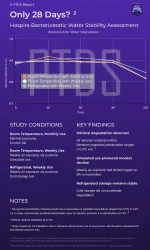
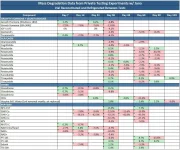
My concern with this test is that if degradation is being defined solely as a decrease in benzyl alcohol concentration, it doesn't really prove all that much.
You have to assume that BA provides broad-spectrum protection against fungi, gram-negative bacteria, and gram-positive bacteria to feel comfortable with this conclusion, but it doesn't. Even if the concentration remains relatively stable, that doesn't automatically make it an ideal preservative system.
Also, this isn't really a true challenge test. BAC water by itself is one thing, but once you add a peptide, fillers, buffers, etc., you've created a completely different environment. Everything in that formulation can interact with the preservative differently. 0.9% BA may be perfectly adequate in one product and less effective in another. It could be fine with retatrutide and not perform the same way with GHK-Cu. Purity and excipient profiles matter too, and those can vary between manufacturers and even between batches. I guess this is where Jano's test is useful to some degree, but again, this does not account for specific batches. We all know some Chinese labs play dirtier than others.
Other things that come to mind are solubility and pH. Concentration isn't the only factor worth looking at. Preservative performance will be affected by solubility and pH, even if the measured concentration hasn't dropped below some arbitrary threshold. Note every preservative has an efficacy pH range. And if benzyl alcohol is floating on the top of the solution, it won't be preserving anything.
It's definitely an interesting test and adds some useful data, but I wouldn't use it as justification to buy a vial of R100, reconstitute it, and assume it's good to go for the next two years on 1mg per week. Tempting, yes, but don't.



 www.peprecon.com