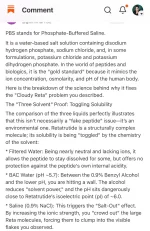
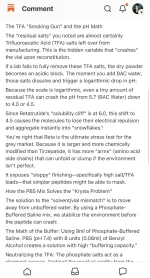
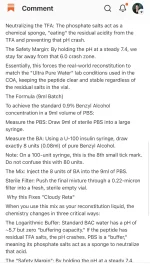
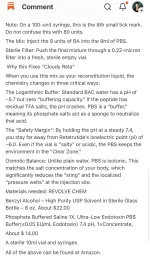
I haven't tried straight up PBS, is that safe to inject? what would it's shelf life be?AA makes acidity worse and kills the Reta. Try straight PBS a little at a time until fairly clear and wait 30 min. That may be the best it's going to get. Did you try that?
My post above says that PBS is the only way to correct the vial by stabilizing the environment for Reta and it dissipates the residual salts. Once that's done, the Reta is as safe as it's going to be. I've attached the entire comment on how to remediate the salts issue. He suggests straight BA (Benzyl alcohol) at 8 IU to replace the BAC. Unless you have BA handy, that's not feasible, and we already know that BAC doesn't help. So it's a trade off. Lower shelf life for a more stable peptide. I don't know your dosage, but I'm at 10 mg so that's two weeks of peptide. You'll have to make that decision.I haven't tried straight up PBS, is that safe to inject? what would it's shelf life be?
I had a similar scenario last month, after bumping around a few other sites and groups I found out others had encountered this same issue and a majority of those others actually still used it, I used it as well and it's still as effective as if it were to be clear but that's just me..I just got a kit of reta20 from a vendor I've used frequently - reconned the first vial and it was cloudy, shit happens was willing to let it slide, did a second vial, also cloudy. I am using a brand new vial of hospira bac. I then reconned an older vial just to make sure it wasn't my bac and it was crystal clear. I have contacted the vendor with pics and hope they make it right but even if they do, I'm now out of Reta and assume I'll weigh 300lbs by next month.
You can't know for sure without testing, but what I've read is that the Reta is still fine. I asked Gemini if AA would compromise the Reta and got the below. This is at up to one drop per mL, up to a 5% AA solution.I have a question about the AA save now, I added a drop on AA to my cloudy reta and immediately it kind of separated and had a bunch of visible particles but after about 15 minutes they had all dissipated and the solution was clear. Do you think the clumping ruined the reta or do you think it's okay now? The PBS rescued vials are not staying clear.
Thanks chili! I'll give it a try and hope for the bestYou can't know for sure without testing, but what I've read is that the Reta is still fine. I asked Gemini if AA would compromise the Reta and got the below. This is at up to one drop per mL, up to a 5% AA solution.
Will the Retatrutide be Compromised?
Generally, no. Retatrutide and similar GLP-1 analogues are relatively stable in slightly acidic environments.
Structural Integrity: Peptides are often stored as TFA salts specifically because they are more stable in an acidic state. Bringing the pH down to a range of 4.0 to 6.0 is standard for many injectable peptide formulations.
Bioavailability: Once injected, the body’s natural buffering system (the bicarbonate buffer) immediately neutralizes the small amount of acid, and the peptide performs as intended.
Injection Comfort: The primary "compromise" is not to the peptide, but to the user. A lower pH can cause a temporary stinging or burning sensation at the injection site.

so you just straight up used the cloudy reta and it was fine? good to know.I had a similar scenario last month, after bumping around a few other sites and groups I found out others had encountered this same issue and a majority of those others actually still used it, I used it as well and it's still as effective as if it were to be clear but that's just me..
correct, will be taking my 3rd dose this Tuesday coming up and the weight is still steadily droppingso you just straight up used the cloudy reta and it was fine? good to know.
I have been searching for threads when it comes to cloudiness and potential fixes and what not. This is all still pretty new to me, so trying to prepare for situations that may come up.correct, will be taking my 3rd dose this Tuesday coming up and the weight is still steadily dropping
This is my question as well. I understand the TFA is neutralized at the higher pH from the PBS, but wouldn’t the TFA still be present, and still have some injection risk?I did some more research and it seems the peptide is fine after PBS. I wanted to know: where do the TFA salts actually go? I found a technical analysis of what the salts do to the peptide, and it sounds like nothing, once the environment is corrected. I'm not a chemist, so I ran it through an AI and got this summary:
1. Residual TFA is the hidden problem
• During peptide manufacturing, TFA (trifluoroacetic acid) is commonly used
• Some of it stays behind as TFA salts
• If not properly removed:
the peptide powder is acidic
⸻
2. When you add BAC water → pH crashes
• BAC water pH ≈ 5.7
• Add residual TFA → drops to ~4–4.5
👉 That matters because:
• Reta’s isoelectric point (pI) ≈ 6
• Near that point → peptides lose charge
• When they lose charge → they clump together
👉 Result:
cloudiness / flakes (“snowflakes”)
⸻
3. Salt and solvent effects worsen it
He explains three environments:
🟢 Filtered water
• No buffering → unstable → can crash
🟡 BAC water
• Alcohol reduces solubility
• pH too close to pI → aggregation
🔴 Saline
• “salting out” effect
• pushes molecules together → precipitation
⸻
💡 His solution
👉 Use PBS (phosphate-buffered saline)
Why?
• PBS buffers pH at ~7.4
• keeps you away from the pI danger zone
• neutralizes residual acid (TFA)
• stabilizes the peptide in solution
Your peptide is fine — it’s just crashing out because the environment is wrong.
Fix the environment → it stays clear.
That's my remaining question also. You would think correcting the environment wouldn't be all there is to it, but that's what Gemini says. I need to ask a chemist guy I know to clarify this.This is my question as well. I understand the TFA is neutralized at the higher pH from the PBS, but wouldn’t the TFA still be present, and still have some injection risk?
TFA salts you say?It’s residual TFA salts in the finishing process as expected.
I mean they’re everywhere including the rain, lakes, etc. I agree, they’re not considered good, as they line right up with the other forever chemical PFAS.TFA salts you say?
German Chemicals Office Submits Proposal to EU Linking TFA to Reproductive Toxicity
![]()
German Chemicals Office Submits Proposal to EU Linking TFA to Reproductive Toxicity
TFA, an atmospheric by-product of HFO-1234yf and other f-gases, is considered by scientists to be a PFAS that persists in the environment.naturalrefrigerants.com
Do you think Lilly is using TFA in the process for their products?I mean they’re everywhere including the rain, lakes, etc. I agree, they’re not considered good, as they line right up with the other forever chemical PFAS.
www.fpp4eu.eu