How do the smartpants design the drug so that it's stable only for 4 weeks?

lastresort

GLP-1 Enthusiast
Member Since
Mar 10, 2026
Posts
339
Likes Received
439
Location
NorthEast US
Perhaps this questions pertains to not just reta, but also other peptides.

A general recommendation seems to be that any reconstituted peptide must be used within 4 weeks...why? And specifically GLP1 drugs, how are these peptides designed so that they are stable for 4 weeks in a fridge?
 
Perhaps this questions pertains to not just reta, but also other peptides.

A general recommendation seems to be that any reconstituted peptide must be used within 4 weeks...why? And specifically GLP1 drugs, how are these peptides designed so that they are stable for 4 weeks in a fridge?
It is not due to stability, necessarily. It is due to sterility. If you choose high quality BAC, and are drawing from that vial only once per week, that time can be extended quite a bit. If you are choosing sterile water, or drawing from a vial daily (or even several times a day) than the risk of contamination (and bacterial growth) increases each time.
 
In addition to sterility, degredation plays a role as well. Once you mix the water itself gradually breaks down the molecule over time, oxygen exposure damages the structure, and some of the peptide molecules can start sticking together and clumping. Due to the structure changes adding up over time the peptide no longer fits the receptor the same way it was designed to, which causes it to slowly lose effectiveness.

There isn't much scientific data published on exact degradation timelines, but the general rule of thumb is about 4 weeks for the glps. In an ideal world you would want to reconstitute right before a dose, but honestly it's not worth the effort for the marginal benefit.
 
A general recommendation seems to be that any reconstituted peptide must be used within 4 weeks...why?
Why is that recommended? because simple explanations are more convenient than accurate explanations.

peps are fragile and decay over time. the are affected by heat and ph over time, just like pretty much any other organic substance.

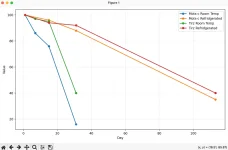
Heres what peptide decay actually looks like, i plotted samples from something i read that reported on purity decreases of reconned mots c and tirzepitide over time chilled vs room temp

X axis is time in days, Y axis is remaining peptide purity

1779896697768.webp


And specifically GLP1 drugs, how are these peptides designed so that they are stable for 4 weeks in a fridge?
its not accurate to say that they are stable for 4 weeks. its more accurate to say that peptides slowly decay over time as a funciton of PH and temperature.

the smartpants would make them stable for longer if it were easy to do so. economy of scale, buddy. if they can make more and store it longer, it makes it cheaper to manufacture, but once they start altering a peptide to make it more stable, it may not have the same effects anymore in the body.
 
Last edited:
This is not a characteristic of the peptide itself, but rather of the amino acids.

Given the nature of entropy, some compounds will degrade significantly over the course of a month, no matter what we do. Gln will deamidate, Tyr will oxidize due to the oxygen introduced into the bottle and exposure to light (this is what causes cut apples to change color), Asp will isomerize, etc.

This results in the loss of only a few percent of the peptide.

The real problem is contamination of the vial caused by repeated punctures of the seal and the drift in the pH of the BAC without a buffer.
 
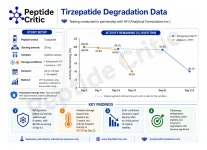
Peptide Critic ran some tests on a couple different peps. His stability data for Tirz shows it being even better.View attachment 25063
Weird how that chart uses an exponential x axis instead of linear to give the illusion that it degrades quicker than it actually does…
Instead of linear x it uses 1, 7, 15, 31, 61, 113…
 
14 weeks on the same Reta it's got at least 2-3 weeks left. As far as I can tell It is working the same today as it did in the first week.
Thank you for that. I read another post else where it said 4 weeks and toss it, started myself into a panic. Ordered 30's that was all they had and only doing 1mg per week that would be a lot wasted
 
Peptide Critic ran some tests on a couple different peps. His stability data for Tirz shows it being even better.View attachment 25063
That graph looks suspicious to me. The shape of the rate of deterioration just looks wrong, that tirz gets to 15 days with 5% deterioration then suddenly drops to 60% deterioration 15 days later seems inconsistent with other data I have seen, and the fact that the fridge and room temp ones ended up at 40% activity also looks dubious, also after getting to 92% ok at 60 days then 40% at 113 days , numbers look made up to me. ( sorry if I am slandering the poor guy who made this / did the testing but it just looks sus. )

My understanding of the GLPs is that tirz is pretty stable but reta does deteriorate a bit quicker and is more sensitive to freezing once rehydrated. Degradation at fridge temps is not an issue at normal use time scales of 4-8 weeks.

The main reason for the 4 weeks is microbial contamination, not degradation. Once the vial is penetrated it is in theory contaminated, the bac water will slow down growth, but over time the odds of bacteria or fungi growing in there slowly increase, and the effect is dependent on temperature, growing faster at room temp than fridge.

The drug companies very carefully formulate the solutions they use with the peptide to increase long term shelf life to years after being mixed with water, so they are stable for much longer than grey peptides mixed with just bac water. But both still require refridgeration and both are not meant to be used more than 4 weeks after sterility is broken.
 
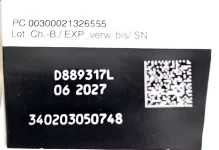
If it is all true, how can monjaro have a shelf life until July 2027? It is also Tirz reconstitution,not? It is more related with our practices and conditions we reconstitute our peptides. If we reconstitute and leave it inside the vial, there will always be air inside which will increase after each injection. Benzyl alcohol in BAC water will evoporate after a time when it comes in contact with air and it will be sterile water back(If it is not contaminated from the air inside). So degredation will be much faster, I suppose? Only for this reason I use insuline pen with 3ml cartridge inside. Once reconstituted, fill the cartridge and inject the air completely out of it. There is no more possibility of alcohol evoporation, excess air inside or a chance for air contamination. I reconstitute my peptides and fill in cartridges also in front of a laminaire flow hood together with a bad particles(<2,5 micron) counter. I know that it works. Because have been cultivating mushrooms before as a hobby. Never experienced bacterie or mold growth in cultures prepared under controlled environment. Before that contamination chance was higher than %60. Mostly thricoderma agressivum. Green mold which we see everywhere.

I don't expect my reconstitution to last until 2027 like Mounjaro. But must be longer than 4 weeks under right conditions. I also don't think penetration of a pen needle can contaminate it. It is not same as penetrating with a syringe needle and also not possible to inject anything in the cartridge with it. Only way is out.

 

Attachments

  • Scan_20260603_133752.webp
    Scan_20260603_133752.webp
    41.6 KB · Views: 1
Last edited:
If it is all true, how can monjaro have a shelf life until July 2027? It is also Tirz reconstitution,not? It is more related with our practices and conditions we reconstitute our peptides. If we reconstitute and leave it inside the vial, there will always be air inside which will increase after each injection. Benzyl alcohol in BAC water will evoporate after a time when it comes in contact with air and it will be sterile water back(If it is not contaminated from the air inside). So degredation will be much faster, I suppose? Only for this reason I use insuline pen with 3ml cartridge inside. Once reconstituted, fill the cartridge and inject the air completely out of it. There is no more possibility of alcohol evoporation, excess air inside or a chance for air contamination. I reconstitute my peptides and fill in cartridges also in front of a laminaire flow hood together with a bad particles(<2,5 micron) counter. I know that it works. Because have been cultivating mushrooms before as a hobby. Never experienced bacterie or mold growth in cultures prepared under controlled environment. Before that contamination chance was higher than %60. Mostly thricoderma agressivum. Green mold which we see everywhere.

I don't expect my reconstitution to last until 2027 like Mounjaro. But must be longer than 4 weeks under right conditions. I also don't think penetration of a pen needle can contaminate it. It is not same as penetrating with a syringe needle and also not possible to inject anything in the cartridge with it. Only way is out.
Commercial peptides like mounjaro etc are very carefully formulated with multiple extra chemicals to stabilise the peptide and then tested extensively so they can guarantee a reasonable shelf life after reconstitution, and are made sterile with very low odds of contamination. Doing it at home with bac water is very crude in comparison so does not have the couple of years shelf life.
 
Perhaps this questions pertains to not just reta, but also other peptides.

A general recommendation seems to be that any reconstituted peptide must be used within 4 weeks...why? And specifically GLP1 drugs, how are these peptides designed so that they are stable for 4 weeks in a fridge?
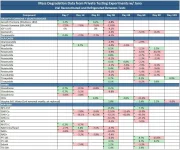
Mass Degradation Data.webp
 
@Labcat explained to slow down bacterial growth: dry, cool, & dark.

Now, Mounjaro/Zepbound vials comes in liquid form (I won't say reconstituted) sealed. And shipped in ice packed ocoolers. Huge carton, 10x10x12 inches for basically, 2ml of liquid. Anybody's guess how long the shit is stored in house.
 
@Labcat explained to slow down bacterial growth: dry, cool, & dark.

Now, Mounjaro/Zepbound vials comes in liquid form (I won't say reconstituted) sealed. And shipped in ice packed ocoolers. Huge carton, 10x10x12 inches for basically, 2ml of liquid. Anybody's guess how long the shit is stored in house.
Not mine, china solved that issue.
 
Perhaps this questions pertains to not just reta, but also other peptides.

A general recommendation seems to be that any reconstituted peptide must be used within 4 weeks...why? And specifically GLP1 drugs, how are these peptides designed so that they are stable for 4 weeks in a fridge?
I use a vial for almost 4 months.. I recon with Hospira bac, I filter, and I keep them in the fridge.
 
Commercial peptides like mounjaro etc are very carefully formulated with multiple extra chemicals to stabilise the peptide and then tested extensively so they can guarantee a reasonable shelf life after reconstitution, and are made sterile with very low odds of contamination. Doing it at home with bac water is very crude in comparison so does not have the couple of years shelf life.
I also don't compare mine with mounjaro. But if all the graphics and published charecteristics about peptides here are true, it must be valid for mounjaro too at a level, not? In each case I can compare mine with those who pulls their constitution daily out of a vial with a syringe and inject. At the moment I am at maintenance dose of 2mg tirz and reconstitute 20mg with 2ml Bac. I can dare to use it 10 weeks long without any doubts. It won't be thrown away after 4 weeks.
 

Trending Topics

Forum Statistics

Threads
18,663
Posts
194,650
Members
62,294
Newest
Ladybluee
Back
Top Bottom