How To? Concentration Plotter

foxgirl

GLP-1 Novice
Member Since
Jan 9, 2026
Posts
32
Likes Received
36
Location
United States
United-States
I think by now I understand the parts of GLP plotting tools enough to plan out doses and keep track of the concentration I’m theoretically maintaining. Maybe I’m over thinking it, but I can’t see though all the concepts to come down to a simplified objective.

I know what the numbers are and how they’re calculated, but is it used to determine when/how much to titrate? Am I looking for my next amount to be in my system before making an increase? For example, starting at 2.5 mg every X days, once my body is peaking 5 mg daily then start dosing at 5 mg. Or am I looking for the amount my body is maintaining to determine my next dose? For example, starting at 2.5 mg every X days, seeing it peak above 3.5 mg daily, so start dosing at 3.5 mg? (Made up numbers)

I’d like to be efficient and mitigate side effects so understanding this and personalized planning does matter to me
 
The simplest approach is to just use the standard dosing schedule, with increases in dose every 4 weeks. The calculator is just an estimation, your particular half life may be a bit different and you really have to go on effects - are you still hungry or not losing weight or are you getting side effects.
On average worst side effects are a few months after starting, as doses start to increase, then they usually very slowly improve.
Using the blood level calculator is mainly useful to work out dosage adjustments, or if you want to use smaller doses more often, but this really only matters if you are trying to deal with side effects that are unpleasant, and do not want to drop the dose down too much. Guessing at blood levels does not work for glp's as the delay in absorption of 24 h or so plus the half life of 5-7 days is totally different to just about every other medication.
You can use it to try to work out how to increase doses more rapidly than standard, but there is a fairly large risk of getting suddenly hit with bad side effects like nausea or vomiting that will take days to a week to get better.
 
The simplest approach is to just use the standard dosing schedule, with increases in dose every 4 weeks. The calculator is just an estimation, your particular half life may be a bit different and you really have to go on effects - are you still hungry or not losing weight or are you getting side effects.
On average worst side effects are a few months after starting, as doses start to increase, then they usually very slowly improve.
Using the blood level calculator is mainly useful to work out dosage adjustments, or if you want to use smaller doses more often, but this really only matters if you are trying to deal with side effects that are unpleasant, and do not want to drop the dose down too much. Guessing at blood levels does not work for glp's as the delay in absorption of 24 h or so plus the half life of 5-7 days is totally different to just about every other medication.
You can use it to try to work out how to increase doses more rapidly than standard, but there is a fairly large risk of getting suddenly hit with bad side effects like nausea or vomiting that will take days to a week to get better.
Smaller doses, more often is while tracking side effects is what I’m going for. I’m extra sensitive to side effects even just trying Tirzepatide for 2 months on the standard schedule, but I expected it based on my disposition. I also partially want to understand more about the calculator just out of curiosity
 
I did not know whether you had used glp medications before so assumed you were just starting. Still much the same. You have to have a dose or a few doses and see what the effects are, then you put your doses into the calculator and from that you can see what blood levels according to it correspond to what effects you get, either side effects or appetite suppression, and you can then use that to try out different dosage schedules in the calculator to see if you can avoid the levels that caused side effects. Smaller doses more often will get you flatter overall blood levels, as it is the peak levels about 24 hours after a dose, when side effects are usually worst.
I had horrible nausea for a year from semaglutide and had to try work it all out by hand graphing levels and half lives on paper, and dosing 0.2mg every 2 days as i had not yet discovered this forum or glp plotters.
 
I did not know whether you had used glp medications before so assumed you were just starting. Still much the same. You have to have a dose or a few doses and see what the effects are, then you put your doses into the calculator and from that you can see what blood levels according to it correspond to what effects you get, either side effects or appetite suppression, and you can then use that to try out different dosage schedules in the calculator to see if you can avoid the levels that caused side effects. Smaller doses more often will get you flatter overall blood levels, as it is the peak levels about 24 hours after a dose, when side effects are usually worst.
I had horrible nausea for a year from semaglutide and had to try work it all out by hand graphing levels and half lives on paper, and dosing 0.2mg every 2 days as i had not yet discovered this forum or glp plotters.
This is helpful! It was probably a lot more stressful doing it that way so I’m glad you did find this stuff.
So if you’re trying to avoid the peak levels that cause the symptoms, I suppose it’s mostly trial and error to decide when to increase then? If you increase and have symptoms, too soon and/or too much, recalculate, repeat?
 
I had horrible nausea for a year from semaglutide and had to try work it all out by hand graphing levels and half lives on paper, and dosing 0.2mg every 2 days as i had not yet discovered this forum or glp plotters.
I plotted this and compared it against the regular schedule which helped me understand more too, so thank you for the example!
 
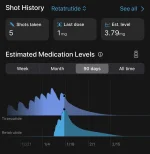
I’m bridging from Tirz to Reta. I use Shotsy (app) and a spreadsheet to track things. For the transition I have gone with the more frequent smaller doses and so far everything is moving well with no to minimal side effects.


Steadier state makes more sense to me with GLP, weekly pulses drop the troughs and raise the peaks, efficacy is through average levels, side effects favor the peaks. Split dosing so far keeps me in the groove with minimal observed or expected downsides.

I did my first 3 doses of 2.5mg Zepbound once a week, then took the fourth mid week when the noise came back which is a common anecdote across weekly injectors.


I do wish it showed y axis scales, currently Reta is .17mg below Tirz exposure.
1768662613724.png
 
I’m bridging from Tirz to Reta. I use Shotsy (app) and a spreadsheet to track things. For the transition I have gone with the more frequent smaller doses and so far everything is moving well with no to minimal side effects.


Steadier state makes more sense to me with GLP, weekly pulses drop the troughs and raise the peaks, efficacy is through average levels, side effects favor the peaks. Split dosing so far keeps me in the groove with minimal observed or expected downsides.

I did my first 3 doses of 2.5mg Zepbound once a week, then took the fourth mid week when the noise came back which is a common anecdote across weekly injectors.


I do wish it showed y axis scales, currently Reta is .17mg below Tirz exposure.
View attachment 13541
This app looks great! Thank you for explaining the peaks and troughs a bit better for me. Definitely makes it easier to mitigate the side effects and understand what I’m aiming for. Split dosing seems to be the way to go from everything I’ve read. I’ll have to start playing around with it. Thank you!
 
Imagine trying to drive your car at a certain speed, but only being able to read the tachometer (RPMs) and not being able to see the speedometer. Eventually you'd figure out a way to make it work, but you'd get confused when you went up and down hills and why your system led to weird results then.

That's what trying to make sense out of symptoms/levels of a GLP is like if you're not tracking your total body dose. If you stick to a standard dosing protocol (e.g. X mg/week, perhaps increasing at some rate) then you don't need to track because your dosing schedule handles things for you. If at some point you decide you want to deviate from that protocol (e.g. you want to reduce a particular side effect, while maintaining efficacy), you're going to find yourself chasing your tail around in circles if you're not tracking your total body dose. This is also the reason why people who take a break for a while find that their prior dosing "doesn't seem to work as well" when they start again, not understanding that what they think is the same dose is actually half the total body dose they were previously on.
 

Trending Topics

Forum Statistics

Threads
9,034
Posts
101,438
Members
28,119
Newest
JustinBMG
Back
Top Bottom