
I'm waiting for @Mr. Blonde to come along and just say blast it! 🙃

You are using an out of date browser. It may not display this or other websites correctly.
You should upgrade or use an alternative browser.
You should upgrade or use an alternative browser.
Less is More. How do you manage impulsive urges to increase dose or more peps.
- Thread starter Neptide
- Start date


I think in general, this is the wrong approach. Unless you are taking GLP drugs without starting off obese, which is what they are for, and taking them for cosmetic or fat percentage reduction effects, it might be different. And I do not think stacking low dose GLPs or other peptides on top of GLP's at low doses, is a good idea most of the time, it increases odds of side effects and allergic responses without being any more effective than higher doses of one GLP.
If using it for its intended purpose, treating obesity, adjusting doses so that very long term treatment is tolerable is essential, and that includes reasonable hunger control. Using tiny doses and sticking it out when hungry , is really not much different to just being on a diet without the drug, and the constant mental effort required to control eating while hungry is exhausting, and eventually people run out of energy and put the weight back on. The advantage of these drugs is breaking that cycle ideally permanently, and to do that , it requires good hunger control. It is not ever going to reduce hunger to zero unless it is making you feel very ill at the same time, the body's appetite regulation system is excessively complex and redundant. But it does need to be to the point where what you choose to eat gets close to matching the number of calories in to lose weight and maintain the loss long term. The idea that you can retrain your body to tolerate a lower calorie diet long term is mostly wishful thinking. It is not impossible to achieve large long term weight loss without drugs or surgery, but requires extreme lifestyle changes that get converted into long term unconscious habits, and the odds of success at this are really incredibly bad, a few percent. Losing and maintaining weight loss on GLPs requires an injection once a week, better lifestyle habits are a good idea but are not required for them to work.
I am overweight, have no self control, and absolutely will implement an extreme lifestyle change in order to not ever get to this weight ever again. GLP1s allow me to do this.
We're trying to solve the issue right? Not only looking to just lose the weight?
OP asked how to avoid impulsive behaviour to avoid ramping up too fast. Guess what, that impulsive result craving obsession is also the culprit of many many kilos.
GPL1s allows you to lose weight but it's not a wonder. it's still up to you to fix the underlying issues and stay healthy.
Trial data can absolutely be misinterpret, please take a look at some resources from Dr. Jones about lowest effective dose and titrating up.
Last edited:

lessthanhalf
GLP-1 Specialist

I both agree and disagree with that.
I was extremely overweight at 145kg in 2022, at that point I believed GLP drugs were impossibly expensive, but had read the research.
I got from 145 to 75 kg in about a year by eating 1600-1800 kcal/day , and mostly lean meat fruit and vegetables and salad, generally low calorific density , with an absolute restriction on any high calorie/ highly rewarding / high glycaemic index foods , and very high protein 40-50%. In the past I had found eating small amounts of rich high calorie food triggered extreme uncontrollable hunger an hour or 2 later, and this was much worse after weight loss, and once started was very hard to stop. presumably something to do with blood sugar spikes then dips then some brain chemistry gone wrong, causing extreme hunger. But still food addiction or binge eating disorder. I got from 65kg in 2014 to 145 in 2022.
I stayed at that weight ( 75kg ) or thereabouts for a year or so, but it was hard and I was nearly always hungry despite eating a diet I had designed around minimising hunger. So in most respects I had solved the problem, using diet and behavioural strategies on myself to control eating, but there is no way it was sustainable long term. I had got to normal weight in the past but could never stay there for more than a year or 2. At some point I would give in and eat too much after being just too hungry for too long.
I found out that ozempic at low dose was not super expensive in Australia at about $40/w aud, and it helped me be less hungry , but also caused nausea that did not get better over a year. And then found this forum and cheap peptides, and tirz 15mg/w plus reta 5mg/w plus cagri 0.5mg/w, do a much better job of controlling hunger and cravings for not allowed foods, I am still sticking to the no high calorie foods approach and have for 3.5 years now, but it is nowhere near as hard on GLP drugs as it was without them and feels like it might be sustainable. This absolute avoidance of high calorie trigger foods is not going to be for everyone, but it worked for me. And I got to 65kg recently at a BMI of 23.
The way I see GLP drugs is they modify appetite , so you are less hungry, they make you feel full after eating less calories, they have some food aversion effects making high calorie foods seem less appealing, reduce cravings for high calorie foods and reduce thinking about food overall, and most importantly of all they still do this after you have lost a lot of weight, where normally hunger is massively increased.
GLP drugs also do work regardless of diet or lifestyle changes, the studies that gave the drugs alone or with diet and exercise interventions did not really show much difference in weight loss, and they improve diet choices unconsciously, people are more likely to eat and buy fresh fruit and vegetables and less likely to buy and eat ultraprocesssed food when they are on GLP drugs. They temporarily modify the functioning of some brain reward circuitry to do this.
GLP drugs are being considered as therapies for binge eating disorder, for the simple reason that they work. Most therapies for that disorder are psychological, mainly cognitive behavioural therapy , which can help, but is not very effective. In general there is a bit of an issue with a psychologist's way of viewing the disorder and a more medical therapy viewpoint. Until GLP drugs the only approved therapy was amphetamines, which help a bit but not a lot. But this field issue is a problem, in general psychologists are going to view it as a problem that needs therapy, not something fixable with drugs, so a lot of what I have seen is from their perspective which does not view them as a solution regardless of how well they work. From what I have read GLP drugs are probably the most effective therapy for binge eating disorder yet found, but this is far from the current consensus, and I would argue this is because of the way it is seen by the people who usually treat it, psychologists, who view it as a problem to be managed with therapy, usually cognitive behavioural ( which in general is a very useful and effective treatment for many psychological and psychiatric disorders, and is often better than medication )
Just from my experience GLP drugs do reduce impulsive or otherwise poorly controlled eating behaviours. Mainly by rewiring the reward circuitry so that the underlying impulse or desire for the food is weaker, and this effect works on other addictions, for alcohol, cocaine amphetamines and opioids, to the point where they are also being considered seriously as therapies for these problems and being actively researched. In my case I had decided to exclude a wide range of foods from my diet totally to bypass this problem, so it is not as easy to say how hard it would have been to start doing this on GLP's, but I can definitely say it is much much easier to stick to it long term with them , and requires a lot less mental effort fighting those impulses, because they are not as strong.
For me GLP drugs are literally lifesaving , were I to regain the 80kg I lost I would be at very high risk, well over 50% of serious cardiovascular disease over the next decade, with a risk reduced to 10-20% with GLP drugs, weight loss and statins etc. Despite having lost the weight without GLP drugs, I do see them as the closest thing there has ever been to a long term solution to obesity, short of surgery which is not without adverse effects. In general all of the research ever done on reducing obesity with diet and exercise shows initial successes with very poor long term results, with single digit percentages ever maintaining major weight loss long term. So as far as I am concerned diet and exercise , as a treatment for obesity do not work, or at best help a bit or temporarily. GLP drugs so far show weight loss and maintenance up to 5 years from start to end of study, with no trend to increased weight over time if the dose used to lose the weight is maintained, and depending on which drug, can cause an average of 15-29% weight loss, much more than diet therapies could ever achieve. And after that 5 years , when the GLP was stopped weight started going up immediately.
In people especially with severe obesity including those with binge eating or food addiction disorder, GLP drugs help to fix the problem. The appetite regulation system in long term obesity gets broken somehow, in a way that is not fully understood as the appetite regulation system is extremely complicated, redundant and full of all sorts of feedback loops. Until GLP drugs there was nothing that really worked , best previous drugs had at best 5-8% weight loss, and weight loss surgery is no picnic. And weight loss , good diet and exercise do not fix the broken appetite regulation system. After weight loss , especially massive weight loss, energy expenditure is quite a bit lower than would be expected for a person of that age and activity level, and hunger is higher than normal. This is the impossible state of trying to maintain weight loss without GLP's. Having to stick to a lower than normal, low calorie diet long term, despite your body telling you it is hungry all the time, which is exactly what I have experienced, requiring 1600-1800 kcal/day to be weight neutral. Which is why so few people succeed in long term weight loss from diet and exercise, so it does not really help to develop excellent eating and exercise patterns, a very small percentage can do it, and develop unconscious habitual patterns of new behaviour with exercise and diet , so that weight can be maintained without constant mental effort in controlling eating, but even then the basic energy equation is fighting you , requiring less calories in at the same time as more hunger. The only fix for this problem that exists so far is GLP drugs.
And taking them long term benefits health, reducing risks of many diseeases related to obesity, so it is not a trade off of weight control for bad health outcomes, you get both better health and lower weight. So long as side effects do not reduce quality of life while taking them, there are very few downsides to GLP drugs. Apart from the extreme cost if you are using the legit versions.
I was extremely overweight at 145kg in 2022, at that point I believed GLP drugs were impossibly expensive, but had read the research.
I got from 145 to 75 kg in about a year by eating 1600-1800 kcal/day , and mostly lean meat fruit and vegetables and salad, generally low calorific density , with an absolute restriction on any high calorie/ highly rewarding / high glycaemic index foods , and very high protein 40-50%. In the past I had found eating small amounts of rich high calorie food triggered extreme uncontrollable hunger an hour or 2 later, and this was much worse after weight loss, and once started was very hard to stop. presumably something to do with blood sugar spikes then dips then some brain chemistry gone wrong, causing extreme hunger. But still food addiction or binge eating disorder. I got from 65kg in 2014 to 145 in 2022.
I stayed at that weight ( 75kg ) or thereabouts for a year or so, but it was hard and I was nearly always hungry despite eating a diet I had designed around minimising hunger. So in most respects I had solved the problem, using diet and behavioural strategies on myself to control eating, but there is no way it was sustainable long term. I had got to normal weight in the past but could never stay there for more than a year or 2. At some point I would give in and eat too much after being just too hungry for too long.
I found out that ozempic at low dose was not super expensive in Australia at about $40/w aud, and it helped me be less hungry , but also caused nausea that did not get better over a year. And then found this forum and cheap peptides, and tirz 15mg/w plus reta 5mg/w plus cagri 0.5mg/w, do a much better job of controlling hunger and cravings for not allowed foods, I am still sticking to the no high calorie foods approach and have for 3.5 years now, but it is nowhere near as hard on GLP drugs as it was without them and feels like it might be sustainable. This absolute avoidance of high calorie trigger foods is not going to be for everyone, but it worked for me. And I got to 65kg recently at a BMI of 23.
The way I see GLP drugs is they modify appetite , so you are less hungry, they make you feel full after eating less calories, they have some food aversion effects making high calorie foods seem less appealing, reduce cravings for high calorie foods and reduce thinking about food overall, and most importantly of all they still do this after you have lost a lot of weight, where normally hunger is massively increased.
GLP drugs also do work regardless of diet or lifestyle changes, the studies that gave the drugs alone or with diet and exercise interventions did not really show much difference in weight loss, and they improve diet choices unconsciously, people are more likely to eat and buy fresh fruit and vegetables and less likely to buy and eat ultraprocesssed food when they are on GLP drugs. They temporarily modify the functioning of some brain reward circuitry to do this.
GLP drugs are being considered as therapies for binge eating disorder, for the simple reason that they work. Most therapies for that disorder are psychological, mainly cognitive behavioural therapy , which can help, but is not very effective. In general there is a bit of an issue with a psychologist's way of viewing the disorder and a more medical therapy viewpoint. Until GLP drugs the only approved therapy was amphetamines, which help a bit but not a lot. But this field issue is a problem, in general psychologists are going to view it as a problem that needs therapy, not something fixable with drugs, so a lot of what I have seen is from their perspective which does not view them as a solution regardless of how well they work. From what I have read GLP drugs are probably the most effective therapy for binge eating disorder yet found, but this is far from the current consensus, and I would argue this is because of the way it is seen by the people who usually treat it, psychologists, who view it as a problem to be managed with therapy, usually cognitive behavioural ( which in general is a very useful and effective treatment for many psychological and psychiatric disorders, and is often better than medication )
Just from my experience GLP drugs do reduce impulsive or otherwise poorly controlled eating behaviours. Mainly by rewiring the reward circuitry so that the underlying impulse or desire for the food is weaker, and this effect works on other addictions, for alcohol, cocaine amphetamines and opioids, to the point where they are also being considered seriously as therapies for these problems and being actively researched. In my case I had decided to exclude a wide range of foods from my diet totally to bypass this problem, so it is not as easy to say how hard it would have been to start doing this on GLP's, but I can definitely say it is much much easier to stick to it long term with them , and requires a lot less mental effort fighting those impulses, because they are not as strong.
For me GLP drugs are literally lifesaving , were I to regain the 80kg I lost I would be at very high risk, well over 50% of serious cardiovascular disease over the next decade, with a risk reduced to 10-20% with GLP drugs, weight loss and statins etc. Despite having lost the weight without GLP drugs, I do see them as the closest thing there has ever been to a long term solution to obesity, short of surgery which is not without adverse effects. In general all of the research ever done on reducing obesity with diet and exercise shows initial successes with very poor long term results, with single digit percentages ever maintaining major weight loss long term. So as far as I am concerned diet and exercise , as a treatment for obesity do not work, or at best help a bit or temporarily. GLP drugs so far show weight loss and maintenance up to 5 years from start to end of study, with no trend to increased weight over time if the dose used to lose the weight is maintained, and depending on which drug, can cause an average of 15-29% weight loss, much more than diet therapies could ever achieve. And after that 5 years , when the GLP was stopped weight started going up immediately.
In people especially with severe obesity including those with binge eating or food addiction disorder, GLP drugs help to fix the problem. The appetite regulation system in long term obesity gets broken somehow, in a way that is not fully understood as the appetite regulation system is extremely complicated, redundant and full of all sorts of feedback loops. Until GLP drugs there was nothing that really worked , best previous drugs had at best 5-8% weight loss, and weight loss surgery is no picnic. And weight loss , good diet and exercise do not fix the broken appetite regulation system. After weight loss , especially massive weight loss, energy expenditure is quite a bit lower than would be expected for a person of that age and activity level, and hunger is higher than normal. This is the impossible state of trying to maintain weight loss without GLP's. Having to stick to a lower than normal, low calorie diet long term, despite your body telling you it is hungry all the time, which is exactly what I have experienced, requiring 1600-1800 kcal/day to be weight neutral. Which is why so few people succeed in long term weight loss from diet and exercise, so it does not really help to develop excellent eating and exercise patterns, a very small percentage can do it, and develop unconscious habitual patterns of new behaviour with exercise and diet , so that weight can be maintained without constant mental effort in controlling eating, but even then the basic energy equation is fighting you , requiring less calories in at the same time as more hunger. The only fix for this problem that exists so far is GLP drugs.
And taking them long term benefits health, reducing risks of many diseeases related to obesity, so it is not a trade off of weight control for bad health outcomes, you get both better health and lower weight. So long as side effects do not reduce quality of life while taking them, there are very few downsides to GLP drugs. Apart from the extreme cost if you are using the legit versions.
Last edited:

5byfive
GLP-1 Enthusiast

As a therapist who specializes in eating disorders and addiction, I pretty strongly feel that BED is wrongly categorized as an eating disorder. It really belongs in the substance abuse disorder category. Everything that is going on both psychologically and neurologically is just a better fit. GLPs seem to be helping with substance abuse issues (they aren't going to solve them but I think they will he shown to be a significant supportive therapy) and I would expect them to work even better with BED.GLP drugs are being considered as therapies for binge eating disorder, for the simple reason that they work. Most therapies for that disorder are psychological, mainly cognitive behavioural therapy , which can help, but is not very effective. In general there is a bit of an issue with a psychologist's way of viewing the disorder and a more medical therapy viewpoint.
I also think there is a good chance they could be helpful in other eating disorders. Eating disorders and substance abuse disorders have a lot in common in what is going on in the brain. Don't tell that to any therapist working in the ED community. I have never seen a more close minded, morally superior, insulated group of people. They will come at you with pitchforks if you even mention GLPs. Its going to be a fight to get then accepted as a therapy.
lessthanhalf
GLP-1 Specialist
So my impression from what I was seeing reading between the lines in papers on google scholar was not totally wrong about the turf issues involved with BED and GLP's.
Their fears of anorexic patients using them do not seem totally unreasonable.
There are a lot of papers by dietitians about how bad GLP drugs are as well.
It is a pity as the impression I get is that for both addictions and BED , GLP's look a lot like the most promising and effective therapies for those problems, even when people are not trying to fix the problem , they work, and emergency department visits for overdoses drop in half if they happen to be on GLP's, but these sorts of issues do limit the research that gets done as it does not fit into peoples' world views very well.
Having personally had experience with addictions to both drugs and food, I definitely agree there are some pretty major similarities. Even my way of dealing with it is similar, I just have to accept that there are certain chemicals I can get addicted to very easily and need to absolutely avoid, and applying that logic to foods that generate the same extreme responses seems to be working, total avoidance , as the little bit won't hurt approach really does not work for me.
Their fears of anorexic patients using them do not seem totally unreasonable.
There are a lot of papers by dietitians about how bad GLP drugs are as well.
It is a pity as the impression I get is that for both addictions and BED , GLP's look a lot like the most promising and effective therapies for those problems, even when people are not trying to fix the problem , they work, and emergency department visits for overdoses drop in half if they happen to be on GLP's, but these sorts of issues do limit the research that gets done as it does not fit into peoples' world views very well.
Having personally had experience with addictions to both drugs and food, I definitely agree there are some pretty major similarities. Even my way of dealing with it is similar, I just have to accept that there are certain chemicals I can get addicted to very easily and need to absolutely avoid, and applying that logic to foods that generate the same extreme responses seems to be working, total avoidance , as the little bit won't hurt approach really does not work for me.

BNLFL
GLP-1 Specialist
This is the only correct answer.You don’t have to be decisive if you just buy them all…

Eating disorder or substance abuse disorder aside, if one were to look at the effect on the mind, it is clear that one of the toughest causes of the resilience of obesity is the lack of hunger control. This cannot exist without ghrelin being involved. Similarly, urges are tied to dopamine. Now, the most likely reason why ghrelin is so uncontrollable in obese people could be because of leptin resistance rather than a mere overproduction of ghrelin.
People are responsible for their choices and actions. That doesn't mean that hormones cannot control the mind. That is undeniable. Hence, awareness of an issue should be followed by deliberate agency and action designed to resolve it. If usage of GLPs is mandated for life because the person cannot control their hunger pangs, apart from a mere loss of willpower and self-control, it is also a definite sign of faulty brain functioning, which could have been caused by prolonged exposure to the offending hormone's unfettered activity.
If leptin resistance is the problem, testing one's satiety is a good bet to see if it is the case for an individual. Potatoes have the highest satiety on the satiety index. If people crave high-calorie foods after potato satiation, then there is leptin resistance involved.
I would look towards using GLp's until our body gets rid of the leptin resistance, and over time, healthy habits should rewire the brain away from unhealthy habits. There's a reason Atomic Habits is among the most read books in the world.
People are responsible for their choices and actions. That doesn't mean that hormones cannot control the mind. That is undeniable. Hence, awareness of an issue should be followed by deliberate agency and action designed to resolve it. If usage of GLPs is mandated for life because the person cannot control their hunger pangs, apart from a mere loss of willpower and self-control, it is also a definite sign of faulty brain functioning, which could have been caused by prolonged exposure to the offending hormone's unfettered activity.
If leptin resistance is the problem, testing one's satiety is a good bet to see if it is the case for an individual. Potatoes have the highest satiety on the satiety index. If people crave high-calorie foods after potato satiation, then there is leptin resistance involved.
I would look towards using GLp's until our body gets rid of the leptin resistance, and over time, healthy habits should rewire the brain away from unhealthy habits. There's a reason Atomic Habits is among the most read books in the world.

UpDownLeftRightAS*
GLP-1 Apprentice


Neptide
GLP-1 Apprentice
Absolutely. You said it. Quality of Life! That’s my goal.I both agree and disagree with that.
I was extremely overweight at 145kg in 2022, at that point I believed GLP drugs were impossibly expensive, but had read the research.
I got from 145 to 75 kg in about a year by eating 1600-1800 kcal/day , and mostly lean meat fruit and vegetables and salad, generally low calorific density , with an absolute restriction on any high calorie/ highly rewarding / high glycaemic index foods , and very high protein 40-50%. In the past I had found eating small amounts of rich high calorie food triggered extreme uncontrollable hunger an hour or 2 later, and this was much worse after weight loss, and once started was very hard to stop. presumably something to do with blood sugar spikes then dips then some brain chemistry gone wrong, causing extreme hunger. But still food addiction or binge eating disorder. I got from 65kg in 2014 to 145 in 2022.
I stayed at that weight ( 75kg ) or thereabouts for a year or so, but it was hard and I was nearly always hungry despite eating a diet I had designed around minimising hunger. So in most respects I had solved the problem, using diet and behavioural strategies on myself to control eating, but there is no way it was sustainable long term. I had got to normal weight in the past but could never stay there for more than a year or 2. At some point I would give in and eat too much after being just too hungry for too long.
I found out that ozempic at low dose was not super expensive in Australia at about $40/w aud, and it helped me be less hungry , but also caused nausea that did not get better over a year. And then found this forum and cheap peptides, and tirz 15mg/w plus reta 5mg/w plus cagri 0.5mg/w, do a much better job of controlling hunger and cravings for not allowed foods, I am still sticking to the no high calorie foods approach and have for 3.5 years now, but it is nowhere near as hard on GLP drugs as it was without them and feels like it might be sustainable. This absolute avoidance of high calorie trigger foods is not going to be for everyone, but it worked for me. And I got to 65kg recently at a BMI of 23.
The way I see GLP drugs is they modify appetite , so you are less hungry, they make you feel full after eating less calories, they have some food aversion effects making high calorie foods seem less appealing, reduce cravings for high calorie foods and reduce thinking about food overall, and most importantly of all they still do this after you have lost a lot of weight, where normally hunger is massively increased.
GLP drugs also do work regardless of diet or lifestyle changes, the studies that gave the drugs alone or with diet and exercise interventions did not really show much difference in weight loss, and they improve diet choices unconsciously, people are more likely to eat and buy fresh fruit and vegetables and less likely to buy and eat ultraprocesssed food when they are on GLP drugs. They temporarily modify the functioning of some brain reward circuitry to do this.
GLP drugs are being considered as therapies for binge eating disorder, for the simple reason that they work. Most therapies for that disorder are psychological, mainly cognitive behavioural therapy , which can help, but is not very effective. In general there is a bit of an issue with a psychologist's way of viewing the disorder and a more medical therapy viewpoint. Until GLP drugs the only approved therapy was amphetamines, which help a bit but not a lot. But this field issue is a problem, in general psychologists are going to view it as a problem that needs therapy, not something fixable with drugs, so a lot of what I have seen is from their perspective which does not view them as a solution regardless of how well they work. From what I have read GLP drugs are probably the most effective therapy for binge eating disorder yet found, but this is far from the current consensus, and I would argue this is because of the way it is seen by the people who usually treat it, psychologists, who view it as a problem to be managed with therapy, usually cognitive behavioural ( which in general is a very useful and effective treatment for many psychological and psychiatric disorders, and is often better than medication )
Just from my experience GLP drugs do reduce impulsive or otherwise poorly controlled eating behaviours. Mainly by rewiring the reward circuitry so that the underlying impulse or desire for the food is weaker, and this effect works on other addictions, for alcohol, cocaine amphetamines and opioids, to the point where they are also being considered seriously as therapies for these problems and being actively researched. In my case I had decided to exclude a wide range of foods from my diet totally to bypass this problem, so it is not as easy to say how hard it would have been to start doing this on GLP's, but I can definitely say it is much much easier to stick to it long term with them , and requires a lot less mental effort fighting those impulses, because they are not as strong.
For me GLP drugs are literally lifesaving , were I to regain the 80kg I lost I would be at very high risk, well over 50% of serious cardiovascular disease over the next decade, with a risk reduced to 10-20% with GLP drugs, weight loss and statins etc. Despite having lost the weight without GLP drugs, I do see them as the closest thing there has ever been to a long term solution to obesity, short of surgery which is not without adverse effects. In general all of the research ever done on reducing obesity with diet and exercise shows initial successes with very poor long term results, with single digit percentages ever maintaining major weight loss long term. So as far as I am concerned diet and exercise , as a treatment for obesity do not work, or at best help a bit or temporarily. GLP drugs so far show weight loss and maintenance up to 5 years from start to end of study, with no trend to increased weight over time if the dose used to lose the weight is maintained, and depending on which drug, can cause an average of 15-29% weight loss, much more than diet therapies could ever achieve. And after that 5 years , when the GLP was stopped weight started going up immediately.
In people especially with severe obesity including those with binge eating or food addiction disorder, GLP drugs help to fix the problem. The appetite regulation system in long term obesity gets broken somehow, in a way that is not fully understood as the appetite regulation system is extremely complicated, redundant and full of all sorts of feedback loops. Until GLP drugs there was nothing that really worked , best previous drugs had at best 5-8% weight loss, and weight loss surgery is no picnic. And weight loss , good diet and exercise do not fix the broken appetite regulation system. After weight loss , especially massive weight loss, energy expenditure is quite a bit lower than would be expected for a person of that age and activity level, and hunger is higher than normal. This is the impossible state of trying to maintain weight loss without GLP's. Having to stick to a lower than normal, low calorie diet long term, despite your body telling you it is hungry all the time, which is exactly what I have experienced, requiring 1600-1800 kcal/day to be weight neutral. Which is why so few people succeed in long term weight loss from diet and exercise, so it does not really help to develop excellent eating and exercise patterns, a very small percentage can do it, and develop unconscious habitual patterns of new behaviour with exercise and diet , so that weight can be maintained without constant mental effort in controlling eating, but even then the basic energy equation is fighting you , requiring less calories in at the same time as more hunger. The only fix for this problem that exists so far is GLP drugs.
And taking them long term benefits health, reducing risks of many diseeases related to obesity, so it is not a trade off of weight control for bad health outcomes, you get both better health and lower weight. So long as side effects do not reduce quality of life while taking them, there are very few downsides to GLP drugs. Apart from the extreme cost if you are using the legit versions.

Mr. Blonde
GLP-1 Enthusiast
Hahaha 😆I'm waiting for @Mr. Blonde to come along and just say blast it! 🙃
Mr. Blonde
GLP-1 Enthusiast
Also...I just load up and start blasting!
lessthanhalf
GLP-1 Specialist
My experience is that the post weight loss metabolic state of increased hunger and reduced energy expenditure, just keeps on going. Without GLP's I lost 70 kg from 145 to 75kg, on a calorie intake of 1600-1900 kcal /day, and with no change in intake, weight loss slowed and stopped at 75kg at the same number of calories, and it has stayed there ever since, for a year without GLP's , a year on low dose ozempic and 10 months on reta/tirz, with a bit of extra weight loss on reta/tirz to 65kg, and all that required the same calorie intake with no sign of any recovery in energy expenditure or reduced appetite, except for the GLP drug effect on hunger, and probably 1-200 kcal/day lower intake on reta/tirz to lose the last 10kg. This is despite a diet with absolutely minimal blood glucose variation, very high protein , no high glycaemic index foods and a hb1ac of 5 to start with and on reta /tirz of 4.5, so there is good evidence of metabolic state improvements, but not in calories per day or hunger.Eating disorder or substance abuse disorder aside, if one were to look at the effect on the mind, it is clear that one of the toughest causes of the resilience of obesity is the lack of hunger control. This cannot exist without ghrelin being involved. Similarly, urges are tied to dopamine. Now, the most likely reason why ghrelin is so uncontrollable in obese people could be because of leptin resistance rather than a mere overproduction of ghrelin.
People are responsible for their choices and actions. That doesn't mean that hormones cannot control the mind. That is undeniable. Hence, awareness of an issue should be followed by deliberate agency and action designed to resolve it. If usage of GLPs is mandated for life because the person cannot control their hunger pangs, apart from a mere loss of willpower and self-control, it is also a definite sign of faulty brain functioning, which could have been caused by prolonged exposure to the offending hormone's unfettered activity.
If leptin resistance is the problem, testing one's satiety is a good bet to see if it is the case for an individual. Potatoes have the highest satiety on the satiety index. If people crave high-calorie foods after potato satiation, then there is leptin resistance involved.
I would look towards using GLp's until our body gets rid of the leptin resistance, and over time, healthy habits should rewire the brain away from unhealthy habits. There's a reason Atomic Habits is among the most read books in the world.
There is some evidence of long term improvement in energy expenditure over time post weight loss in some studies, but in general weight loss maintenance is very poorly researched, which is a pity as , as far as I am concerned, it is the real problem, and where nearly all weight loss fails, with the exception of staying on glps long term.

birdwhacker
GLP-1 Enthusiast
That's six things, Stacy.I have a mental limit of doing a max of 3 things at a time. Currently, Reta, Klow and MOTS-C.
How did you manage to pull this off with peps? I'm curious.Wait until you take too much shit and start feeling off. It sucks.
I've done this MANY times with supplements, from destroying my methylation cycle by megadosing niacin or glycine, mobilizing heavy metals with ALA, causing DAO shutdown with NAC, making myself spaced out with insane doses of Vitamin C and Magnesium... Did it for years.
But, I learned a lot and I'm at a very good place with the supplements now, and the peptides are just falling into place. Currently running reta, BPC and KPV, bronchogen, epitalon daily, about to add in TB4 as well. A few other peps off and on. Trying not to add anything too fast and... It's working. I feel pretty great lol.
So tell me where you went south so I can avoid it!
Me three. I don't really want to take 12mg of reta. I'm interested in adding both tirz and cagri down the roadz maybe around 8mg. I'm a firm believer in shotgun polypharmacology. The more receptors you hit, the less likely shit is to go south.I’m considering the Tirz - Reta split as well. Thanks
Maxing out the dose on one drug is the pharmacokinetic equivalent of cultivating a single crop – you're practically begging for a plague.
birdwhacker
GLP-1 Enthusiast
Say it louder for the people in the back. Injecting random bullshit has me in the best health of my life.I can't put enough sketchy chinese WhoKnowsWhat into my body all day every day. Surprisingly, I feel fantastic, with almost no sides.
I don't do influencer doctors.Trial data can absolutely be misinterpret, please take a look at some resources from Dr. Jones about lowest effective dose and titrating up.
As a long time substance abuser, I'll get 100% behind you. My relationship with food has been, and arguable still is, strictly pharmaceutical. I'm some brand of autistic and drugs became my special interest and trauma cope. I see everything through a chemical lens. When I ordered a milkshake, I would think "drinking all of this sugar is going to make me feel good, if i time it right I might even be able to take a nap." Or "this cheese burger is going to help me blow off some steam after work." Compulsive redosing. Stealing it from friends and family. Manipulating people to get more.As a therapist who specializes in eating disorders and addiction, I pretty strongly feel that BED is wrongly categorized as an eating disorder. It really belongs in the substance abuse disorder category.
Now, the relationship has changed a little bit and I view food the same way a bodybuilder might view anabolic compounds. I eat the green shit and fruit because I need the fiber and micronutrients. I eat the chicken breasts because they maintain my muscles. I eat the cheese sticks before bed to sustain my insulin release by slowly digesting the casein throughout the night.
There is something deeply wrong with me, but now at least it's pointed away from my face.
lessthanhalf
GLP-1 Specialist
It is incredibly easy with GLP peptides, a bit of a dose increase and you feel like garbage, nauseous maybe with vomiting, not much fun.How did you manage to pull this off with peps? I'm curious.
I could not agree more, possibly the least credible medical source possible, they are almost certainly selling something or selling themselves, which does not tend to produce reliable scientifically credible information.I don't do influencer doctors.

cloratheshadow
GLP-1 Enthusiast
For me it was just stacking too many peps that make me feel altered. Like Cagri makes me tired Reta gives me aches CJC/Ipa gives me head rushes so if I overdo any of them I just feel like trash. But everyone has different tolerances! I seem to be hyper responder to almost everything I take. I also got too obsessed with supplements so I was taking like 12. Just noticed I introduced too many things all at once. It’s better to try to add things slowly so if you do feel weird you know what’s causing it! Now if I add something I only add that one thing until I know for sure it’s tolerated. Plus there are on and off cycles so I remind myself that I can always try the others on my off cycles. It’s hard not to want to try everything. It’s hard also if you really take a lot of supplements on top of it.That's six things, Stacy.
How did you manage to pull this off with peps? I'm curious.
I've done this MANY times with supplements, from destroying my methylation cycle by megadosing niacin or glycine, mobilizing heavy metals with ALA, causing DAO shutdown with NAC, making myself spaced out with insane doses of Vitamin C and Magnesium... Did it for years.
But, I learned a lot and I'm at a very good place with the supplements now, and the peptides are just falling into place. Currently running reta, BPC and KPV, bronchogen, epitalon daily, about to add in TB4 as well. A few other peps off and on. Trying not to add anything too fast and... It's working. I feel pretty great lol.
So tell me where you went south so I can avoid it!
Me three. I don't really want to take 12mg of reta. I'm interested in adding both tirz and cagri down the roadz maybe around 8mg. I'm a firm believer in shotgun polypharmacology. The more receptors you hit, the less likely shit is to go south.
Maxing out the dose on one drug is the pharmacokinetic equivalent of cultivating a single crop – you're practically begging for a plague.
How has epithalon been for you? I’ve been wanting to try it myself!
As mentioned by others earlier, I think that even if the adipose tissue loses all its cytoplasm, the shells remain metabolically active. What do you reckon? Would people who do liposuction AFTER the weight loss- removing what's left, fare better in this regard? I have been doing research on leptin resistance for a long time, albeit secondary. The logical state of this context hits my brain too harshly to ignore.My experience is that the post weight loss metabolic state of increased hunger and reduced energy expenditure, just keeps on going
And this is where I posit the strategy of choosing the appropriate counter, instead of playing incessant defense. What I mean is, if GLP's mandate hunger suppression, but no cure, then maybe one could try doing the opposite of what fat cells do. Use metabolically active tissues to counter by building as much muscle as possible. Muscles consume energy, but raise our TDEE too, giving us more latitude in daily calorie consumption. Also, the myokines produced by muscles do include those that elevate metabolism, such as Irisin., and it has stayed there ever since, for a year without GLP's , a year on low dose ozempic and 10 months on reta/tirz, with a bit of extra weight loss on reta/tirz to 65kg, and all that required the same calorie intake with no sign of any recovery in energy expenditure or reduced appetite, except for the GLP drug effect on hunger, and probably 1-200 kcal/day lower intake on reta/tirz to lose the last 10kg. This is despite a diet with absolutely minimal blood glucose variation, very high protein , no high glycaemic index foods and a hb1ac of 5 to start with and on reta /tirz of 4.5, so there is good evidence of metabolic state improvements,
birdwhacker
GLP-1 Enthusiast
I think I like it, I'll have to get back to you though. This is only the third night for me.How has epithalon been for you? I’ve been wanting to try it myself!
If you like dreams, DSIP was a big winner for me! Not worth the money honestly but I got it for free. I'm excited to cycle it after I finish with the epitalon 😀

bonelifts
GLP-1 Apprentice
I guess the less is more depends on the peptide itself. Those that have impact on receptors for sure could be impacted by increased and ongoing use, as over time that impact will diminish. There are others that don’t impact receptors as part of use and those probably can be used long term or in higher reasonable doses.I have quite a few experienced peptide adepts saying that less is more in order to maintain longer tolerance and effects. Interested to hear your perspective and experience.
Is your gang looking for new initiates?Not worth the money honestly but I got it for free
birdwhacker
GLP-1 Enthusiast
Depends, do you know how to work an iron?Is your gang looking for new initiates?
Jk, I ordered KPV from HKMS and they accidentally sent me two kits of DSIP. They replaced the KPV and I am super satisfied LOL.
Peep today's order. I'm gonna dry scoop the SLU without a scale. I heard it has zero human studies, excited to try it. Taking SLU instead of cardarine is like eating fruity pebbles when what you're really craving is aquarium gravel.
Attachments
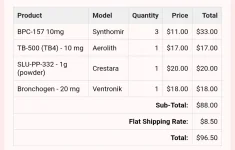
Has your martial arts school managed to perfect the art of making the vendors accidentally deliver the wrong product? Very Sun Tzu-esque of you. And the vendors are Chinese, so it fits. With that luck of yours, you should head to Vegas; pole-dancers will find themselves falling from broken poles straight onto your lapI ordered KPV from HKMS and they accidentally sent me two kits of DSIP. They replaced the KPV and I am super satisfied LOL.
Neptide
GLP-1 Apprentice
Absolutely 👍. It really does depend on the peptide. The key, I suppose, is to find the right approach/protocol to cycling on and off.I guess the less is more depends on the peptide itself. Those that have impact on receptors for sure could be impacted by increased and ongoing use, as over time that impact will diminish. There are others that don’t impact receptors as part of use and those probably can be used long term or in higher reasonable doses.
lessthanhalf
GLP-1 Specialist
I looked it up as I have not read much about liposuction and vaguely remembered people tend to regain the weight removed. It is not quite as clear cut as that but at least 50% do regain a lot of the removed weight, just somewhere else. And it can improve blood test biomarkers that originate from fat cells, but the effect is not long term, and there seem to be very few long term studies on it. So I don't think you can just suck out all the fat cells depleted or not and get rid of the unhelpful signalling.As mentioned by others earlier, I think that even if the adipose tissue loses all its cytoplasm, the shells remain metabolically active. What do you reckon? Would people who do liposuction AFTER the weight loss- removing what's left, fare better in this regard? I have been doing research on leptin resistance for a long time, albeit secondary. The logical state of this context hits my brain too harshly to ignore.
The problem with leptin and ghrelin, etc, is that research on appetite and weight regulation discovers more and more systems and neurotransmitters and hormones and micro rnas continuously , as well as ever more complex brain circuitry controlling them, and while parts of the system are understood, I don't really think it can be said to be known yet what goes on to control weight , appetite and eating. I saw a paper recently trying to compare 4 different fundamental principles the system might work on, weight set point theory etc, and they really cannot even answer that question yet. And current knowledge would be a very large page of different systems , chemicals, cells , interactions and feedback loops with hundreds of components.

I've read a little about it. Supposedly the fat cells that are removed don't come back but the ones that are left can become larger. I was curious. I heard its very painful though, so prob not worth it!!I looked it up as I have not read much about liposuction and vaguely remembered people tend to regain the weight removed. It is not quite as clear cut as that but at least 50% do regain a lot of the removed weight, just somewhere else. And it can improve blood test biomarkers that originate from fat cells, but the effect is not long term, and there seem to be very few long term studies on it. So I don't think you can just suck out all the fat cells depleted or not and get rid of the unhelpful signalling.
The problem with leptin and ghrelin, etc, is that research on appetite and weight regulation discovers more and more systems and neurotransmitters and hormones and micro rnas continuously , as well as ever more complex brain circuitry controlling them, and while parts of the system are understood, I don't really think it can be said to be known yet what goes on to control weight , appetite and eating. I saw a paper recently trying to compare 4 different fundamental principles the system might work on, weight set point theory etc, and they really cannot even answer that question yet. And current knowledge would be a very large page of different systems , chemicals, cells , interactions and feedback loops with hundreds of components.

thats why I am using Adipotide and AOD before I get on Tesa while on Reta.Supposedly the fat cells that are removed don't come back but the ones that are left can become larger.

myopicmystic
GLP-1 Apprentice
I am indecisive on adding too much. Still just on tirz for now.
I’m interested in doing a mitochondrial protocol at least once. I also want to try a cycle of KLOW. Semax and selank also have my eye.
But I’m not sure if that’s the hyper fixation talking or if it’s transferring over from whatever addictive habits I had with food. So I’ll sit on it until I sort out which one it is.
I’m interested in doing a mitochondrial protocol at least once. I also want to try a cycle of KLOW. Semax and selank also have my eye.
But I’m not sure if that’s the hyper fixation talking or if it’s transferring over from whatever addictive habits I had with food. So I’ll sit on it until I sort out which one it is.

LongevitybroTX
GLP-1 Apprentice
That's been my problem too, I'm curious to try quite a few things, but am also the type that wants to know anything and everything about each one, and not stack too much at any given time as I want to be able to know what's not working well for me. Also, shit adds up fast $$! ha!I am indecisive on adding too much. Still just on tirz for now.
I’m interested in doing a mitochondrial protocol at least once. I also want to try a cycle of KLOW. Semax and selank also have my eye.
But I’m not sure if that’s the hyper fixation talking or if it’s transferring over from whatever addictive habits I had with food. So I’ll sit on it until I sort out which one it is.
Geez! With a shot-stack like that, it's a wonder you have a sack to chew on.It only started as one pin a week. Now it is 6 pins daily. Let's just say the stack has grown. It is like the movie Groundhog Day. Switch 80% of them to Glutes. Belly was getting tender and lumpy.
GHK-cu ( 6 months)
Tesamorelin ( Until I can see a shadow of my Kidney)
5-Amino-1mq ( 30 days) 2-week break
AOD-9604 ( 60 days) 2-week break
SS-31 ( 30 days) then MOTS-c ( every other day)
KPV (Everyday)
Tirz (Once a week)
To a regular person, I would look like a psycho, but to you guys and girls, just another day at the office.
Forget it. It doesn't work.AOD? I want to try it
I'm with you. Let's start our own group...The Leftouts.Need to learn GB's. I feel left out.
Na, the best way to take it is to forget about it.AOD. I’m going to try it. Seems from what I hear, the best way is to take it fasted and then go to the gym
There is.. CharitAx-500. You keep sending 500usd to me everytime your hunger to order more kits takes over. It's a guaranteed cure.I'm hoping someone will develop a peptide that curbs my appetite to order more kits. I'd buy 10 kits of a peptide like this.


