YesI have a vial of reta 30 that was reconstituted 10 weeks ago and has sat in the refrigerator undisturbed for all that time. It is crystal clear--no floaters, etc. Would you still use it?
I really appreciate the detailed reply. My instinct is to get rid of it and you just confirmed it.No one can tell you how much active Reta remains after 10 weeks. Based on the results of some experiments, it is more likely between 40% and 60%. The problem is not so much the loss of activity, but rather that no one knows what the degradation products consist of, what their biological effects are, or whether they are capable of triggering an immune response.
It is unlikely that bacterial contamination significant enough to form a biofilm has occurred. This depends on whether you followed proper aseptic techniques during reconstitution.
Keep in mind that none of this will be visible to the naked eye.
A quick and simple test is to check the pH by placing one or two drops on a test strip. If the pH is below 5 or above 8, you can discard it. Around 5.5 - 6, it’s worth a try.
If I were to try it, I’d start with a small dose of a few units (less than 0.05 ml, or 5 u) to check for any reaction at the injection site within 24 hours. If that’s okay, gradually increase to a higher dose. Keep a phone nearby to call emergency services, or better yet, someone with an EpiPen.
But since I pay between $15 and $30 for my vials depending on the quantity, I wouldn’t risk my life for so little.

As a geezer-in-training, I would never!Yeah, I totally read the thread title as a question about us Geezers.🤣 I was prepared to defend the no age limit for glp line!
haha, me too!Yeah, I totally read the thread title as a question about us Geezers.🤣 I was prepared to defend the no age limit for glp line!
Yes though probably degraded about 10 to 15 percent. Just adjust dose for the degradation.I have a vial of reta 30 that was reconstituted 10 weeks ago and has sat in the refrigerator undisturbed for all that time. It is crystal clear--no floaters, etc. Would you still use it?
It was given to me reconstituted so I doubt it was filtered or anything. I keep looking at it but will probably get rid of it.10 weeks is generally my limit. Had I reconstituted it, I likely use it. It also depends how big the vial is.
Me personally would pin it.It was given to me reconstituted so I doubt it was filtered or anything. I keep looking at it but will probably get rid of it.
By someone you know?It was given to me reconstituted so I doubt it was filtered or anything. I keep looking at it but will probably get rid of it.
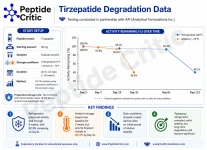
Nice. That is some good info.I know it's not Reta, but this reconstituted Tirz testing was done last month.
Not directly. A friend of a friend.By someone you know?
I would probably not put too much stock into testing conducted by AFI. Thankfully other testing done by more reputable labs in the past actually shows much better results than this for tirz.I know it's not Reta, but this reconstituted Tirz testing was done last month.
or Peptide Critic. He had a couple of good educational videos and then fell off into chasing clicks undermining any good he had accomplished.I would probably not put too much stock into testing conducted by AFI.
The 503A/B compounders are a whole different thing with 503B having tested stability (I assume with some sort of preservative) out to one year - hence their long BUD date...but again, we're not talking Reta. Regarding the 28 day rule once those sealed vials have been pierced...that's all about sterility of introducing air and whatnot every time you draw from the vial. Many are comfortable going well beyond the 28 days with 503A/B as long as it's crystal clear. For self-reconstituted grey, 28 days is 5 draws...maybe stretch out a couple of weeks to 7 draws...but that's about as far as I personally want to take it.Before gray I bought from compounding pharmacies. I'd normally get a 90 day supply and each vial had an expiration date of 90 days from compounding. I don't understand why some people say 28 days. One time I got a six month supply (of either sema or tirz, I don't remember.) Yes, I know reta has been tested to degrade faster, but that's it, degrade.
So I used a vial reconstuted 6 months before (by a compounding pharmacy.) It was clear so I used it.
Compounding pharmacies are way more sterile than what us gray people do, so there is that.
If it's still sterile, I'd say no problem going as long as it takes, maybe just add a bit more.
I've seen the results of culture testing and I wonder what kind of sterile conditions the vial was in.
So, I'm on the side of "if it's still clear, it possibly may still be good" (but I'm cheap and don't want to waste it.)
What are people's thoughts on filtering into a pen cartridge and priming to remove air in terms of longer stability? Curious if a study has been done (or a study using a reconned vial under vacuum). If the puncturing and introducing air is one of the issues that causes degradation and/or lowering of sterility, in theory, if you minimize those factors you minimize the loss as well. If I vacuum seal food, it says good longer; would the same apply to a peptide?Regarding the 28 day rule once those sealed vials have been pierced...that's all about sterility of introducing air and whatnot every time you draw from the vial.
The compounding pharmacies are also selling tirzepatide which holds up very well for months with negligible degradation in tests of both their products and gray market tirz.The 503A/B compounders are a whole different thing with 503B having tested stability (I assume with some sort of preservative) out to one year - hence their long BUD date...but again, we're not talking Reta. Regarding the 28 day rule once those sealed vials have been pierced...that's all about sterility of introducing air and whatnot every time you draw from the vial. Many are comfortable going well beyond the 28 days with 503A/B as long as it's crystal clear. For self-reconstituted grey, 28 days is 5 draws...maybe stretch out a couple of weeks to 7 draws...but that's about as far as I personally want to take it.