Storage talk, supply anxiety, and realizing I may only be halfway there a rambling I invite fellow autists to join. Chapter 1 seeking perfect storage

Notafed

GLP-1 Apprentice
Member Since
Aug 1, 2025
Posts
49
Likes Received
127
Location
California
United-States
Another one of those long posts I have to write, but recommend you don't read. If you do discuss your storage setup in the comments.

Hey it's your friendly neighbor not a federal agent. So, much has happened with life, but you didn't ask so I'll get straight to my rambling you also didn't ask for's main topic. Storage. First, if you have a few grand in peptides, I think it is ridiculous not to be anal about the longevity of your investment. So, whether you assume these peptides are bullet proof or fragile I would in either case give them the best home possible and that means taking a look at 3 things temp, temp fluctlation, and humidity.

Full disclaimer my definitely not federal work has nothing to do with medicine so I know as much as someone who has "done there own research" I don't read peer reviewed studies I read this forum, watch YouTube videos, and graduated college without AI writing my essays, and occasionally get the tism and go down Google search rabbit holes. That's all I got going for me and a life full of lead and micro plastic's going against me. So, if I say something wrong correct me, and we can hopefully all have civil discussions.

So, with that out of the way temperature. The debate. Talk on the streets is just a generic don't put these in a hot garage or next to the heater combined with the general room temp < fridge < freezer. The point against being anal is the Janoshik talk and the anecdotal evidence he provided in that he tested a peptide with minimum degration that had been forgotten about in his garage for years so if you do want to be haphazard we have some justification it's okay, but that peptide wasn't sema/tirz/Reta and we don't know truly how fragile they will prove to be in the long term. I think we have seen in testing, later tests of a batch generally do worse in purity which effects yield. I lean towards these are fragile maybe not enough to worry shaking during reconstitution (but why risk), but they do/will degrade and depending on which factory in China and the lyophilization process more or less. The closest to an official medical answer is this if you can store in a freezer at -40 freedom units do so. It's the best environment.

So, the solution is a medical freezer, except those are expensive, often small. The better solution and compromise. Amazon has some chest freezers labeled as ultra low/ super low usually with the term "upgraded compressor" and these freezers go down to -40 freedom degree's. Multiple people multiple names/sellers I assume one factory in China. This is the freezer I got and temp guns show this thing really does get down to those low temps. Anyone who stockpiles and can reasonably afford one of these should get one IMHO. It's working for me. Now I wish this was me trying to sell you these freezers and I would go through the work, but I don't have the room in my garage to start out as an Amazon reseller selling freezers if I did I would have added a link to my post. That's all I have to convince you of my lack of personal gain bias. Anyways if you consider yourself serious I would consider one of these.

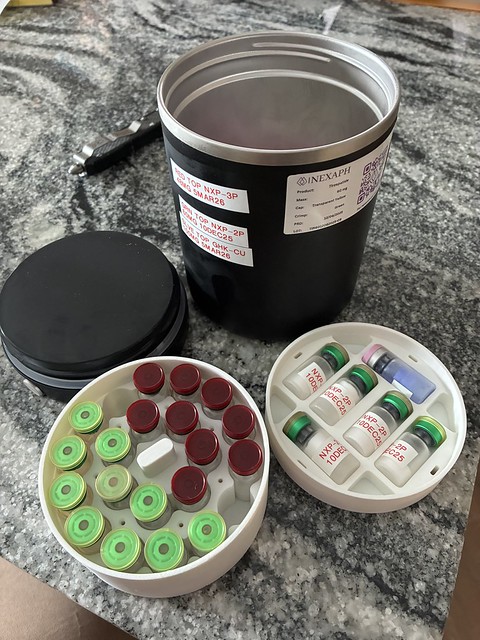
Two temp fluctlation. Chest freezers don't usually cycle I don't believe the Amazon ones do as I am getting ice buildup. Still temp fluctlation is not a good idea for long term storage and you may not want or have the space for a deep freezer. My next point is this the 3d printed storage cases and original packaging are not long term storage's best answer. The best most available easy storage is to get Hydrapeak 32oz food jars. You can buy or 3d print storage trays that can go in them and get 68 3ml vials to a jar I think this is pretty good. There not to big you can get them in multiple colors there pretty peak. This is my recommendation, but really any thermos is better than those 3d print storage cases. If you have to use a different freezer with thawing cycles a thermos is extra important. The 3d cases are fun trust me I had them as my storage backbone for awhile but they don't do essentially anything to prevent thermal transfer. And they let in one last problem.

Humidity. Lyophilization for anyone who didn't know is freeze drying. Freezers build up ice for a reason, bring in thawing and those caps and crimps don't strike me as infinitly impermeable. Humidity getting to the pucks will degrade them. Back to the 3dcases I was noticing even if light a frost buildup inside them and on the vials. Thier often tpu ring around the seal is not a real seal stop pretending. The solution here again is one a thermos/ the hydrapeak and two 3d printed 3ml vial sized silica gel holders. See print here https://makerworld.com/en/models/1378681-3ml-vial-sized-desiccant-jar-v2#profileId-1426649. I think if you can get some silica gel pretty cheap and add a few of these to your sealed thermos you will be doing well for yourself.

In conclusion especially for those who have put real money into hoarding, think of the peace of mind that comes pretty cheaply I might add with just a thermos and some desecant. You don't got to do it my way even if it is superior to all others /s (but only the attitude). My point here is take pride in your work if your a researcher and not just some junky whether you do this because you can't afford alternatives or not prove yourself an intelligent person. Just a used thermos and desecant in a freezer is decent insurance and added longevity and a lot better than just a fridge hoard. If you feel called out think about it a little harder. Add in a -40 degree freezer that while small is affordable for what it provides and still big enough for probably dozens of hydrapeaks and therefore 1000+ vials and you have something I think a doctor scientist would say is the best storage you can provide as a normie that is 99% as good as a lab freezer environment. I will make more too long posts now please discuss.

View: https://youtu.be/vz51ymeEqsU

This guy is pretty cool he is mostly just selling stuff for rookie pricing, but I don't think he is a bad dude and his community seems about as nice as ours here. Covers some of what I talked about.
 
Last edited:
Out of curiosity, what is your reasoning behind choosing -40F rather than just 0F? The latter is certainly easier to come by, cheaper, lower energy to maintain, etc.

One downside I could imagine to using the popular thermo-style containers is that they typically require transferring the vial from their original kits to containers of some sorts. For a small number of kits, this is probably just fine, but for a larger number, you do introduce the risk of human error here. What I mean by that is that by keeping in the original kits (perhaps with printed CoAs handy or details written on the kits themselves), the only potential for mixing up products would be if the vendor or someone upstream from you mixed them up. Once you start moving vials from one containers to another, you introduce the potential additional human error to occur. This is going to be especially true for containers holding odd numbers of vials where a kit will be split between two different containers or a container might contains vials from two different kits (or even worse two different batches).

30 years in the future (the point at which ultra-preservation might start to pay off VS standard preservation techniques), after your kids help you move the freezer from your house to the senior housing apartment you just moved into, you may no longer remember that the pink tops are the 20mg vials at the green tops are the 5mg vials and you may no longer remember how to look that up, since after Facebook merged with Snapchat and acquired Google in 2040, the direct link to your Google sheet with that info stopped working and your kids were too busy farming in the metaverse to make time to help you figure out how to AI-sync your legacy Google account with your Zuck profile. This will be especially frustrating for you, if we happen to be neighbors at that point and I'm saying "you know sonny, that's why I just kept using the original kits and wrote what was in each one on the top of the kit." And then when I see the deflated expression on your face, I offer to buy you a beer to cheer you back up.
 
Out of curiosity, what is your reasoning behind choosing -40F rather than just 0F? The latter is certainly easier to come by, cheaper, lower energy to maintain, etc.

One downside I could imagine to using the popular thermo-style containers is that they typically require transferring the vial from their original kits to containers of some sorts. For a small number of kits, this is probably just fine, but for a larger number, you do introduce the risk of human error here. What I mean by that is that by keeping in the original kits (perhaps with printed CoAs handy or details written on the kits themselves), the only potential for mixing up products would be if the vendor or someone upstream from you mixed them up. Once you start moving vials from one containers to another, you introduce the potential additional human error to occur. This is going to be especially true for containers holding odd numbers of vials where a kit will be split between two different containers or a container might contains vials from two different kits (or even worse two different batches).

30 years in the future (the point at which ultra-preservation might start to pay off VS standard preservation techniques), after your kids help you move the freezer from your house to the senior housing apartment you just moved into, you may no longer remember that the pink tops are the 20mg vials at the green tops are the 5mg vials and you may no longer remember how to look that up, since after Facebook merged with Snapchat and acquired Google in 2040, the direct link to your Google sheet with that info stopped working and your kids were too busy farming in the metaverse to make time to help you figure out how to AI-sync your legacy Google account with your Zuck profile. This will be especially frustrating for you, if we happen to be neighbors at that point and I'm saying "you know sonny, that's why I just kept using the original kits and wrote what was in each one on the top of the kit." And then when I see the deflated expression on your face, I offer to buy you a beer to cheer you back up.
A lot of assumptions in this post, but going down the list. Via the power of a nelko p21 (nimbot knockoff) all my vials have been labeled. The labels include type and yield and even include little qr codes to their coa reports. Those qr codes may break one day, but everything I need to know is already on the vial. So, sadly no cheer up beer. Again and this is part autism I simply believe once you cross a line of a few grand in peptides you should be offering your stash the best possible storage.

The reason for -40 freedom units is because the corporate paid research side of science says at least -20 freedom units is preferred with even colder being better. https://www.sigmaaldrich.com/US/en/...pmental-biology-research/handling-and-storage

If someone posts here there -80 freedom units freezer I'll bow down and admit defeat, but I'll also be certain they will have paid more in both acquisition and upkeep. I feel the Amazon freezer is a very affordable, practical, cost to benfit play.

If I was stuck with a medical grade low temp freezer the electricty could be expensive, but the Amazon special while I did not track my electricity before and after is obviously not significantly raised my energy bills and can still function as a deep freezer for frozen foods. Thank it's dual purpose as a product advertised to normies and the extreme efficiency of chest freezers and heat pumps.
View: https://youtu.be/CGAhWgkKlHI


The truth is we don't know if these glp / incretin hormone memetics are stable long term. Retatrutide in particular seems to have a lot of failed reconsution I see on reddit. I expect human error, but the peptide could be less ressilant. If there like the hgh in Janoshik garage then it may be overkill. But plenty of peptides suffer degradation just from heavy vibration (this is overstated by sellers as an easy cop out).

Long term storage is not something recommended or done in real research settings. We're going outside the norm of storage length and it could be like 28 day rules and be a practical nothing burger or in 5 years time those with fridge setups and freezers with cycles and no thermos might start posting about their ineffective vials and or showing off pucks that were exposed to moisture asking "is this safe to use".
On the origins of glp's
View: https://youtu.be/9dMpY-ZALXc


Science is forcing these peptides to avoid being broken down for nearly a week in our body's. This is only because they are much larger and harder to filter in out bodies than real incretin hormones. I don't find it hard to believe that even if recognizable and therefore not "degraded" in an assy beyond a few percent we won't see faster breakdown and therefore less effectiveness from peptides that have been in storage for a year plus. Beyond this we already have seen degradation of a real amount in just a few weeks or months when testing is later than the initial testing.

I believe most everyone should hesitate to go beyond even 5 years supply and suspect that anyone keeping there peptides in a fridge will see issues before that time is up and those with regular frost freezers and no insulation provided the same. Those with regular grade freezers and thermoses will probably see mostly the same efficacy as me, but if degradation is an exponential process then the gap might widen and be a concern in a few years time.

Ultimately if you knew me irl I usually only takes bets I am okay with losing. I'll bet we're not getting off work early because if we do I am happy to lose. If my side of things proves overkill it was just that, if I am right however a lot of people will be out a lot of money then I spent on 20 dollar thermos, 10 dollars for a lifetime of descant, and a little over 200 something for a chest freezer that I get to use for food as well.
 
Last edited:
A lot of assumptions in this post, but going down the list. Via the power of a nelko p21 (nimbot knockoff) all my vials have been labeled. The labels include type and yield and even include little qr codes to their coa reports.
Nice! That sounds like a pretty fool-proof approach there. You might lose per-kit segregation there (since in theory a vendor could ship you two different kits from two different batches without you knowing), but obviously you could print that on the vial too and at that point it's probably overkill.

The reason for -40 freedom units is because the corporate paid research side of science says at least -20 freedom units is preferred with even colder being better.
Interesting link, but that seems to be based on best practices for vials that researchers are regularly opening and resealing VS set and forget and (at least partially) based on reducing the risk of oxidation of certain amino acids, at which point vacuum integrity would seem to be the more important factor in avoiding. If oxygen can get into the vials then weaker amino acids can oxidize over time, with that rate presumably being reduced as temperature goes down.

I agree with you that when you get down to -80F, capacity becomes more limited and the equipment becomes more specialized. If you are employing techniques to get peptide lifespan over a decade, you may be shooting yourself in the foot if it turns out the freezer itself struggles to last a decade, as an example.

Science is forcing these peptides to avoid being broken down for nearly a week in our body's.
That's kind of a separate thing. It's not that the peptides themselves degrade in your blood or at human temperatures, but rather that your body itself intentionally breaks them down or expels them over time. For comparison brand name Mounjaro can sit out at room temperature for a month and still be used (per the manufacturer). It's certainly going to degrade over time in your body, but that degradation is going to be negligible relative to your body itself attacking it naturally.

Ultimately if you knew me irl I usually only takes bets I am okay with losing.
Same here. And I'm not criticizing your decisions here. I'm just exploring the progression that led to them.

In my mind, there are a handful of different considerations that could all prove important in regards to longer-term storage. It's not clear to me which ones matter the most.

For example, if a 0F freezer ends up being more reliable or easier to replace when it fails, that potentially could be a consideration (VS a -80F freezer). Your -40F probably could be replaced in a reasonable amount of time too.

(Hopefully) most of the vials will maintain their vacuum the entire time and under those conditions, light (which is eliminated already) and temperature fluctuations in my estimation would be the biggest stressors when it comes to fragile molecules. The use of a thermos (although one could just as easily use a larger high quality cooler to accomplish the same effect) help accomplish that goal during periods of power outage. In general, the rate of heat transfer will always be proportional to delta T during a longer-term power outage, which is to say the larger the delta T (for similarly insulated structures), the more rapid the temperature change during that period. That is to say that if someone had the option to replace a -80F freezer with a -160F freezer, doing so could actually be undesirable. This also applies when a vial is eventually removed from the thermos, although that's generally a one-time event and it seems doubtful to me worthy of significant consideration.

To the extent some vials lose their vacuum, desiccants could help avoid moisture creeping in (if you live in a humid environment), but won't protect against oxygen creeping in. Vacuum sealing and/or the use of freezer bags could actually be useful from that perspective. That could be inside of the thermos/cooler, or you could place the thermos itself inside of a vacuum sealed or freezer bag to partially reduce the amount of oxygen available to degrade vials with imperfect seals.

Speaking of seals, the thermal expansion coefficients for rubber VS glass will generally be different, meaning lower temperatures could affect the integrity of those seals, making vacuum more likely to fail. This can play out in surprising ways. If rubber shrinks more than glass at low temperatures, that would be an obvious failure risk in that a small gap could form between the rubber and the glass. If the opposite is true you would think that would avoid the risk, but it could also put strain on the glass, possibly fracturing it. Even if the glass isn't fractured, rubber is generally going to become more hard and rigid as it cools, which means it could be compressed smaller on the trip down to a lower temperature (which is fine). But on the trip back up to a higher temperature, that could compromise the vacuum as both materials expand, but the rubber isn't malleable enough to keep up with the glass expansion rate until a certain temperature is reached. That's all theoretical and I haven't explored if it's been studied, but it's an angle I might hit if I was trying to be thorough, as that could cause very low temperatures to actually be detrimental.

Honestly your approach is probably just fine, but thought it could be fun to unpack some of these points a bit.
 
Last edited:
A lot of assumptions in this post, but going down the list. Via the power of a nelko p21 (nimbot knockoff) all my vials have been labeled. The labels include type and yield and even include little qr codes to their coa reports. Those qr codes may break one day, but everything I need to know is already on the vial. So, sadly no cheer up beer. Again and this is part autism I simply believe once you cross a line of a few grand in peptides you should be offering your stash the best possible storage.

The reason for -40 freedom units is because the corporate paid research side of science says at least -20 freedom units is preferred with even colder being better. https://www.sigmaaldrich.com/US/en/...pmental-biology-research/handling-and-storage

If someone posts here there -80 freedom units freezer I'll bow down and admit defeat, but I'll also be certain they will have paid more in both acquisition and upkeep. I feel the Amazon freezer is a very affordable, practical, cost to benfit play.

If I was stuck with a medical grade low temp freezer the electricty could be expensive, but the Amazon special while I did not track my electricity before and after is obviously not significantly raised my energy bills and can still function as a deep freezer for frozen foods. Thank it's dual purpose as a product advertised to normies and the extreme efficiency of chest freezers and heat pumps.
View: https://youtu.be/CGAhWgkKlHI


The truth is we don't know if these glp / incretin hormone memetics are stable long term. Retatrutide in particular seems to have a lot of failed reconsution I see on reddit. I expect human error, but the peptide could be less ressilant. If there like the hgh in Janoshik garage then it may be overkill. But plenty of peptides suffer degradation just from heavy vibration (this is overstated by sellers as an easy cop out).

Long term storage is not something recommended or done in real research settings. We're going outside the norm of storage length and it could be like 28 day rules and be a practical nothing burger or in 5 years time those with fridge setups and freezers with cycles and no thermos might start posting about their ineffective vials and or showing off pucks that were exposed to moisture asking "is this safe to use".
On the origins of glp's
View: https://youtu.be/9dMpY-ZALXc


Science is forcing these peptides to avoid being broken down for nearly a week in our body's. This is only because they are much larger and harder to filter in out bodies than real incretin hormones. I don't find it hard to believe that even if recognizable and therefore not "degraded" in an assy beyond a few percent we won't see faster breakdown and therefore less effectiveness from peptides that have been in storage for a year plus. Beyond this we already have seen degradation of a real amount in just a few weeks or months when testing is later than the initial testing.

I believe most everyone should hesitate to go beyond even 5 years supply and suspect that anyone keeping there peptides in a fridge will see issues before that time is up and those with regular frost freezers and no insulation provided the same. Those with regular grade freezers and thermoses will probably see mostly the same efficacy as me, but if degradation is an exponential process then the gap might widen and be a concern in a few years time.

Ultimately if you knew me irl I usually only takes bets I am okay with losing. I'll bet we're not getting off work early because if we do I am happy to lose. If my side of things proves overkill it was just that, if I am right however a lot of people will be out a lot of money then I spent on 20 dollar thermos, 10 dollars for a lifetime of descant, and a little over 200 something for a chest freezer that I get to use for food as well.
Nervous The Big Bang Theory GIF
 
What I mean by that is that by keeping in the original kits (perhaps with printed CoAs handy or details written on the kits themselves), the only potential for mixing up products would be if the vendor or someone upstream from you mixed them up. Once you start moving vials from one containers to another, you introduce the potential additional human error to occur.
Peel off your labels from the kit, affix to the Hydrapeak. Nexaph wins in this department; product name, mass, cap, crimp, date and Lot # all right on the label. P-Touch for the individual vials for added ease of identification.

Plus, free Staph in many vials, no extra charge!


Trending Topics

Forum Statistics

Threads
18,078
Posts
188,333
Members
60,620
Newest
Aw44
Back
Top Bottom