SURMOUNT-4: Weight regain despite continuing lifestyle and diet modifications

BioDad

GLP-1 Apprentice
Member Since
Sep 23, 2025
Posts
41
Likes Received
104
Location
Baltimore, MD
United-States
I'm not sure if this study was posted here yet, but the long and short of it is...

Obese adults did 36 weeks of tirzepatide + lifestyle modification (500 kcal/day deficit + ≥150 min/wk activity). After 36 weeks, the group was randomized and split into a tirzepatide group and a placebo group, which is just evil, for 52 weeks.

Despite remaining on the lifestyle interventions, in the placebo group, 82.5% regained ≥25% of the weight they had lost within 1 year, and cardiometabolic improvements (waist, BP, glycemic markers, lipids/insulin resistance) reversed in proportion to the amount of weight regained.

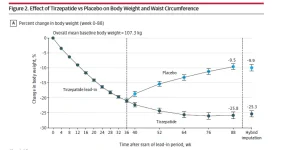
Worth a read and at the very least, a peek at the graphs - the 36 week divergence in weight is significant.

 
It's really not shocking. If you stop cholesterol meds but still maintain good lifestyle choices, your cholesterol will still creep back up as well.

That poor placebo group probably thought they were going crazy with returning food noise and "just a little bit" justification snacking.
Amen! But I’ll bet it was ALOT of food noise roaring back. I think I’d know in just a few days if I was in the placebo group bc the noise would be back. I wonder how that effects trials like this one.
 
That's the exact result I'd expect, if I'm being honest.

Had the "lifestyle" intervention been sufficient to converge at a BMI of 25 (or whatever target one chose) then there would have been no need for the drug in the first place. The problem is that the primary lifestyle driver chosen was simple calorie-restriction. That's obviously going to break down when you take away the drug that enables easy calorie-restriction.
 
Clearly, "remaining on the lifestyle interventions" was a lie. If someone could explain to me how someone could gain weight in a 500-calorie deficit and 150+ minutes a week of cardio, I would appreciate it.
 
Clearly, "remaining on the lifestyle interventions" was a lie. If someone could explain to me how someone could gain weight in a 500-calorie deficit and 150+ minutes a week of cardio, I would appreciate it.
Lying or failing is the more common reasons, but there are people out there who gain weight on what they believe to be a 500-calorie deficit. The problem with using "calorie deficit" as a metric is that you don't know if you're in an actual deficit until after the fact. If you lose weight then by definition it was a deficit. If you don't lose weight then by definition it was not. "Calories out" is a moving target.
 
A similar study is currently ongoing with Reta, the only difference is subjects receive the drug for 80 weeks, follow by 26 weeks of either placebo or drug…
I expect a very similar outcome on this one 🙁
 
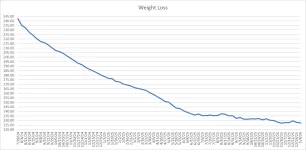
I have tried every diet there is and always gained the weight back. So, it's not a surprise to me. On the other hand, here is what my weight loss and maintenance looks like 75 weeks in. I think I'll stick with the medicine for the rest of my life, thank you very much.1767561369994.png
 
Worth a read and at the very least, a peek at the graphs - the 36 week divergence in weight is significant.


Thanks for sharing. This recent article is actually not the SURMONT-4 clinical trial results, which were published back at the end of 2023. This new article is a post hoc analysis using the Surmont-4 data trying to tease out the cardiovascular parameter changes based on weight-regain after stopping tirzepatide.

To me, this figure from Surmont-4 study always suggested a weight regain after stopping tirzepatide, so nothing surprising when folks stop treatment that weight gain would occur.

The big takeaway for me with this new study is that that cardiovascular benefits persist for a certain group of individuals even after stopping treatment. So that the weight gain is not homogeneous across the non-treatment group. A significant portion (~20%) regained less than 25% of the excess weight loss.

1767570642438.png
 
I like that graph a lot , very clear signal about what happens when it is stopped, and a strong argument for staying on glp-1 agonists for maintenance. But even for those who stopped there are still significant benefits in terms of weight and long term risks. Before these medications were available research would talk about the metabolic and risk benefits of 5-10% weight loss, and that those benefits were still significant.
 
I think it’s important to point out that people with diabetes are excluded from this post hoc analysis. It seems almost cruel that this study included a randomization after successful treatment and weight loss to placebo or continued Tirzapeptide. It’s a very effective argument by the drug companies that obese individuals without diabetes need to continue to stay on the meds or risk regaining weight and loosing cardio metabolic benefits. Sadly, I don’t think that it will convince insurance companies to continue paying for these expensive medications for individuals who can no longer be considered obese.
 
It seems almost cruel that this study included a randomization after successful treatment and weight loss to placebo or continued Tirzapeptide.

Yeah, it’s does seem kind of cruel to take participants off treatment, especially in later stage clinical trials when researchers actually know that the medication is safe and effective. But we all benefit from the knowledge from these studies and participants know about the placebo arms of these studies before they agree to participate. But it still must suck. Can you imagine being on trizepatide for 9 months and then being yanked off and being expected to continue in the study for another year….
 
There are alternatives to staying on GLP-1 for life, such as moving to Contrave after stopping GLP-1. One university also found that non-diabetics are able to keep the weight off by moving to metformin after stopping the GLP-1.

It isn't in Lilly's or Novo's interest to help people find alternative drugs so that they can stop using GLP-1s forever, but there are universities doing the studies showing that there are alternatives that work.

For now, anyone who maybe can't afford to stay on the GLP-1 forever, or has some other reason to not take it, can look at the non-Lilly and non-Novo studies.
 
does seem kind of cruel to take participants off treatment
I assume this is for participants who've completed a full run of a study, rather than getting yanked early.

Their alternatives to this free placebo-randomized study might be to pay >$$$$$/month cash, or possibly a very high monthly insurance co-pay, or in most cases complete insurance coverage denial and discontinuation.

I don't think clinical trials offer anything to their participants post-graduation...???
 
I assume this is for participants who've completed a full run of a study, rather than getting yanked early.

Their alternatives to this free placebo-randomized study might be to pay >$$$$$/month cash, or possibly a very high monthly insurance co-pay, or in most cases complete insurance coverage denial and discontinuation.

I don't think clinical trials offer anything to their participants post-graduation...???

From a research perspective, I get the idea (especially in early stage clinical trials) that placebo arms are needed to test the intention-to-treat. But I guess for me, that is participants receving the placebo from the beginning of the study. Not putting participants on an amazing medication that's life changing for many people and then taking it away. But in the end, now that I think of it, everyone in the clinical study eventually is taken off the medication. No free rides forever.

It brings up the proverbial question, is it better to have loved and lost than never to have loved at all. Now that I love tirzepatide, I don't want to lose it, so I just want to keep on lovin' 😆
 
I don't think clinical trials offer anything to their participants post-graduation...???
I think you are right. We've got a few people who were in clinical trials and said that nothing was offered or suggested as the trials ended. I think people would do much better if they had a plan ready for a possible eventuality that their insurance might stop paying for their GLP, or that they may no longer tolerate the GLP.

If not a different medication, then at least counseling or therapy.
 
Top Bottom