Weight gain after GLP use

drzoid614

GLP-1 Apprentice
Member Since
Jan 20, 2026
Posts
28
Likes Received
44
Location
british columbia
Canada
Has anybody experienced weight gain affer coming off tirz or reta?

Just wondering what it looks like for people if you decide to come off these GLPs after being on them for a long time. I.e a year? Especially if you are not obese and just trying to reach a healthier BMI.

Please let me know your experiences !
 
The group of people your asking about are probably those who would be most successful transitioning off glp-1 treatment. People who weren’t obese or metabolically challenged before treatment were never the target population for these medications. So, there aren’t going to be any clinical studies examining long term outcomes for mildly overweight individuals after stopping gap-1 treatment. Any accounts will be purely anecdotal.

What we do know is that, in general, people regain weight after stopping treatment. That regain is probably more pronounced in people who were originally more metabolically challenged.

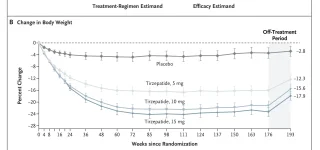
This is from one of the SURMOUNT studies. Treatment stopped at week 176.

IMG_0147.webp
 
I did 6 months a couple of years ago then stopped. I'd say for probably 8/9 months I maintained fairly well, but then a combo of Christmas and general life drama meant the weight started to creep back up. I totally knew I was eating unhealthily though, and probably could have stopped - but I was just in a poor headspace so didn't care.
 
My partner stopped a few weeks ago due to sides and he is reporting feeling ravenous in the mornings. He's clearly eating a lot more than he did when on the meds, and weight gain will be inevitable unless a change is made. I am fortunate to have only mild sides I can live with and plan to take the meds forever and ever and ever and ever and eeeeeverrrrrr.
 
I'm sure lots have... its best to stick to doing it for life especially with how cheap it is from China
Is it really best to stick with it for life? Wouldn't it be better to take advantage of the GLP-1 effects and adopt healthy eating habits?

It's probably easier said than done, but this is the approach I've been using. I'd like to hear people's opinions on it!
 
Is it really best to stick with it for life? Wouldn't it be better to take advantage of the GLP-1 effects and adopt healthy eating habits?

It's probably easier said than done, but this is the approach I've been using. I'd like to hear people's opinions on it!

I think the medical community has largely accepted that obesity is a medical condition rather than a character flaw correctable through diet, exercise, and behavior modification alone. For mildly overweight individuals who are not metabolically challenged, this approach may be sufficient—but those individuals likely never required a GLP-1 to begin with. In contrast, for individuals with true obesity, behavioral strategies alone are unlikely to permanently overcome underlying dysfunction in the mind–gut signaling system.
 
I did 6 months a couple of years ago then stopped. I'd say for probably 8/9 months I maintained fairly well, but then a combo of Christmas and general life drama meant the weight started to creep back up. I totally knew I was eating unhealthily though, and probably could have stopped - but I was just in a poor headspace so didn't care.
So did you have to start back up on it?
 
I think the medical community has largely accepted that obesity is a medical condition rather than a character flaw correctable through diet, exercise, and behavior modification alone. For mildly overweight individuals who are not metabolically challenged, this approach may be sufficient—but those individuals likely never required a GLP-1 to begin with. In contrast, for individuals with true obesity, behavioral strategies alone are unlikely to permanently overcome underlying dysfunction in the mind–gut signaling system.
Well said. I don't have experience or much practical knowledge of it, but mood stabilizing drugs like those for bipolar disorder or similar, come to mind. Get bad off, get on them... start doing better, compliance falls, mayhem ensues and the cycle repeats.

I don't think the same magnitude of deleterious effects are as likely with GLP drugs, and the slippery slope is perhaps easier to identify (behaviors lead the scale, the scale leads the visual cues) if you can keep a watchful eye on them. For me, regularly tracking scale weight is a great step towards ongoing compliance, the injections with the lack of sides are low friction at this point.

Depending on how my journey goes, I plan on titrating down on my dose, perhaps including time entirely off to see how my body does. I do expect old habits and dysregulation will present and likely require medical intervention to constrain long term, but I won't know to what extent until I get there. Receptor refresh during that time off may also be a thing to be able to regain regulation at a lower dose than was necessary before... this could also be a long term cycle towards whatever end presents itself in the data.
 
Is it really best to stick with it for life? Wouldn't it be better to take advantage of the GLP-1 effects and adopt healthy eating habits?

It's probably easier said than done, but this is the approach I've been using. I'd like to hear people's opinions on it!
No, it's not 'bad' to stick with it for life - this is not a moral equation with good and bad. Metabolic disfunction is a lifelong, chronic condition, these medications normalize metabolic function, and if you stop taking them the disfunction will return.
 
People don't really like the idea that mental effort is a finite resource, but there is quite a lot of good evidence that people just work that way, whether consciously or not.
So if maintaining a lower weight requires continuing mental effort , either restricting food intake when you are hungry or stressed or having to make yourself exercise, most people whether they like it or not eventually run out of that ability to make that constant effort. It cannot be a moral failing if that is just how people's brains work. It is not impossible to modify eating habits and exercise patterns in a way that does not take constant ongoing effort, but the reality is very few people succeed in losing significant amounts of weight long term, without long term interventions.
GLP drugs reduce appetite , make smaller amounts of food more filling so you do not need to eat as much and mess with reward circuitry in your brain to reduce desire for high calorie foods. The amount of effort required to have a once weekly injection is something that anyone can make long term, and is so low effort that you are not going to run out of motivation or ability to make the effort. So continuing to take glp medications is easy and you can maintain weight loss when you are taking them, but every bit of research on obesity ever shows when you stop the weight loss intervention, no matter how hard you try, almost everyone eventually regains the weight.
 
Well said. I don't have experience or much practical knowledge of it, but mood stabilizing drugs like those for bipolar disorder or similar, come to mind. Get bad off, get on them... start doing better, compliance falls, mayhem ensues and the cycle repeats.

I don't think the same magnitude of deleterious effects are as likely with GLP drugs, and the slippery slope is perhaps easier to identify (behaviors lead the scale, the scale leads the visual cues) if you can keep a watchful eye on them. For me, regularly tracking scale weight is a great step towards ongoing compliance, the injections with the lack of sides are low friction at this point.

Depending on how my journey goes, I plan on titrating down on my dose, perhaps including time entirely off to see how my body does. I do expect old habits and dysregulation will present and likely require medical intervention to constrain long term, but I won't know to what extent until I get there. Receptor refresh during that time off may also be a thing to be able to regain regulation at a lower dose than was necessary before... this could also be a long term cycle towards whatever end presents itself in the data.

I definitely think that some people will be able to stop glp1 treatment and not have a problem with weight regain or will regain weight slower and over a longer period of time. I also agree that changing underlying behaviors is vital to long term success. And I don’t want to give the impression that an obesity diagnosis is an excuse for making poor decisions regarding food choices.

I really don’t mean to come across so negative on the prospect of people being successful off these meds. There are definitely different levels of sickness when it comes to obesity, just like different types of mental illness. Mildly depressed people who start antidepressants in conjunction with therapy would have better luck getting of the meds than someone with severe bipolar disorder.

There are lots of people on glp1s who have been obese for a lifetime and have lost and regained significant weight over their lives. And there are people mildly overweight or mildly obese using these medications. Results transitioning off these medications will vary across these groups.
 
I agree. I was trying to illustrate another example when therapeutic success develops complacency which leads to poor compliance and the loss of that success… something that is frequently seen in the weight loss journey including my own.

For me, the first step in complacency has been to stop recording scale weight… the ideas fall from the mind, record keeping is lost, “oh it’s only 5lb” turns into a quick 30lb then “it doesn’t matter.” With GLP, it’s amazing how much easier control is vs a restrictive diet that is tough to maintain long term.


Yesterday I realized for the first time in my life I have to actually work at getting my macros/eating enough. I know that’s normal for some people and appreciate that has to be tough on them.
 
You really need to use the time you are on GLP's to work on all the things that got you to a place where you decided to start them.

Someone mentioned how this mimics the yo-yo effect mental health drugs can have.
Start drug-feel better-stop drug-feel bad-start drug
But for us it's
Start drug-loose weight-stop drug-gain weight-start drug.

In both situations, the goal of the medication is to help you address the causes of the problems, so that you may come to a place where you can live with out the medication.
So, use that time to work on yourself.
We all realize this is easier said than done, but it can be accomplished.
May not be the first time you stop the GLP, it may be the 3rd or 4th. But you will get there.

And if you have an underlying medical condition, it may be a life time drug. But, perhaps at a much lower dosage. And that is still an accomplishment
 
You really need to use the time you are on GLP's to work on all the things that got you to a place where you decided to start them.

Someone mentioned how this mimics the yo-yo effect mental health drugs can have.
Start drug-feel better-stop drug-feel bad-start drug
But for us it's
Start drug-loose weight-stop drug-gain weight-start drug.

In both situations, the goal of the medication is to help you address the causes of the problems, so that you may come to a place where you can live with out the medication.
So, use that time to work on yourself.
We all realize this is easier said than done, but it can be accomplished.
May not be the first time you stop the GLP, it may be the 3rd or 4th. But you will get there.

And if you have an underlying medical condition, it may be a life time drug. But, perhaps at a much lower dosage. And that is still an accomplishment


While it's not something I'm very familiar with, my point was the opposite... bipolar meds are almost always stopped due to lac of adherence, not because the doctor thinks the problem is fixed. Bipolar isn't a problem that can't be disciplined away.

T1 diabetics take insulin to manage their blood sugar, not treat the cause of their diabetes. Hypogonadal men take exogenous testosterone to treat their symptoms, not what caused their symptoms. Obesity/metabolic dysfunctions are probably a varied mix of lifestyle and biology, like T1 vs T2 diabetes.

Personally my goal with GLP drugs is to normalize or reduce my food noise and appetite so I don't have to fight that while trying to burn enough calories to offset its effect. My food noise and appetite has undoubtably been influenced by choices I've made as well as physiological differences that stacked the odds against me. While I'm open to the idea of a life without GLP intervention, it's not a primary goal nor something I have high hopes for. I do expect a reduced dosage over time, but that remains to be seen.
 
Is it really best to stick with it for life? Wouldn't it be better to take advantage of the GLP-1 effects and adopt healthy eating habits?

It's probably easier said than done, but this is the approach I've been using. I'd like to hear people's opinions on it!
Why not? It's a once every 5-7 days injection
 
Is it really best to stick with it for life? Wouldn't it be better to take advantage of the GLP-1 effects and adopt healthy eating habits?

It's probably easier said than done, but this is the approach I've been using. I'd like to hear people's opinions on it!
Thats definitely the goal! And what i am aiming to do! Im just curious about others experiences. As old habits can creep back in especially if appetite significantly increases again
 
The group of people your asking about are probably those who would be most successful transitioning off glp-1 treatment. People who weren’t obese or metabolically challenged before treatment were never the target population for these medications. So, there aren’t going to be any clinical studies examining long term outcomes for mildly overweight individuals after stopping gap-1 treatment. Any accounts will be purely anecdotal.

What we do know is that, in general, people regain weight after stopping treatment. That regain is probably more pronounced in people who were originally more metabolically challenged.

This is from one of the SURMOUNT studies. Treatment stopped at week 176.

View attachment 15285
About a pound per week regained in the study.

I set a benchmark weight for myself and only use a maintenance pep dose when I get above it. I don’t know if this is a good idea but even when I took a smaller dose only every 2 weeks, I continued to lose. I want to stay right where I am.
 
Thats definitely the goal! And what i am aiming to do! Im just curious about others experiences. As old habits can creep back in especially if appetite significantly increases again
We can definitely go back to our old habits, but I never thought about it from the perspective that Grogu and others mentioned. I guess it depends on how bad of a position you are in!

In my experience, GLP-1s have helped me develop the habit of eating two big meals a day. I'm basically doing intermittent fasting with no effort. They say you need to do the same thing for over 20 days to develop a habit. I think that might be true, but I was also in a somewhat "privileged position." I'm only 50 kg over my normal weight, and I'm also tall, which I've noticed allows me to go into a calorie deficit more easily (idk if this last thing makes sense but its what i feel like).
 
Thanks for sharing. When she started the video with: "Do you need to stay on GLPs for life? The answer is...it depends." I was in for the whole thing.

It's refreshing to see it acknowledged that we all are starting from a different place and might have varying requirements for health maintenance. Not many of the YouTube peptide bros seem to do that.
 
Not everyone is going to need glp-1 medications long term, those who are not severely overweight, or those who have a bmi of around 30 or so, but they are not really who they were designed for and outside the grey market , in the absence of medical complications of obesity , doctors would be reluctant to prescribe them for those patients.
Now , I did start off very overweight , but 3 years later I am eating more or less exactly the same number of calories per day that I ate to lose the weight, about 1600 to 1800 kcal per day. Initially I lost exactly 6 kilos per month, from 145 to about 90 to 95 kg, then weight loss gradually dropped to zero as i got to 75kg and weight stabilised until I started tirzepatide plus a bit of retatrutide and in the last 7 months have lost another 8 kg, which is slowing down to 100-200 grams a week. During all of this there was no change in calorie input.
When you are very overweight basal metabolic rate is higher from the excess fat mostly but there is usually a bit of extra muscle so you can still walk, but the main reason weight loss slowed to zero or near zero is metabolic adaptation to lowered calorie input. This process while much less extreme in those who lose less weight still occurs, and does not necessarily go away ever. So that maintaining that lowered weight requires less calorie input than would be average for someone of that weight and level of activity, and increased hunger that is directly proportional to the amount of weight lost. ( there is a really good study that shows this ) For nearly everyone, who has been overweight or obese and loses weight this combination causes weight regain, unless something is acting to stop it. The only things that work long term other than medical intervention is permanent diet changes or permanent increases in exercise, and in general people really are pretty bad at achieving those changes and keeping to them forever. In general if you were good at maintaining a healthy amount of exercise and had really good eating habits , you would not have gotten overweight. There is nothing at all wrong with tapering or attempting to stop glp medications at goal weight , so long as you restart them if needed and do not let weight regain get out of hand before restarting them. Unless you are older and have high absolute cardiovascular risks in which case taking them long term is a good idea regardless of effects on weight.
 
I have bounced back. I've put 75% of the weight back on in about 8 weeks. I dropped down to 7.5mg and then went to 0 though.

Have recently started on 2.5 again and now am looking at Grey. Haven't felt much on 2.5 yet though...
 
I have bounced back. I've put 75% of the weight back on in about 8 weeks. I dropped down to 7.5mg and then went to 0 though.

Have recently started on 2.5 again and now am looking at Grey. Haven't felt much on 2.5 yet though...
Can you say more about why you went to 0? I don't understand the urge to drop or stop (unless you're truly buying into the gross shame attempts of some folks) the medications that work so well to solve what (for me) was an otherwise impossible problem. Is it purely financial? I see that you're "looking at Grey" so perhaps it was an affordability problem, which would be something I'd struggle with too if I was name-branding it.
 
One thing that most do not account for is that we all look at that lowest recorded body weight and expect to keep that. That weight is usually obtained in a caloric restricted, glycogen depleted, possibly dehydrated state. I would put on at least 5lbs just going into a hydrated, glycogen filled, maintenance diet. I may be 235 today, but I know I’m really 240-245 full. If you have a goal weight of 225, you should probably hover at 220 for awhile before letting off the gas
 
I went off reta for about five weeks. I gained five pounds. But I was also eating way too much sugar and junk food. I'm restarting reta again. I just consider it a reset. It is like it kicked in right away. And my appetite was reduced the next day.
 
Thanks for sharing. When she started the video with: "Do you need to stay on GLPs for life? The answer is...it depends." I was in for the whole thing.

It's refreshing to see it acknowledged that we all are starting from a different place and might have varying requirements for health maintenance. Not many of the YouTube peptide bros seem to do that.
This is a great resource! Thanks for sharing
 
This is a really good video but it also makes me sad in a way. I’ve spent the last year learning how to count calories and understand my relationship to food to better it through Noom. I’ve also taken this time to become comfortable with the gym to strengthen my body and increase my cardiovascular health. Through this I lost a considerable amount of weight but still needed Reta to continue to lose. I meet several of her “conditions” for being someone who will need long term GLP-1 use. And I also think it goes further than that. I feel if I truly want to stay healthy I will always have to pursue the gym, always have to count calories and probably always have to use some dose of a GLP-1. To be healthy is to become one with the food scale 😮‍💨🤣
 

Trending Topics

Forum Statistics

Threads
18,379
Posts
191,675
Members
61,580
Newest
PepG101
Back
Top Bottom