Who takes Jardiance?

AndyPanda

GLP-1 Specialist
Member Since
Aug 29, 2024
Posts
1,671
Likes Received
4,030
Location
Narnia
United-States
I am seeing a lot of positive information regarding Jardiance (empagliflozin) for heart and kidney health, fitness and anti-aging. A lot of it seems to overlap a the benefits I have read about Metformin and it also appears that Jardiance is much better for your liver. I tried Metformin in the past and it wreaked havoc on my digestive system. Can anyone share your experiences of stacking Jardiance with GLPs?
 
I have been using Jardiance, metformin and Reta for about 6 months now. I was at my ideal weight when I added Jardiance to my Reta and metformin regiment. The biggest change adding Jardiance is my labs. All of my insulin markers when even lower when I added Jardiance. I’m hopeful about the liver and kidney benefits. All of those tests have always been normal so hard to know if it’ll be something that prevented something I’ll never know.
 
Metformin did not decrease mortality for prediabetics. So I think metformin for anti-aging is overrated.

With Jardiance, I suspect the same issue to some degree. Animal studies with the Jardiance drug class are more promising for longevity than metformin (at least for male mice, per Gemini). So still intriguing, and a good reminder to resume the Jardiance I got from India. No sides for me before.
 
Last edited:
The more diabetic drugs you’re on, the more risk of hypoglycemia, in response to a blood sugar spike, especially as we try out the GLPs not yet fda approved that have extra high GIP potency! This means that all us diabetics and prediabetics and metabolic syndrome folks who tend to spike higher than average after meals… will tend to slam lower. Just be aware and prepare. I know someone on jardiance and metformin (not for diabetes!) and her doc added zep (which is not contraindicated btw), and she had a couple woozy episodes, luckily it was not while driving and awake and at home so her husband could bring her candy and rescue her.

Jardiance dumps sugar, so gnarly UTIs are a risk. It worked okay for me but not enough. GLPs seem to do what Jardiance does, just typically better, including cool mitochondrial benefits. Not saying anyone should not use it, but be aware that you would be moving into the range of polypharmacy with some major drugs so things bear monitoring.
 
Jardiance and GLP's are like a god-send to the diabetic person !
your kidney, your heart, just loves it.
But I would go to my GP to get Jardiance if neeeded, just to get blood test check ups etc.
 
GLP-1 Agonists vs. SGLT2 Inhibitors: 6 Differences Between These Diabetes Medications

GLP-1 agonists act like the gut hormone GLP-1 that’s naturally found in your body. They work to lower sugar by:

  • Signaling your pancreas to release insulin after you eat

  • Helping your body use its natural insulin better

  • Telling your liver to make less new sugar

  • Slowing down how quickly food leaves your stomach

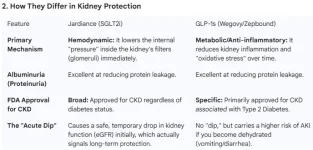
SGLT2 inhibitors block the actions of the protein SGLT2. They lower sugar levels by preventing the body from reabsorbing sugar through the kidneys. This extra sugar is then removed from the body through your urine (pee)...

Yes, you can take both a GLP-1 agonist and an SGLT2 inhibitor if needed. These medication classes work differently and can be safely combined. Plus, taking both may provide greater A1C reduction than either could by itself.

But you likely wouldn’t start both a GLP-1 agonist and an SGLT2 inhibitor at the same time. It’s more common to try one class and add another if the first isn’t working well enough by itself. For instance, if you haven’t met your goal A1C level with the highest dosage of Ozempic (a GLP-1 agonist), your prescriber may suggest adding Jardiance (an SGLT2 inhibitor)...

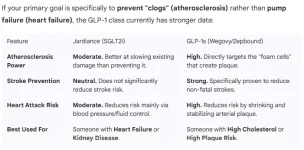
GLP-1 agonists promote greater weight loss and lower blood glucose (blood sugar) more than SGLT2 inhibitors. But SGLT2 inhibitors have more proven benefits for people who have heart failure. If needed, you can take a GLP-1 agonist and an SGLT2 inhibitor together.

 
I take it. If you're diabetic and only take Metformin, this may be slightly better. It has significant renal and heart protection over Metformin. Likely over Sema and Tirz as well with those two conditions. You pee out a couple of hundred calories of glucose per day and that may add up to an extra 5 lbs of weight loss.

Concerns:
If you're low-carb or fasting fan, this may not be for you, as its MOA involves excreting glucose via urine. If you feel woozy, this is why. It will initially make you get up in the middle of the night to pee. But for most people, this goes away in a week or so. I had to get up the first two nights, but not after that. Dehydration is a risk. You'll need to stay on top of your water and electrolytes. UTI risk is not as high as we initially thought: https://pmc.ncbi.nlm.nih.gov/articles/PMC9717627/ (Yes, I just cherry picked a study to support my narrative, but know that published counterpoints to the UTI concern exist.) If not covered by insurance, cost to US users is $500 per month. It's $15 from India where it's off-patent and you trust the source and process. Mark Cuban's Cost Plus Pharmacy has an equivalent SGLT2i for $49.

I take it + Reta. It's a powerful cardio-metabolic combo and is not free of risk. I would not cowboy this combo. Do not even attempt low-carb or try fasting with this. Risk of Euglycemic DKA is real if you do. It does wonders for the metabolically broken, but be careful with this duo.
 
The more diabetic drugs you’re on, the more risk of hypoglycemia

That's not quite correct. If you're taking a Sulfonylureas (or similar) or injecting insulin then you're at risk of hypoglycemia if you dose too much of either and you have to be constantly vigilant about that. That's because both force the insulin levels in your blood to increase and if it increases too much then the body isn't able to maintain sufficient blood sugar levels.

The other diabetes drugs don't generally put you at risk of hypoglycemia, but here's where problems can come up. If a person on Sulfonylureas or insulin starts another diabetes drug, that new drug needs to be taking into account. For example, let's say a patient is on insulin and starts taking Jardiance. If that patient keeps injecting the same amount of insulin that they did before starting Jardiance, then it's likely that amount of insulin will now be too much. But that same risk would apply to anything else (e.g. a low-carb diet) that reduced the person's need for insulin, were they to continue taking the same amount they previously had.

Jardiance dumps sugar, so gnarly UTIs are a risk.

This I very much agree with and I would not take Jardiance longer-term. The primary effect of taking an SGLT2 inhibitor (like Jardiance) is that your kidneys stop recycling all of the sugar back into your blood and start diverting some of it to your bladder so that you pee it out. This is the exact same thing your body does when you're in uncontrolled diabetes. The difference is that when you're a diabetic, your kidneys don't start doing that until your blood sugar is very high and it's a last ditch defense mechanism to protect your other organs from excessive glucose levels by dumping it into your urine. You could think of an SGLT2 inhibitor shifting the level at which your kidneys start doing that so that it begins happening at more normal blood sugar levels.

Reducing blood sugar levels (and other related biomarkers) is good on paper, but the major trade off here is now there's going to be sugar present in your urinary tract. Yeast and bacteria in general are going to love that, putting you at much greater risk of infection in that region as foreign invaders gobble up all that yummy sugar along the way.

You'd be much better off reducing blood sugar (and other related biomarkers) via a GLP-1 class drug, which many here are already taking.
 
That's not quite correct. If you're taking a Sulfonylureas (or similar) or injecting insulin then you're at risk of hypoglycemia if you dose too much of either and you have to be constantly vigilant about that. That's because both force the insulin levels in your blood to increase and if it increases too much then the body isn't able to maintain sufficient blood sugar levels.

The other diabetes drugs don't generally put you at risk of hypoglycemia, but here's where problems can come up. If a person on Sulfonylureas or insulin starts another diabetes drug, that new drug needs to be taking into account. For example, let's say a patient is on insulin and starts taking Jardiance. If that patient keeps injecting the same amount of insulin that they did before starting Jardiance, then it's likely that amount of insulin will now be too much. But that same risk would apply to anything else (e.g. a low-carb diet) that reduced the person's need for insulin, were they to continue taking the same amount they previously had.


This I very much agree with and I would not take Jardiance longer-term. The primary effect of taking an SGLT2 inhibitor (like Jardiance) is that your kidneys stop recycling all of the sugar back into your blood and start diverting some of it to your bladder so that you pee it out. This is the exact same thing your body does when you're in uncontrolled diabetes. The difference is that when you're a diabetic, your kidneys don't start doing that until your blood sugar is very high and it's a last ditch defense mechanism to protect your other organs from excessive glucose levels by dumping it into your urine. You could think of an SGLT2 inhibitor shifting the level at which your kidneys start doing that so that it begins happening at more normal blood sugar levels.

Reducing blood sugar levels (and other related biomarkers) is good on paper, but the major trade off here is now there's going to be sugar present in your urinary tract. Yeast and bacteria in general are going to love that, putting you at much greater risk of infection in that region as foreign invaders gobble up all that yummy sugar along the way.

You'd be much better off reducing blood sugar (and other related biomarkers) via a GLP-1 class drug, which many here are already taking.
I think while technically correct, I’m in a support group where we’ve seen the cases of hypoglycemia anyway despite not being on the endangering drugs, that went away upon decreasing the non-glp. Wasn’t the prescriber’s fault since that wasn’t in the warnings. The best theory seems to be that the interactions, particularly if you are already diabetic and have control issues, are more complicated than the clean model that’s helpful to understand the generalities. I just thought I share the individual cases because we as a group also venture into polypharmacy, a land with hidden potholes.
 
I think while technically correct, I’m in a support group where we’ve seen the cases of hypoglycemia anyway despite not being on the endangering drugs, that went away upon decreasing the non-glp. Wasn’t the prescriber’s fault since that wasn’t in the warnings. The best theory seems to be that the interactions, particularly if you are already diabetic and have control issues, are more complicated than the clean model that’s helpful to understand the generalities. I just thought I share the individual cases because we as a group also venture into polypharmacy, a land with hidden potholes.
To be clear, I'd definitely stick to your thumb rule when discussing with a diabetic support group and think it's a good rule for that audience. You don't know who is going to be on insulin or certain specific insulin-raising drugs and who is going to misunderstand the finer points of hypoglycemic risk if you try to unpack it. I was more unpacking that for a more general audience so that non-diabetics could understand the reason for that disclaimer and the specific times when it applies.

In regards to why type 2 diabetics are at greater risk of experiencing hypoglycemic episodes in general, I'd think that would stem their metabolism having a more difficult time shifting from insulin-dominant to glucagon-dominant. It's not so much insulin or glucagon levels on their own, but rather the ratio of insulin to glucagon that controls that. When you've got sky-high insulin levels (as will be common in type 2 diabetics), it's going to take sky-high glucagon levels to overcome that and shift the body from energy storage mode to energy release mode. The same will be true in the other direction. Their poor alpha and beta cells are struggling to keep up with all that!
 
Top Bottom