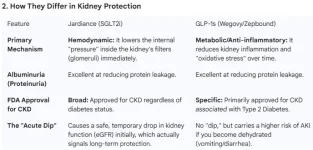
GLP-1 agonists act like the gut hormone GLP-1 that’s naturally found in your body. They work to lower sugar by:
- Signaling your pancreas to release insulin after you eat
- Helping your body use its natural insulin better
- Telling your liver to make less new sugar
- Slowing down how quickly food leaves your stomach
SGLT2 inhibitors block the actions of the protein SGLT2. They lower sugar levels by preventing the body from reabsorbing sugar through the kidneys. This extra sugar is then removed from the body through your urine (pee)...
Yes, you can take
both a GLP-1 agonist and an SGLT2 inhibitor if needed. These medication classes work differently and can be safely combined. Plus, taking both may provide
greater A1C reduction than either could by itself.
But you likely wouldn’t start both a GLP-1 agonist and an SGLT2 inhibitor at the same time. It’s more common to try one class and add another if the first isn’t working well enough by itself. For instance, if you haven’t met your goal A1C level with the highest dosage of Ozempic (a GLP-1 agonist), your prescriber may suggest adding Jardiance (an SGLT2 inhibitor)...
GLP-1 agonists promote greater weight loss and lower blood glucose (blood sugar) more than SGLT2 inhibitors. But SGLT2 inhibitors have more proven benefits for people who have heart failure. If needed, you can take a GLP-1 agonist and an SGLT2 inhibitor together.