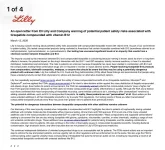
The preprint analytical data for anyone who’d like to read in more depth:
Background Compounded versions of tirzepatide are widely available in the U.S. in the form of fixed-dose combinations of tirzepatide and various analogs of vitamin B12. These combinations are mass marketed in the U.S. and other countries as comparable to FDA-approved tirzepatide products even...

www.medrxiv.org
Thanks for that, it did seem odd that the letter from Lily had no real information in it about what they detected and what it might mean. For those who have not read it, they found b12 covalently bonded to tirzepatide molecules, to varying degrees but up to 10%. At this point there is no evidence at all of what effects this might or might not have, but it certainly suggests that if you mix b12 and tirz a significant amount will react and combine, what properties this combo molecule has are unknown, but to me it says do not combine them, it is not safe. It may simply make the tirzepatide less effective if it interferes with binding to the receptor, it may change its metabolism, it may make it more immunogenic, but without any testing there is no way to know.
Despite lots of people saying big bad pharma, they are not wrong that compounded versions could be more dangerous, and grey ones even more so. Legally compounded tirzepatide at least has to meet some safety standards, but various clinics do not necessarily use the legal versions, and the decision to compound with b12 turned out to be a mistake, creating legally compounded tirzepatide with a fair amount of a combination molecule with completely unknown effects. Grey peptides are more dangerous, there are no safety standards, mislabelling and dosing errors do happen. For some fairly hard to understand reasons it seems to happen less often than I would guess, but there are added risks, and without individual batch testing there is no way to be certain your product is safe. Whether these added risks are worth taking or not is an individual decision. I think for those with severe longstanding obesity unable to afford the legit versions, the risks of no treatment are so high that it would overwhelm any risk effects from grey peptides, but whether that applies to other groups is more complicated, given there is no way of determining the incidence of major mislabelling and major misdosing events. The academic papers that exist on testing grey peptides use random sources, and find very high probabilities of no drug or very underdosed drug, but they do seem designed to accentuate the dangers as a sort of public health awareness issue, which is not a terrible idea but it does not correspond to what I see on this forum, which is that serious dosing and labelling errors are uncommon, but do happen.