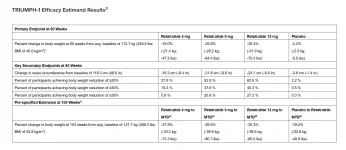
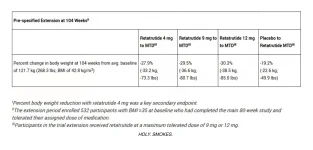
And how does the placebo group jump to from 2% to 19%??Interesting.
While at 80 weeks there is a clear difference between 4mg and 12mg for weight loss.
But pull back to to 104 weeks out, those differences are pretty much insignificant, esp between 4mg and 9mg.
Because all participants titrated up to their maximum tolerated dose of reta from weeks 80-104 according to the chart and study design.And how does the placebo group jump to from 2% to 19%??
I'm right there with the poster. I've lost 27.5% in 8 months. The last 12 lbs took 2 months. Your set point fights the last bit of loss hard.Some comments from a blogger who participated in the trial.
I would love to know if they gave some MEGA-LAXATIVE as placebo
More for them to kill/This is a national security issue.
The US DoD needs to make sure gen Z has this stuff so they're fit for service.
The CCP is selling us the drugs that will improve the draft pool of their adversary.
For some reason the US is ok with keeping their kids fat, and the Chinese are ok with making them fit.
This confuses the patriot.
🙄 🙄 🙄 though, the placebo details seem very sketchy to me.I’d gladly take 3.4% more weight loss right about now
More for them to kill/
🙄 🙄 🙄 though, the placebo details seem very sketchy to me.
It seems more like in their desperation, they stole a bunch of Reta vials and went on a stabbing spree.Yes, the 17% in 24 weeks seems pretty dramatic. But by week 80, those people were so desperate to lose weight that they went on a hunger strike 😂.
🙄 🙄 🙄 though, the placebo details seem very sketchy to me.
I know...weird. Placebo certainly is a real effect.And how does the placebo group jump to from 2% to 19%??
That's why it seemed sketchy to me, meaning the study methodology. How can you call them a placebo group when they were given the real deal? Second, some indicate they were given the drug later on and then they got huge weight loss...All of that seemed off to me.You realize the placebo group got put on Reta and that caused them to lose weight, right?
The placebo group is the control group… everyone is in the control group until the test variable is introduced…. For the ones that started getting Reta at 80 weeks, they were in the control group before that. Picture it as consecutive trials with the control groups running concurrently for the placebo and lower dose escalation trials.That's why it seemed sketchy to me, meaning the study methodology. How can you call them a placebo group when they were given the real deal? Second, some indicate they were given the drug later on and then they got huge weight loss...All of that seemed off to me.
Right, that's how I saw it, too. IMO, that methodology seems flawed to me because the moment we give the real drug to a group, how can they be called placebo group after that? Also, doesn't that defeat the whole purpose of a placebo group in the first place? IMO, if we want to test the efficacy of a drug over long-slow-titration, quick-dose-escalation, and a real placebo group, shouldn't we keep a third group who never gets the drug? Do you get my assertion?For the ones that started getting Reta at 80 weeks, they were in the control group before that. Picture it as consecutive trials with the control groups running concurrently for the placebo and lower dose escalation trials
Better yet how did placebo group at 104 weeks post numbers not too far off from the 4mg reta group....The real question is why did the participants remain in the trial after it became obvious they were in the placebo group? Apparently the monetary incentive was adequate to keep them ethical.
I told my brother about the Reta trials enrolling and he immediately looked into it. Fortunately, he didn't qualify since he previously was on tirz. He's the kind of participant nobody wants in their trial. He is familiar with GLP-1 effects and told me he would drop out in the first week if he didn't feel any effects.🤷

Better yet how did placebo group at 104 weeks post numbers not too far off from the 4mg reta group....
You get paid to participate in a medical trial whether you are on the real deal or a placebo. When I did medical trial, it was $1000/wk for the 8 weeks. (Not a weight loss trial)The real question is why did the participants remain in the trial after it became obvious they were in the placebo group? Apparently the monetary incentive was adequate to keep them ethical.
I told my brother about the Reta trials enrolling and he immediately looked into it. Fortunately, he didn't qualify since he previously was on tirz. He's the kind of participant nobody wants in their trial. He is familiar with GLP-1 effects and told me he would drop out in the first week if he didn't feel any effects.🤷
I've had none of these, and I'm on 8mg.
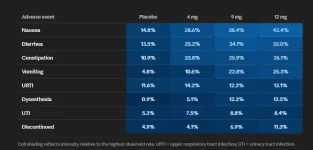
Sometimes I wonder how different my opinion would be if I had tried tirz instead of reta when I first got into this.The side effects profile was much more pronounced in higher dosages. If anything, these results just reaffirmed my choice to stick with Tirzepatide, as my personal results have exceeded the Reta trial results without any of the side effects. Down 35.4% total weight in 52 weeks.
It was an extension, not part of the main trial. The main trial ended with the placebo group still injecting sterile water. Only after that did they get switched.That's why it seemed sketchy to me, meaning the study methodology. How can you call them a placebo group when they were given the real deal? Second, some indicate they were given the drug later on and then they got huge weight loss...All of that seemed off to me.