Good-Heart6425
GLP-1 Enthusiast

Opinion | I No Longer Think GLP-1s Are the Answer
The drugs 'work' but may be working against us long-term

I hate to say it... I agree. After being on sema, and stacking others, I had to stop for 8 weeks as I had scheduled surgeries.. one that got pushed back two weeks. I had stopped a few other times but for only a week or two due to surgeries and colonoscopies.Opinion | I No Longer Think GLP-1s Are the Answer
The drugs 'work' but may be working against us long-termwww.medpagetoday.com


Blood pressure meds, cholesterol meds, blood sugar control meds are also long-term use. Reta offers the potential ability for many to just consolidate that into a singular med.All types of issues with the article, but I guess for me, I always thought that long-term use of a glp-1 was going to be required. In my mind, glp-1 medications treat an underlying metabolic disease and none of the glp-1s are cure for that disease. For me, I think if I stopped taking the medication, I would fully expect my symptoms (ravenous hunger, weight, joint pain, etc.) to return with a raging vengance. And even this go around with weight loss I've done nutrition counseling, cognitive behavioral therapy, and adjusted my behaviors, I honestly don't think that's going to "cure" bad physiology.


Statins were found to significantly decrease naturally occurring GLP-1 levels (in addition to previously having been found to increase diabetes risk and increase plaque calcification). Not sure how that would affect GLP-1RA efficacy, unless you're saying they'd make it harder for someone to maintain a weight loss after going off GLP1 drugs.I read recently that cholesterol meds, ie statins reduce glp1 efficacy.


As much as I am benefiting from these drugs, I could never do it without overeaters anonymous. I have been in that program for 16 years, and it changed my life. Even before the drugs, food noise was hugely diminished, and I had been at a stable weight for 14 years. Never perfect and it required constant spiritual work, but it changed my life. I started taking GLP because of menopause and an auto immune disorder that made my metabolism come to a screeching halt. I think most people who try to stop who had chronic issues with food addiction will definitely have trouble keeping the weight off.


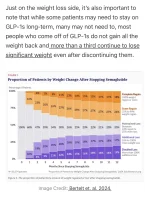
This is just in relation to the image under this statement, not the comment itself.Thanks for sharing. It's good to hear other perspectives, but I don't find this guy particularly persuasive.
He cites is own personal anecdotal evidence and a study from several years ago that had been superceded by more recent and comprehensive research. This isnt to say that people don't come off of glps and gain back all their weight. That obviously happens, and I am sure it is unbelievably frustrating for those folks. But he asserts that as the norm, and it doesn't look like that is factually correct.
I misread it, thanksStatins were found to significantly decrease naturally occurring GLP-1 levels (in addition to previously having been found to increase diabetes risk and increase plaque calcification). Not sure how that would affect GLP-1RA efficacy, unless you're saying they'd make it harder for someone to maintain a weight loss after going off GLP1 drugs.

I've come to this same conclusion. When I think of how freeing it's been to have no food noise for the 2.5 years I've been on glp (was sema, now tirz) I can't imagine going back. It actually scares me to think of having to live that life again. It's not the "eat better, exercise, sleep quality" part of it - I got that nailed - it's the actual, physical manifestation of food noise, that constant thought of eating all day long, that was like torture now that I look back. I almost cry for reals when I think of not having a glp to keep that at bay. I've got about 3 years of tirz stocked up, along with some reta if I go that route, but I seriously want to keep adding to the tirz pile as I'm so worried that years down the road I won't have access.I have always approached GLP-1s as a treatment, and not a cure. I intend to stay on some version of them for life. That might explain my completely irrational desire to hoard multiple years' worth. I'm never going off. I'm never going back. I just can't.

When I took my very first dose I was already planning on taking it long term, even without a full fledged plan on how to pay for it beyond the first year. Fortunately I learned about the grey market after the first 2 months. I have no intention of ever stopping. I do have a medical procedure scheduled in February and I will most likely have to take a 2 week break .. I am not looking forward to it.I hate to say it... I agree. After being on sema, and stacking others, I had to stop for 8 weeks as I had scheduled surgeries.. one that got pushed back two weeks. I had stopped a few other times but for only a week or two due to surgeries and colonoscopies.
I was at my absolute lowest since I started this peptide journey. The noise came back full force. I was ravenous. I ate like I had not in 4 years. The holidays and having junk in the house has not helped. Thankfully I have only gained about 7 lbs but... I absolutely hate this. I "thought" I had my shit in check. I eat healthy, walk a lot, do some strength training.. but I don't deprive myself when I want something sweet.. I just eat a "normal" portion. Now? Once I start eating junk I just want more...
I have restarted what I was taking but low and slow. I do not want to get sick because I am eating like an asshole. I still think they are the answer but I am convinced I will be pinning something until the day I die...
Two weeks wasn't bad. I have done that a few times. You will still have some of your dosage in your body. My situation was not by choice.. trust me. Back a few years ago everyone spoke about "resets".. stopping a few months and restarting to stop a stall. I never subscribed to that theory.When I took my very first dose I was already planning on taking it long term, even without a full fledged plan on how to pay for it beyond the first year. Fortunately I learned about the grey market after the first 2 months. I have no intention of ever stopping. I do have a medical procedure scheduled in February and I will most likely have to take a 2 week break .. I am not looking forward to it.
But their efficacy fades with time. So staying on them for life won’t necessarily work.I have always approached GLP-1s as a treatment, and not a cure. I intend to stay on some version of them for life. That might explain my completely irrational desire to hoard multiple years' worth. I'm never going off. I'm never going back. I just can't.
But their efficacy fades with time. So staying on them for life won’t necessarily work.

 pubmed.ncbi.nlm.nih.gov
Three years isn’t long term at all.I'm not sure if there is enough data to support the statement that the efficacy of glp-1 medications fades with time. The medications just haven't been used that long for weight management.
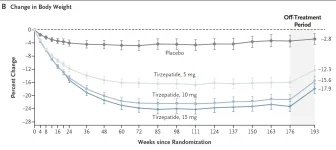
But this article from earlier this year reports long-term usage of tirzepatide and the results suggest that at least at 3 years that study participants were able to maintain their weight loss while staying on the dosage of tirzepatide assigned at randomization.
Tirzepatide for Obesity Treatment and Diabetes Prevention - PubMed
Three years of treatment with tirzepatide in persons with obesity and prediabetes resulted in substantial and sustained weight reduction and a markedly lower risk of progression to type 2 diabetes than that with placebo. (Funded by Eli Lilly; SURMOUNT-1 ClinicalTrials.gov number, NCT04184622.).
The increase at week 176 through 193 is off-treatment.
The flatening of the weight loss line at week 85 and the line staying flat, suggests to me that weight loss is pretty durable while on treatment. So, at least at 3 years there is no loss of efficacy. The flat line is beautiful to me and really exciting.
View attachment 12213
Three years isn’t long term at all.
If the efficacy doesn’t wear off, then why do we have to increase dosage?
I think it has to do with continued weight loss. Like taking 2mg of substance x will get you down 50 pounds but you will need to increase your dose to lose another 10 pounds.Three years isn’t long term at all.
If the efficacy doesn’t wear off, then why do we have to increase dosage?
seems like you only have to increase when you hit certain weight "stalls" not because it no longer works anymore. At least that's what I experienced. Like If I wanted to stay at 200 lbs I would have stayed on a smaller dose of Tirz. I kept going Until I Hit around 155 to 160. I haven't tried it out but I bet if i went higher I would lose more. Even though I still feel over 200lbs at times looking in the mirror is a reality check that I'm at a good size. Kinda do want to try it though but I feel that might be a dark road...Three years isn’t long term at all.
If the efficacy doesn’t wear off, then why do we have to increase dosage?
Thank you. 💖This is my second new years on my 18 month GLP1 journey. I came off a months long stall with mounjaro. Went grey in 2025 and commenced Reta in September.
Three months on Reta, now at 7mg and I’ve dropped 14lbs. Hardly melting away. That’s because the smaller doses of Reta didn’t work for me and 6mg is where weight loss started happening again. As many here suggested and I am delighted with it.
Until…. I hit another stall. This is my third week of staying the same and I increased to 7mg. I was not prepared for how I’d feel hitting a 3 week stall not knowing when or if it will ending, how much that’s challenged my feelings about the journey ahead, and while I know it’s the long game I still have 50lbs to lose. It hits me right in the hope. Hard. Because even then I will still be classed by BMI as obese.
In this stall… I know something is up in my body, I feel it. I have pcos, a metabolic disorder, and I know from the appearance of odd symptoms something is out of whack in my hormones (erm hello 👋 is that you perimenopause 👀?). Make sense it would affect all my systems. But it will pass.
Long way of saying …. I think I know I will be on some form of this long term and I feel good and reassured about my 2 years of peptide freezer supplies.
I knew I would probably have to keep taking it to feel normal and keep the weight stable: I have accepted now there is something wrong with me that cannot be cured and will worsen again without helping myself using this treatment, combined with diet and ongoing exercise for health and self care.
Sending 💜love to @Laxfinity because as bad as I’m feeling, I’d be really depressed if I put 7lbs back on over the festive when it took me 7 dang months to lose it. Reading your story I thank you for sharing it because I feel for you! You will drop it again. Onwards we go!