Are we saving money on groceries by using GLP1 drugs?

kugelblitz

GLP-1 Apprentice
Member Since
Jun 8, 2026
Posts
31
Likes Received
115
Location
Europe
European-Union
I read recently that grocery markets are feeling the squeeze of people eating less and purchasing fewer groceries.
https://www.theguardian.com/business/2026/jun/10/weight-loss-drugs-grocery-bills-glp-1s
https://www.newsweek.com/ozempic-costing-grocery-stores-billions-2099920
https://www.mjemcgill.com/articles/vhlei566e9xnm86weq3jtxudjcwacv
http://archive.today/2026.06.25-052...cle/glp-1-weight-loss-pill-shopping-sntdn9hcr
(paywall, so archive link)

That made me wonder of the impact that my intake of retatrutide is having on my personal finances. I calculated my food costs per month and my treatment costs per month, calculated my total food savings per month by assuming my intake is 25% less (this number is highly debatable, I just found it online, and it tracks with my own experience of retatrutide, if you disagree, please propose a better one), and deducted my monthly treatment cost from my food grocery savings.
I arrived at net grocery savings of 22.88% at my current monthly dose, and 12.30% savings at max dose of 12mg per week (48mg per month).

That's pretty remarkable. Has anyone else run this kind of calculation?

EDIT: If I also added the cost of Janoshik GLP1 test (one per 10 vials), and the cost of a comprehensive blood panel every 3 months, at my current dose of 2mg, I'm still saving 7.95%. If I go up to 12mg per week, I am no longer saving, in fact my total cost of diet (food + treatment cost) is 24.41% up.

(Disclaimer: I am a liberal arts graduate, I couldn't mathematically model my way out of a paper bag. My model can be validly criticised on many axes, and likelihood of logic or arithmetic errors is very high. This is just a back of an envelope number. Anyone who wishes to propose a more robust model, please do so, I'd love to plug in my numbers.)
 
Last edited:
It's not that simple. For my partner and I we're eating out less so there's money saved in that but it's subbed by buying groceries more often and on top of that it's healthier food which is often more expensive. From looking at our spending across all of our cards there's maybe around a 13% savings but I don't have enough data from before GLP1s since we started tracking expenses better around the same time.
 
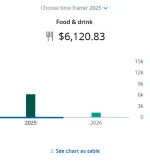
Too lazy to run the calculation myself so I checked my Chase app. Holy shit.....

Ik 2026 isn't over yet but I'm on track to save like 65% on food between this year and last year. Started dieting in January and started Reta in mid-March.
 

Attachments

  • 1782384828561.webp
    1782384828561.webp
    10.1 KB · Views: 1
I agree with Maokai. I seldom eat at restaurants or pick up snacks, coffee, etc. I also didn't buy lot's of junk before I started dieting. My portions have went down which resulted in a small decrease, but nothing major. I didn't calculate the exact percentage but do track spending closely. Savings will vary depending on pre and post habits.
 
It's not that simple. For my partner and I we're eating out less so there's money saved in that but it's subbed by buying groceries more often and on top of that it's healthier food which is often more expensive. From looking at our spending across all of our cards there's maybe around a 13% savings but I don't have enough data from before GLP1s since we started tracking expenses better around the same time.
I agree, this number is extremely rough. I'm not gonna be making any decision based on this number, it is mostly a curiosity.

In my personal case, my wife and I have robust grocery cost tracking for 6 months prior to starting, and we were food prepping for all this time, and did very little eating outside of our food prep, so I'm fairly confident that our pattern of eating didn't change much, rather the absolute consumed amount has dropped relatively flatly.

I agree with Maokai. I seldom eat at restaurants or pick up snacks, coffee, etc. I also didn't buy lot's of junk before I started dieting. My portions have went down which resulted in a small decrease, but nothing major. I didn't calculate the exact percentage but do track spending closely. Savings will vary depending on pre and post habits.
How do you isolate the food savings from the rest? Do you have the ability to do that?
 
I have saved a CRAZY amount of money on food, especially since I used to order delivery 2-4x a week, eat fast food 4-5x a week and eat a lot more of my groceries. A pack of fig bars (my weakness!) could sometimes be eating within a few hours and will now last 1-2 weeks. I also drink a LOT less alcohol: I used to buy 1-2 six packs a week, now it’s pretty much one sixer a month. My total saving are approximately $400-$600 a month, even with buying healthier/more expensive food. It more than converted the cost of compounded meds, which was a great surprise! And now that I’ve gone gray—even with testing—my savings will be even more!
 
I read recently that grocery market is feeling the squeeze of people eating less and purchasing fewer groceries.
https://www.theguardian.com/business/2026/jun/10/weight-loss-drugs-grocery-bills-glp-1s
https://www.newsweek.com/ozempic-costing-grocery-stores-billions-2099920
https://www.mjemcgill.com/articles/vhlei566e9xnm86weq3jtxudjcwacv
http://archive.today/2026.06.25-052...cle/glp-1-weight-loss-pill-shopping-sntdn9hcr
(paywall, so archive link)

That made me wonder of the impact that my intake of retatrutide is having on my personal finances. I calculated my food costs per month and my treatment costs per month, calculated my total food savings per month by assuming my intake is 25% less (this number is highly debatable, I just found it online, and it tracks with my own experience of retatrutide, if you disagree, please propose a better one), and deducted my monthly treatment cost from my food grocery savings.
I arrived at net grocery savings of 22.88% at my current monthly dose, and 12.30% savings at max dose of 12mg per week (48mg per month).

That's pretty remarkable. Has anyone else run this kind of calculation?

(Disclaimer: I am a liberal arts graduate, I couldn't mathematically model my way out of a paper bag. My model can be validly criticised on my axes, and likelihood of logic or arithmetic errors is very high. This is just a back of an envelope number. Anyone who wishes to propose a more robust model, please do so, I'd love to plug in my numbers.)
I eat considerably less food than before , however I am now using Protein shakes that are not cheap. Leaner beef, and pork than before , at a higher cost per pound as well. The way I look at it. I spent a hell of a lot of money getting fat eating and drinking alcohol. Haven't had a drink since April 24th, and that was 3 light beers which I really didn't have a taste for anymore. Hopefully I will spend less in the Future on Medical Costs by returning to a more healthy place in life.
 
I added the cost of a Jano GLP1 test and the cost of a blood panel every 3 months, and savings at my current dose went down to 7.95%. At 12mg a week, I am no longer saving money, now I'm 24.41% up on my total food + treatment costs.
 
Last edited:
We've definitely saved $$ here! We used to door dash like 3-4 times a week (long work hours & laziness 😆) but since I started Reta (husband doesn't need to be on it) we're down to like 1-2 times weekly, and that's him ordering.
 
We've definitely saved $$ here! We used to door dash like 3-4 times a week (long work hours & laziness 😆) but since I started Reta (husband doesn't need to be on it) we're down to like 1-2 times weekly, and that's him ordering.
This was long before taking reta, but we did the same thing, and we switched to meal-prepping and no delivery for 6 months so far. Our food expenditure literally halved.
 
My beer saving alone is noteworthy....I'm surprised Anheuser-Busch hasn't called the authorities for proof of life 😉 Jokes aside, I have cooked over 99% of our food for over a decade because I live in the middle of nowhere and while I don't track exact grocery costs, we eat about half the portion sizes we used to so I need to buy way less/way less frequently at the grocery store but our monthly costs are up with the peptide and supply costs, vitamins/supplements/protein shakes/electrolytes, clothing purchases, and more regular bloodwork and dr visits to adjust other medication we were previously on.
 
I am way lower on food costs even when I include the two non-GLP-1 muggles that share the household...Of course, that's only if I amortize the peps cost over their expected useful life...If I just do straight month over month costs from the last 3-4 months with peps included, I am like a million point five percent higher in costs... 😳
 
My biggest saving is from not ordering food anymore. I did that almost every day.
Vegetables and shit is not cheap though.

I am still spending a lot of money on cigarettes and monster energy drinks. I should probably quit that too.
 
It's not that simple. For my partner and I we're eating out less so there's money saved in that but it's subbed by buying groceries more often and on top of that it's healthier food which is often more expensive. From looking at our spending across all of our cards there's maybe around a 13% savings but I don't have enough data from before GLP1s since we started tracking expenses better around the same time.
Good point, plus I know when my wife and I do eat out we typically will share a dish, or just get an appetizer for each of us. This equates to more savings on top of less frequent eating out.
 
I feel I'm way ahead on food cost. Just me and the hubby in the house and with both of us on GLP's we really do spend much less on food. Now each meal we cook usually ends up as two meals. Still haven't got the don't cook to much thing down yet......Sadly I reinvest all the 'saved' money into more peps I want to try and all the things. Storage, labels, new pens, ya know the stuff
 
My biggest savings like many others are from not visiting the liquor/beer store. It used to be 3-4 stops per week. I'm saving enough that I could continue on compounded tirz for less money, but glad I've found this forum. Now I have more money to research many other peptides!
 
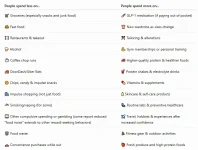
I've cut back quite a bit on alcohol, groceries, eating out, and (somewhat surprisingly) even fresh salads since starting GLPs...more quest protein bars. The peptides themselves add some cost, but my weekly dose is only a few dollars, so it's pretty negligible.

On the other hand, I've spent more on new clothes and tailoring as my size has changed, plus supplements, vitamins, and routine lab work. I've also noticed I spend more on skincare (SPF, moisturizers, etc.), while spending less on things like chewing gum and even nail biting. Oddly enough, my utility bills have shifted too—slightly higher heating costs in the winter because I get cold more easily after losing weight, but lower air conditioning costs in the summer.

The long-term health and lower medical costs could be a real benefit. All my wealth for another day.....
1782395049580.webp
 
I tend to do a protein shake for breakfast, a couple of small healthy snacks, a real lunch (not gonna lie, usually order out) and another shake for dinner. if the price of groceries hadn’t skyrocketed where I am I’d probably be saving quite a bit of money, but everything has become so expensive in the past year that eating the same way I was wouldn’t even be financially feasible.
 
My groceries are roughly the same as I was meal prepping a bit before Reta, but I am saving massively by not using doordash. I used to struggle alot with ordering way too much food on a whim when I had access to better food in the kitchen
 
My biggest saving is from not ordering food anymore. I did that almost every day.
Vegetables and shit is not cheap though.

I am still spending a lot of money on cigarettes and monster energy drinks. I should probably quit that too.
I was on like 2 monsters a day a couple of months ago and one day i just said fuck it and quit cold turkey, no stepping down or anything just stopped. I have since then had 3 small Red Bulls on 3 different very rough/hard days kind of like one should use energy drinks.

Probably the best thing i have done in my life recently and my energy is just about the same as when i did drink alot of monster

Edit: i did quit before starting glp1 but it was a decision which came from planning to start glp1s so i would count the saving as part of my glp1 journey
 
Last edited:
I've cut back quite a bit on alcohol, groceries, eating out, and (somewhat surprisingly) even fresh salads since starting GLPs...more quest protein bars. The peptides themselves add some cost, but my weekly dose is only a few dollars, so it's pretty negligible.

On the other hand, I've spent more on new clothes and tailoring as my size has changed, plus supplements, vitamins, and routine lab work. I've also noticed I spend more on skincare (SPF, moisturizers, etc.), while spending less on things like chewing gum and even nail biting. Oddly enough, my utility bills have shifted too—slightly higher heating costs in the winter because I get cold more easily after losing weight, but lower air conditioning costs in the summer.

The long-term health and lower medical costs could be a real benefit. All my wealth for another day.....
View attachment 28660
My left column not only weighs out my right, I also see a long term ROI on the right in terms of reduced health issues and quality of life.
Has been a win/win for me.
I did spend some on inventory, but that should pay for itself.

As for the savings of DIY china.. that pays for everything!

PS:
I feel much better in my blue jeans!
 

Trending Topics

Forum Statistics

Threads
18,530
Posts
192,863
Members
61,882
Newest
illoptics
Back
Top Bottom