Body Fat % Lies: Which Scales Are Actually Lying to You (And Which Tell the Truth)

Member Since
Feb 28, 2026
Posts
19
Likes Received
28
Location
USA
United-States
Body Comp Scale Showdown: Which $100 Scale Beats the $1,000 Model? Let's Crowdsource the Truth

Hey everyone,

I'm on a mission to solve a question I bet a lot of you have wondered about: What's the best body composition scale for the money?

Here's the deal—some digital scales that measure body fat, lean mass, and overall composition cost $1,000+. Others are $50. And I have a hunch that a solid $100-$150 scale does 90-95% of what the premium models do. But I need your expertise to figure out which ones actually deliver.

What I'm looking for:

  • Have you personally tested a body composition scale against a DEXA scan or other gold-standard measurement?
  • If so, how accurate was it? Did it hold up?
  • Which scales have you used that were surprisingly good for the price?
  • Which ones are complete garbage that you'd warn others away from?
  • Beyond accuracy—which are easiest to use? Which have the best app integration? Which ones are reliable long-term?
The goal here:

By combining all of our real-world experience, I want us to crowdsource an honest breakdown of body composition scales:

  • Most accurate overall (regardless of price)
  • Best value (accuracy per dollar spent)
  • Most user-friendly
  • Biggest waste of money (avoid these)
  • Best bang for buck (the sweet spot)
I'm hoping we can build a genuine consensus based on actual hands-on experience—not marketing claims or Amazon reviews. If you own one, have tested one, or have strong data on how it compares to DEXA or other validated methods, please share your findings.

Whether you've got a $50 scale or a $5,000 one, your real-world feedback matters. Let's help each other make smart choices.

Looking forward to hearing what you've learned!
 
Did you get responses to your question to arrive at answers❓️

I found your post by searching "body composition scales" as I am also on a mission to purchase one and would love to hear from first-hand users!
 
I don't pay too much attention to the numbers, just the overall trends, minimum 1 month. Even dexa has a 5% individual error rate when it comes to fat percentage estimation, so expecting a scale to do close or better is a quick recipe for needless frustration.
 
Body Comp Scale Showdown: Which $100 Scale Beats the $1,000 Model? Let's Crowdsource the Truth

Hey everyone,

I'm on a mission to solve a question I bet a lot of you have wondered about: What's the best body composition scale for the money?

Here's the deal—some digital scales that measure body fat, lean mass, and overall composition cost $1,000+. Others are $50. And I have a hunch that a solid $100-$150 scale does 90-95% of what the premium models do. But I need your expertise to figure out which ones actually deliver.

What I'm looking for:

  • Have you personally tested a body composition scale against a DEXA scan or other gold-standard measurement?
  • If so, how accurate was it? Did it hold up?
  • Which scales have you used that were surprisingly good for the price?
  • Which ones are complete garbage that you'd warn others away from?
  • Beyond accuracy—which are easiest to use? Which have the best app integration? Which ones are reliable long-term?
The goal here:

By combining all of our real-world experience, I want us to crowdsource an honest breakdown of body composition scales:

  • Most accurate overall (regardless of price)
  • Best value (accuracy per dollar spent)
  • Most user-friendly
  • Biggest waste of money (avoid these)
  • Best bang for buck (the sweet spot)
I'm hoping we can build a genuine consensus based on actual hands-on experience—not marketing claims or Amazon reviews. If you own one, have tested one, or have strong data on how it compares to DEXA or other validated methods, please share your findings.

Whether you've got a $50 scale or a $5,000 one, your real-world feedback matters. Let's help each other make smart choices.

Looking forward to hearing what you've learned!
Simple measuring tape is the absolute truth
 
TBH, I think they are all pretty trash. Pick any scale and you will find half the people who have it say it is the best thing ever snd half want to burn the company to the ground.

I saw some good reviews for Hume and got one. Its pretty good at telling me my weight otherwise not great. It was off significantly from Dexa, which isnt the end of the world, but its trends don't seem to have any relation to reality.

I think they are mildly interesting, but not very useful, toys. The technology just isn't there.
 
Body Comp Scale Showdown: Which $100 Scale Beats the $1,000 Model? Let's Crowdsource the Truth

Hey everyone,

I'm on a mission to solve a question I bet a lot of you have wondered about: What's the best body composition scale for the money?

Here's the deal—some digital scales that measure body fat, lean mass, and overall composition cost $1,000+. Others are $50. And I have a hunch that a solid $100-$150 scale does 90-95% of what the premium models do. But I need your expertise to figure out which ones actually deliver.

What I'm looking for:

  • Have you personally tested a body composition scale against a DEXA scan or other gold-standard measurement?
  • If so, how accurate was it? Did it hold up?
  • Which scales have you used that were surprisingly good for the price?
  • Which ones are complete garbage that you'd warn others away from?
  • Beyond accuracy—which are easiest to use? Which have the best app integration? Which ones are reliable long-term?
The goal here:

By combining all of our real-world experience, I want us to crowdsource an honest breakdown of body composition scales:

  • Most accurate overall (regardless of price)
  • Best value (accuracy per dollar spent)
  • Most user-friendly
  • Biggest waste of money (avoid these)
  • Best bang for buck (the sweet spot)
I'm hoping we can build a genuine consensus based on actual hands-on experience—not marketing claims or Amazon reviews. If you own one, have tested one, or have strong data on how it compares to DEXA or other validated methods, please share your findings.

Whether you've got a $50 scale or a $5,000 one, your real-world feedback matters. Let's help each other make smart choices.

Looking forward to hearing what you've learned!

I have the Hume, an InBody H20, a Withings (?), a Renpho ES 30m, and a Tanita RD-545.

I've been doing weekly scans on all, and plan a Dexa later this week (at which time i'll go straight home and compare).

Unforunately Renpho lost all my history when I scanned yesterday, so it's only point in time, but the rest I should be able to build some graphs of variance over the last few months.
 
I have the Hume, an InBody H20, a Withings (?), a Renpho ES 30m, and a Tanita RD-545.

I've been doing weekly scans on all, and plan a Dexa later this week (at which time i'll go straight home and compare).

Unforunately Renpho lost all my history when I scanned yesterday, so it's only point in time, but the rest I should be able to build some graphs of variance over the last few months.
Please report back after your Dexa Scan. You have great comparison with your scale inventory!
 
Seems the consumer scales are all junk. All of the composition metrics are linear. I use inbody at my gym. It may be a tad more accurate.
 
There are several reports in this thread. Somewhere in there, I linked a Reddit post where someone took his Renpho to his Dexa scan and literally did them within minutes of each other and it was surprisingly accurate.
I have a Renpho Elis 2X and and am happy with it.
 
Dexa scans are the gold standard. Do a google search many colleges offer them for way cheaper than clinics. A college local to me only charges 75 bucks. My gym offers inbody tests. I did both within an hour of each other. Inbody was 10% body fat less. Asit was explained by the doctor that did the dexa scan, the inbody test isn't accurate with the trunk. Conveniently my tunk is fat lol. So that makes sense.
 
I was about to upgrade my renpho Elis scales to the new renpho morphoscan. But the reviews of it against a dexa scan made me change my mind. So will keep the renpho Elis for monitoring trends and then do a dexa later in the year.
 
Dexa scans are the gold standard. Do a google search many colleges offer them for way cheaper than clinics. A college local to me only charges 75 bucks. My gym offers inbody tests. I did both within an hour of each other. Inbody was 10% body fat less. Asit was explained by the doctor that did the dexa scan, the inbody test isn't accurate with the trunk. Conveniently my tunk is fat lol. So that makes sense.
They are not the gold standard, MRI scans are. Dexa scans results can be influenced by hydration status, and whether you just finished working out before a scan. Individual error is on average 5% for those, which means 15% body fat could mean your fat % is as low as 10%, or as high as 20%.
 
They are not the gold standard, MRI scans are. Dexa scans results can be influenced by hydration status, and whether you just finished working out before a scan. Individual error is on average 5% for those, which means 15% body fat could mean your fat % is as low as 10%, or as high as 20%.
Sure. To be hyper critical, an MRI is clinically better. As would be hydrodensitometry. In the fitness and sports world the Dexa is considered the modern day, accessible, gold standard. Especially when following the 12 hours no food, no workout instructions given when scheduling. Cheers!
 
Last edited:
Body Comp Scale Showdown: Which $100 Scale Beats the $1,000 Model? Let's Crowdsource the Truth

Hey everyone,

I'm on a mission to solve a question I bet a lot of you have wondered about: What's the best body composition scale for the money?

Here's the deal—some digital scales that measure body fat, lean mass, and overall composition cost $1,000+. Others are $50. And I have a hunch that a solid $100-$150 scale does 90-95% of what the premium models do. But I need your expertise to figure out which ones actually deliver.

What I'm looking for:

  • Have you personally tested a body composition scale against a DEXA scan or other gold-standard measurement?
  • If so, how accurate was it? Did it hold up?
  • Which scales have you used that were surprisingly good for the price?
  • Which ones are complete garbage that you'd warn others away from?
  • Beyond accuracy—which are easiest to use? Which have the best app integration? Which ones are reliable long-term?
The goal here:

By combining all of our real-world experience, I want us to crowdsource an honest breakdown of body composition scales:

  • Most accurate overall (regardless of price)
  • Best value (accuracy per dollar spent)
  • Most user-friendly
  • Biggest waste of money (avoid these)
  • Best bang for buck (the sweet spot)
I'm hoping we can build a genuine consensus based on actual hands-on experience—not marketing claims or Amazon reviews. If you own one, have tested one, or have strong data on how it compares to DEXA or other validated methods, please share your findings.

Whether you've got a $50 scale or a $5,000 one, your real-world feedback matters. Let's help each other make smart choices.

Looking forward to hearing what you've learned!
I read a review about the tech used in those scale a while ago.
They are ALL at least 10% or more inaccurate.
 
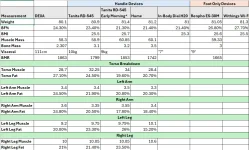
So here we go. I went and got a Dexa, drove home, and took measurements on each of my scales within 20-30 mins of the scan. Please note that the Dexa technician said the weight measurement would be about 1kg low due to it not measuring water.

I normally jump on the scales first thing after waking, so I noticed quite a variation between waking measurement, and middle of the day. I'd eaten a light breakfast and had a coffee 3 hours before the scan.

You can see the difference between the Tanita at 7am and 12pm is quite marked.

It does however appear to be the closest to the Dexa in most areas.
 

Attachments

  • Screenshot 2026-04-16 145806.webp
    Screenshot 2026-04-16 145806.webp
    74 KB · Views: 4
Last edited:
So here we go. I went and got a Dexa, drove home, and took measurements on each of my scales within 20-30 mins of the scan. Please note that the Dexa technician said the weight measurement would be about 1kg low due to it not measuring water.

I normally jump on the scales first thing after waking, so I noticed quite a variation between waking measurement, and middle of the day. I'd eaten a light breakfast and had a coffee 3 hours before the scan.

You can see the difference between the Tanita at 7am and 12pm is quite marked.

It does however appear to be the closest to the Dexa in most areas.
Thanks for sharing the results.
 
So here we go. I went and got a Dexa, drove home, and took measurements on each of my scales within 20-30 mins of the scan. Please note that the Dexa technician said the weight measurement would be about 1kg low due to it not measuring water.

I normally jump on the scales first thing after waking, so I noticed quite a variation between waking measurement, and middle of the day. I'd eaten a light breakfast and had a coffee 3 hours before the scan.

You can see the difference between the Tanita at 7am and 12pm is quite marked.

It does however appear to be the closest to the Dexa in most areas.
Thank you for taking time to report back with an easy to review chart.
 
Great info thanx a ton mate . Out of interest why do you have so many scales ?

I don't have a bf scale yet myself . I'm keen to purchase my first soon , the Withings body scan 2 , hopefully released in a few months .
 
Simple measuring tape is the absolute truth
I disagree. Tape can’t differentiate lean tissue and fat, bloating or edema, or other similar factors. As far as manual methods go, calipers are surely more accurate.

However, just like the scale, tape is perfectly fine for observing trends over time.
 
I have the Hume, an InBody H20, a Withings (?), a Renpho ES 30m, and a Tanita RD-545.

I've been doing weekly scans on all, and plan a Dexa later this week (at which time i'll go straight home and compare).

Unforunately Renpho lost all my history when I scanned yesterday, so it's only point in time, but the rest I should be able to build some graphs of variance over the last few months.
Wow - I have four scales and thought that was too many.
 
So here we go. I went and got a Dexa, drove home, and took measurements on each of my scales within 20-30 mins of the scan. Please note that the Dexa technician said the weight measurement would be about 1kg low due to it not measuring water.

I normally jump on the scales first thing after waking, so I noticed quite a variation between waking measurement, and middle of the day. I'd eaten a light breakfast and had a coffee 3 hours before the scan.

You can see the difference between the Tanita at 7am and 12pm is quite marked.

It does however appear to be the closest to the Dexa in most areas.
Thanks for sharing the results. I have the Hume (disappointed) a FitIndex 8 sensor, and a Renpho that I use for daily measurements.
 

Trending Topics

Forum Statistics

Threads
18,070
Posts
188,241
Members
60,595
Newest
zebs
Back
Top Bottom