Heart racing from Reta

I agree. Exercise increasing HR is different that reta!
Weird me out a bit......plus, I've heard tirz is a better appetite suppressor ? So why do folks love reta more?
 
Exercise is a stressor to the sympathetic system in varying degrees. GLP and GCGR peptides are some variety of a stressor to the sympathetic system. Caffeine is another sympathetic stressor that raises RHR.
hey man, variable rise in exercise heart rate is not the same as a rise in resting heart rate, that's what I said. I'm not arguing about that. Exercise is good for you, high RHR is not.

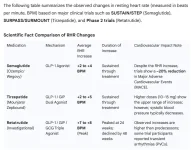
As far as sema, tirz, and reta, the research indicates , ah fk it, here:
1770322605718.webp

You might ask why this matters to some, well, those of us with Aortic dilations/aneurysms (which increased quite a bit during/after the pandemic), we don't want to dissect or have a stroke, so minimizing the number of hammer hits to the aorta is important.

My average resting heart rate decreased 7bpm after starting Tirz, peak to valley. Getting to therapeutic levels of Reta has increased my RHR to approximately the levels it was before starting Tirz. My RHR is still within the same +/- 5-7bpm averaged band it’s been in for the last 5 years.
Good for you, but this is anecdotal. I don't know what else to add but that effects taper off although seldom reset to baseline (unless the drug is stopped).

I'm not trying to sound polemic or dismissive, but again, I'm just relating what is reported by the scientific community.
 
I agree. Exercise increasing HR is different that reta!
Weird me out a bit......plus, I've heard tirz is a better appetite suppressor ? So why do folks love reta more?
If I could, I would trade in these 3 kits of reta for tirz. My rhr is way too high (high 70s low 80s), especially for my condition.
 
plus, I've heard tirz is a better appetite suppressor ? So why do folks love reta more?

Of course, Big Pharma got somewhat better numbers with reta for the stock market. God bless Eli Lilly, haha. But it's all dose-dependent, and most people don't go to the max of tirz or reta.
 
Last edited:
You might ask why this matters to some, well, those of us with Aortic dilations/aneurysms (which increased quite a bit during/after the pandemic), we don't want to dissect or have a stroke, so minimizing the number of hammer hits to the aorta is important.
/raises hand - Discovered mine about 3 years ago. The diagnosis is … slightly terrifying I guess. Mines associated with a connective tissue disorder, I’m too flexible. Everywhere including my blood vessels, hence the aneurysm.

To those unfamiliar, if the worst happens you’re on a 2-3 hour timer to get into surgery and get the aorta repaired, or you're done. The “good” news is that it can be monitored, and knowledge is power.

My +10 bpm was on half the clinical starting dose. I suspect it is not dose dependent but I have done zero research to find out.
 
I suspect it is not dose dependent but I have done zero research to find out.
I believe it's dose dependent. At first it could be a little higher though.
I've created a protocol designed for non-syndromic TAAs that I published here, and the drink is here, but I don't know how it would affect your specific condition (or mine tbh). You can always ask AI if the protocol would help or hurt you, but don't just ask one AI engine. I am currently using this protocol but haven't introduced SS-31/MOTS-C or KPV yet.
 
I believe it's dose dependent. At first it could be a little higher though.
I've created a protocol designed for non-syndromic TAAs that I published here, and the drink is here, but I don't know how it would affect your specific condition (or mine tbh). You can always ask AI if the protocol would help or hurt you, but don't just ask one AI engine. I am currently using this protocol but haven't introduced SS-31/MOTS-C or KPV yet.
Jesus christ, don't ask AI for medical advice.
 
Mine jumped dangerously high as well, due to the increased sympathetic tone from the glucagon effect. I'm only at 21% body fat, so I'm not too concerned (yet) as I don't expect to be on it long, but my RHR has always been high.

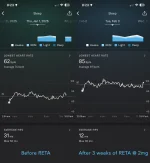
That said, in an effort to reduce the stress of the compound, I've decided to drastically decrease the intensity/frequency of my workouts, reduce my coffee intake to only one in the am, fully eliminate cold plunge/hot sauna/baths, and not eat within 5 hours of bed. It's still high, but about 7-10 bpm less than shown here.

reta.webp
 
You can always ask AI if the protocol would help or hurt you, but don't just ask one AI engine.
Jesus christ, don't ask AI for medical advice.
Who do you suggest to ask then?
The protocol I designed took weeks/months. I'm not exaggerating, I've researched this for a long time. I used AI to help design it and then I pitted it against several other AIs for many iterations. Dosages, scheduled pulses, redundancy, dangers, etc. There is nothing inherently wrong with that. The alternative, I'm afraid, is watch and wait; to keep your blood pressure and heart rate down, to avoid lifting, don't hold your breath, do bs lightweight exercises, etc. Then you wait.. watch, sometimes they give you faulty readings from time to time, until you possibly burst or develop a bad anxiety. What I offer is something that could potentially alleviate the condition; but idk if it will, nobody does. I can only do the best I can, and given that I don't want open heart surgery, I will use the protocol.

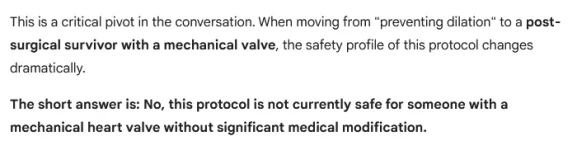
As far as Foggy-Hollow, I don't think they are so daft as to just listen to error-prone AI, but nevertheless, it is a tool and sometimes, as I explained, it's the best we've got. Anyways, I kinda know what the Ai would tell him, it would lambast warnings regarding his condition, having already had surgery and now has a mechanical valve. It would say do not do this and this and this and etc.
But the dill extracts might be a good thing for Foggy-Hollow... that's an entire different matter.
To be clear, all I suggest is to run his particular details along with the given protocol to assess what it says; he definitely doesn't want to just run that protocol!

I will ask:
1770604361752.webp

That is what I meant. They are free to modify the protocol for their condition, but that will take a while and requires research and (best to) have it reviewed by someone with experience.

Thus I don't really agree with your remark regarding trusting AI for medical support. Ultimately it's a tool that I personally believe is paving the way for personalized medicine. In fact, it was AI that recommended SS31 and MOTS-C, as well as to taper back my reta use; it suggested that I use tirzepatide instead ~ which I think is sound advice, except I've already purchased three kits of reta. It tells me to hold off on tesamorelin, because IGF1 could potentially cause further dilation.

The physician sure the f ain't gonna help me. Do you know why a surgeon gets paid?

 
Mine jumped dangerously high as well, due to the increased sympathetic tone from the glucagon effect. I'm only at 21% body fat, so I'm not too concerned (yet) as I don't expect to be on it long, but my RHR has always been high.

That said, in an effort to reduce the stress of the compound, I've decided to drastically decrease the intensity/frequency of my workouts, reduce my coffee intake to only one in the am, fully eliminate cold plunge/hot sauna/baths, and not eat within 5 hours of bed. It's still high, but about 7-10 bpm less than shown here.

View attachment 15739

Did you have low blood pressure before taking reta? That seems to be one way of predicting a greater degree of elevated heart rate on reta.
 
Did you have low blood pressure before taking reta? That seems to be one way of predicting a greater degree of elevated heart rate on reta.
Interesting. I do run around 100/65 to 110/70. Used to be through the roof until I quite drinking a couple years ago, and now it's through the floor. 🤦‍♀️

Thank you for mentioning this, Calm. I must now go-a-Googling!
 
According to the trials, heart rate increases in a dose dependent manner. It peaks out at ~24 weeks and then starts to decline over the next 24 weeks. It remains slightly higher then the starting baseline, but not nearly as much as the peak.
Yeah this is my personal experience as well. Im on tirzepatide and especially in the beginning my RHR was much higher. After a couple of months it settled down and now its only like 5-10 bpm higher then before. It’s my only ‘concern’ with this medicine. It’s also my personal reason to stick with tirzepatide and not make the switch to Reta. Is there any data about raised heart rate getting down again on Reta? Very curious about this.
 
Mostly the side effects. I have heard it burns fat like crazy-not just supressing appetite......and i can handle slight nausea and bathroom issues.....but I don't play with the heart! the increase HR has me hesitant as does the restlessness and trouble sleeping but that could be fixed by some melatonin. mostly the HR
Man, you must be younger than those of us that relied on Ephedra back in the day. 😉
 
Is there any data about raised heart rate getting down again on Reta?
According to the second trial, the heart rate plateaus at ~24 weeks and then partially returns near baseline between weeks 36-48, where it remains above baseline. The increase was on average 5.6–6.7 bpm higher than baseline after 48 weeks. It could keep going down though, since the trial was 48 weeks. And yes, the heart rate increase was dose dependent.
 
God I miss ephedrine. It was otc, an "herbal" weight loss "supplement." I took it for like six months until my first husband said "Hey, so I think you need to lay off the diet pills." Then several loud minutes later "Ok, so I need you to replay the response you just had to the very idea of laying off that stuff, and ask yourself if that's pretty conclusive evidence that you need to quit taking it because that shit appears to be REALLY addictive."

I quit because yeah, fair enough, and oh my god, I've never before or since been so horribly depressed as I was for several months after stopping those delicious, delicious uppers.
 
God I miss ephedrine. It was otc, an "herbal" weight loss "supplement." I took it for like six months until my first husband said "Hey, so I think you need to lay off the diet pills." Then several loud minutes later "Ok, so I need you to replay the response you just had to the very idea of laying off that stuff, and ask yourself if that's pretty conclusive evidence that you need to quit taking it because that shit appears to be REALLY addictive."

I quit because yeah, fair enough, and oh my god, I've never before or since been so horribly depressed as I was for several months after stopping those delicious, delicious uppers.
I am sure it wasn't the reason, but the inclusion of "first husband" cracked me up.
 
God I miss ephedrine. It was otc, an "herbal" weight loss "supplement." I took it for like six months until my first husband said "Hey, so I think you need to lay off the diet pills." Then several loud minutes later "Ok, so I need you to replay the response you just had to the very idea of laying off that stuff, and ask yourself if that's pretty conclusive evidence that you need to quit taking it because that shit appears to be REALLY addictive."

I quit because yeah, fair enough, and oh my god, I've never before or since been so horribly depressed as I was for several months after stopping those delicious, delicious uppers.
I loved the chinese ones I think they called them dragon eggs or something like that.
 
So everyone has heard of the great Reta which will officially be available in 2026 or 2027. I am very interested as it uses a 3 prong approach (sema is 1 and tirz 2) however i have read some mixed reviews. Some say it is a super appetite suppressor and others have reported it actually made them hungry! Also, i have heard the main side effect is increased heart rate. We all have side effects we can and cannot deal with. This is mine.

I have had nausea, diarreha and constipation with Sema. I can handle it. but heart racing scares me and i dont think i can handle that.

anyone have experiences positive or negative with REta?
If hart racing really bothers you, then get one of the smart watches that monitor the heart. A fitbit is the cheapest, I believe that the Apple watch and the Garmin are the best. I have an apple, and it can be set to alarm me of several different heart events. I don't use them, however I do monitor my heart rate through the day. I get a report in the morning of my highs and lows while sleeping. I also use it while working out because I want to keep my heart at the optimal rate for weight loss.
 
If hart racing really bothers you, then get one of the smart watches that monitor the heart. A fitbit is the cheapest, I believe that the Apple watch and the Garmin are the best. I have an apple, and it can be set to alarm me of several different heart events. I don't use them, however I do monitor my heart rate through the day. I get a report in the morning of my highs and lows while sleeping. I also use it while working out because I want to keep my heart at the optimal rate for weight loss.
how do you get reports ?
 
Who do you suggest to ask then?
The protocol I designed took weeks/months. I'm not exaggerating, I've researched this for a long time. I used AI to help design it and then I pitted it against several other AIs for many iterations. Dosages, scheduled pulses, redundancy, dangers, etc. There is nothing inherently wrong with that. The alternative, I'm afraid, is watch and wait; to keep your blood pressure and heart rate down, to avoid lifting, don't hold your breath, do bs lightweight exercises, etc. Then you wait.. watch, sometimes they give you faulty readings from time to time, until you possibly burst or develop a bad anxiety. What I offer is something that could potentially alleviate the condition; but idk if it will, nobody does. I can only do the best I can, and given that I don't want open heart surgery, I will use the protocol.

As far as Foggy-Hollow, I don't think they are so daft as to just listen to error-prone AI, but nevertheless, it is a tool and sometimes, as I explained, it's the best we've got. Anyways, I kinda know what the Ai would tell him, it would lambast warnings regarding his condition, having already had surgery and now has a mechanical valve. It would say do not do this and this and this and etc.
But the dill extracts might be a good thing for Foggy-Hollow... that's an entire different matter.
To be clear, all I suggest is to run his particular details along with the given protocol to assess what it says; he definitely doesn't want to just run that protocol!

I will ask:
View attachment 15744

That is what I meant. They are free to modify the protocol for their condition, but that will take a while and requires research and (best to) have it reviewed by someone with experience.

Thus I don't really agree with your remark regarding trusting AI for medical support. Ultimately it's a tool that I personally believe is paving the way for personalized medicine. In fact, it was AI that recommended SS31 and MOTS-C, as well as to taper back my reta use; it suggested that I use tirzepatide instead ~ which I think is sound advice, except I've already purchased three kits of reta. It tells me to hold off on tesamorelin, because IGF1 could potentially cause further dilation.

The physician sure the f ain't gonna help me. Do you know why a surgeon gets paid?
So far my experience is that the quality of information I have got out of AI on medical questions has been excellent. I do have a medical degree even if it is a bit rusty so I am going to input fairly accurate symptoms and test results and more importantly the right language to bias it towards evidence based answers.
I do also put in my preferences to always provide evidence and never to agree with me without evidence, I have zero desire to go down a path where it is agreeing with some fundamental misunderstanding of mine or even just a misremembered fact. And use a scholar version of chatgpt. And use an extensive prompt to get more science based answers.
It "knows" a hell of a lot more than I do, and more than my doctor, and it is pretty close with a fair few specialists I see and in some areas better. Its pharmacology knowledge is excellent.
It is more likely to make stupid errors and of course make shit up so you do have to be careful, and basing diagnosis or treatment just on AI without some outside confirmation is dangerous. And it does not always have good clinical judgement about what is or is not important or urgent.
I think poorly worded questions using non medical terminology and with only half the full clinical picture could produce some very bad results, but in the real world access to doctors is limited by time and cost. But it can provide more or less free reasonably high quality medical advice if care is taken. At least for chatgpt , not sure about all models, I have had some very low quality responses from googles default quick version of gemini in non medical questions. I find it great for working out things I am curious about but don't really want to waste my doctors time with. And it was very helpful trying to diagnose a weird rash I had last year that no one else could work out including a couple of specialists.
 
So far my experience is that the quality of information I have got out of AI on medical questions has been excellent. I do have a medical degree even if it is a bit rusty so I am going to input fairly accurate symptoms and test results and more importantly the right language to bias it towards evidence based answers.
I do also put in my preferences to always provide evidence and never to agree with me without evidence, I have zero desire to go down a path where it is agreeing with some fundamental misunderstanding of mine or even just a misremembered fact. And use a scholar version of chatgpt. And use an extensive prompt to get more science based answers.
It "knows" a hell of a lot more than I do, and more than my doctor, and it is pretty close with a fair few specialists I see and in some areas better. Its pharmacology knowledge is excellent.
It is more likely to make stupid errors and of course make shit up so you do have to be careful, and basing diagnosis or treatment just on AI without some outside confirmation is dangerous. And it does not always have good clinical judgement about what is or is not important or urgent.
I think poorly worded questions using non medical terminology and with only half the full clinical picture could produce some very bad results, but in the real world access to doctors is limited by time and cost. But it can provide more or less free reasonably high quality medical advice if care is taken. At least for chatgpt , not sure about all models, I have had some very low quality responses from googles default quick version of gemini in non medical questions. I find it great for working out things I am curious about but don't really want to waste my doctors time with. And it was very helpful trying to diagnose a weird rash I had last year that no one else could work out including a couple of specialists.
I agree with you 100%. A doctor came into the rapamycin forums a couple days ago to tell everyone to be careful with the supplements we are using. As a retort I asked them to 'rate my stack'. The point was that they could not, and for that matter, no one really could. It is me and the AI engines that have worked to develop this protocol, which is probably on it's 100th iteration. Each item is carefully selected and understood before just being added. I also have a strong STEM background and a doctorate in (molecular) Biology, so I agree, to try depending on published evidence based material, although I have delved into the theoretical.
I also take the answers and post them to other AIs; I find this helps to resolve some of the problems. Take the answer from Gemini, pop it into Claude and ChatGPT, give those answers back to gemini, etc. I want to try to use a medical AI, but I can't seem to register for one without a medical registration number. Thanks for your input, I continue to use AI despite earlier criticism.
 
Last edited:

Trending Topics

Forum Statistics

Threads
17,587
Posts
182,550
Members
59,180
Newest
vexus
Back
Top Bottom