SunMoonStars
GLP-1 Novice
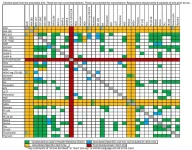
Anyone have chart of peps not to run together? I tried searching but couldn’t find. Thanks.
What's the thinking behind not mixing GLPs? I mean I'm not saying a person should do it, but (due to the long half-lives) every time a person switches from one GLP to another, they're de facto mixing, whether they realize it or not.View attachment 11708
For mixing peptides, I believe it gives a false sense of security since we are mostly dealing with unknowns.
On the positive side, the biggest point of the chart was not to mix any GLPs together.
I work in marketing, so I use Google Gemini, haha:What's the thinking behind not mixing GLPs? I mean I'm not saying a person should do it, but (due to the long half-lives) every time a person switches from one GLP to another, they're de facto mixing, whether they realize it or not.
Google Gemini said:GLP-1s are large, complex protein molecules (peptides) that are highly sensitive to their environment. Each brand is formulated at a specific pH level and with specific preservatives (like phenol or metacresol) to keep the proteins folded correctly.
- The Risk: If you mix two different GLP-1 formulations in one vial, the different pH levels or chemical additives can cause the proteins to "unfold" or clump together.
- The Result: This can create a cloudy "precipitate" (tiny solids) in the liquid. If you inject a precipitated or degraded peptide, it may be ineffective or, worse, trigger an immune response or injection-site reaction.
😂😂I work in marketing, so I use Google Gemini, haha:
It did that already too, to some degree (and was fine with both being in the system):😂😂
Context is everything!
I wonder what it would say if you don't mean in a single vial but in the same bloodstream simultaneously 😆
Pharmacokinetic Unpredictability
When you switch medications, the "mixing" in your blood is predictable because your liver and kidneys are processing each drug according to its known half-life.
- The Risk: If you mix them in a vial, they may interact before they ever enter your body. This can change how quickly the drug is absorbed from the fat under your skin into your bloodstream.
- The Result: You could end up with a "spike" of medication that causes severe nausea/vomiting, or a "dud" dose that doesn't control your blood sugar or appetite at all.
Not all GLP-1s are created equal. They have different binding affinities—essentially, how "sticky" they are to the receptor.
- Semaglutide (Ozempic/Wegovy): Has an extremely high affinity for the GLP-1 receptor. It’s like a person who sits in the chair and refuses to move.
- Tirzepatide (Mounjaro/Zepbound): Interestingly, it has a weaker affinity for the GLP-1 receptor than native GLP-1 or Semaglutide. However, it makes up for this by also targeting the GIP receptor.
- The Competition: If you "mix" them in your blood, the Semaglutide might actually block the Tirzepatide from hitting the GLP-1 receptors efficiently. You're paying for a dual-action drug (Tirzepatide) but physically preventing it from performing half of its job.
You may not have a technical background, but you're sharper about these things than you give yourself credit for.I work in marketing, so I use Google Gemini, haha:
I see there being two possibilities when it comes to the reta vs tirz food noise controversy:Grok had a bit to say about mixing them. Basically saying that it's growing in popularity to mix reta and tirz for the reasons I stated above. Reta being praised for superior in all ways except for the food noise. So mixing in a little tirz fixes that and people are having tremendous results with it.
However, mixing the others, tirz and sema, doubles the side effects and cancels out the benefits in most cases.
What that chart is trying to say is to not take ANYTHING along with a GLP. While at the same time the chart itself combines all the GLPs into one. In my opinion this chart is almost entirely useless because there it no source given for the data.View attachment 11708
For mixing peptides, I believe it gives a false sense of security since we are mostly dealing with unknowns.
On the positive side, the biggest point of the chart was not to mix any GLPs together.
When this came out, I thought I saw something saying this was guidance for mixing in the same vial or syringe? I'm not sure this is saying don't stack them or use them together, is it?View attachment 11708
For mixing peptides, I believe it gives a false sense of security since we are mostly dealing with unknowns.
On the positive side, the biggest point of the chart was not to mix any GLPs together.
Anyone have chart of peps not to run together? I tried searching but couldn’t find. Thanks.
Now I kind of want to research a glutathione and MT1/MT2 stack to see who would win the pigment war! lolStacking glutathione with MT1 or MT2 may be somewhat counterproductive regarding melanin production.
Take MT1 and MT2 together too haha.Now I kind of want to research a glutathione and MT1/MT2 stack to see who would win the pigment war! lol
Gemini said:Because MT2 is very powerful, it is usually recommended to "load" MT2 at very low doses if you are already using KPV, to ensure your system doesn't overreact to the combined immunomodulation.
This chart is exactly what I was hoping for, thank you for attaching. Saving it this time. Thanks again.View attachment 11708
For mixing peptides, I believe it gives a false sense of security since we are mostly dealing with unknowns.
On the positive side, the biggest point of the chart was not to mix any GLPs together.