Ratio of agonists…

cloratheshadow

GLP-1 Enthusiast
Member Since
Mar 22, 2026
Posts
180
Likes Received
626
Location
California
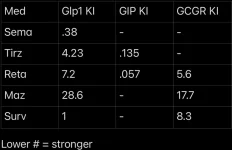
I’m going to try to word this correctly without sounding dumb. Does anyone know the ratio of each agonist in Sema vs Tirz vs Reta. Sema has has more GLP1, Reta has LET GLP1 and GIP, so do we know exactly what those numbers look like? Like if I am stacking Reta and Tirz do we know how much GLP is being activated?
 
Last edited:
I’m going to try to word this correctly without sounding dumb. Does anyone know the ratio of each agonist in Sema vs Tirz vs Reta. Sema has has more GLP1, Reta has LET GLP1 and GIP, so do we know exactly what those numbers look like? Like if I am stacking Reta and Tirz do we know how much GLP is being activated?
Kindof:

1777167244606.webp

The studies were conducted in vitro using human GLP-1 receptors.
 

Attachments

Last edited:
According to NEJM "Retatrutide is designed to be less potent at the GLP-1 receptor (roughly 0.4 times as active as natural GLP-1) compared to its high potency at the GIP receptor. This strategic tuning is due to its triple agonist design." I've read somewhere that the GIP is significantly higher but not sure how much.
 
One of the best posts on KI values:
You need a degree in pharmacology to understand this. Let me try and explain;

What I posted were Ki values.

Ki represents the concentration at which the inhibitor ligand occupies 50% of the receptor sites when no competing ligand is present.

The smaller the Ki number, the greater the binding affinity and the smaller the amount of ligand is needed to inhibit its binding partners activity.

Notice how little Sema is needed for the Glp1 receptors to be saturated? Also make note of how doses of sema are 1mg to a max of 2.4mg per week.

Now in comparison notice tirz and how much of a higher dose you need to equal the GLP1 effect of Sema? Also keep in mind the molecules at hand are not one and the same. Chemically different structures and different makeups entirely.

Tirz and reta are more similar in chemical structure to one another than sema or tirz or reta and sema.

Now what you use this for is up to you.

Sema is not better than tirz
Tirz is not better than reta
Reta is not better than sema

It just comes down to your basic need? What is it you want. Let me give you an example. For hunger suppression and food noise reduction, nothing beats sema in this regard (from these 3 drugs we are comparing).

If you are looking for weight loss then you should target a drug with a higher affinity towards GIP, Reta is your friend here with approx 8x the binding affinity compared to tirz’s GIP strength. Sema has no GIP activity as it is a single agonist Glp1 drug.

As reta activates your glucagon pathways it can increase your heart rate as well, so if your body cannot handle this and you still want weight loss then go with tirz.

Tirz has no glucagon activation so in theory it should not affect your heart rate.

Reta has one added advantage in that it lowers blood cholesterol and blood lipids as well. Activation of Glucagon pathways actually inhibits PCSK9 and that directly lowers blood lipids profile.

Now if it is blood lipids/triglycerides/cholesterol that is your main concern and this is what you want to reduce then a drug with higher affinity towards Glucagon is needed.

A new drug currently being tested which is called Pemvidutide (a dual receptor agonist of Glp1/Glucagon) has a stronger affinity towards glucagon compared to reta.

So the point I am trying to make here is you have different strokes for different folks. Ask yourself what is it you are trying to address and then do your research to find your answers.

I hope this helps.

My fingers are so sore right now … I feel as though I typed an essay on my phone lol …
Gemini on the KI values for GIP:
Tirzepatide GIP (0.135): This is roughly 3x to 4x more potent than natural GIP.

Retatrutide GIP (.057): This hits the 8x to 9x mark.
For GLP:
Gemini said:
GLP-1 Receptor Potency Comparison

MedicationGLP-1 Ki (nM)Relative Strength
Sema0.38~1x (Matches Natural GLP-1)
Surv1.0~2.5x Weaker than natural
Tirz4.23~12x Weaker than natural
Reta7.2~20x Weaker than natural
Maz28.6~80x-100x Weaker than natural

For glucagon:

Gemini said:
But when you look at maz, you begin to see the limitations of these KI values:

Gemini said:
The Limitations of Ki (Binding Affinity) vs. Real-World Results

Why a "weak" number on paper can still be a "strong" drug in the body.

MetricWhat Ki MeasuresThe Limitation (Why it "Lies")Real-World Application
Binding vs. ActionAffinity: How "sticky" the drug is to the receptor.Efficacy (EC50): Ki doesn't measure how hard the drug "flips the switch" once it’s attached.Mazdutide may have a "loose" grip (28.6), but it can still be a highly efficient "switch flipper."
Dose VolumeRaw Binding: 1-to-1 molecule strength.Concentration: You can overcome "weak" binding by simply using a much higher dose.Because Maz is "weak" at GLP-1, you can dose at 9mg - 16mg, flooding receptors to force activation.
Side Effect CeilingPotency: How much drug it takes to work.Tolerance: High affinity (like Sema) often hits the "nausea ceiling" before other receptors can be engaged.Maz’s weak GLP-1 affinity is a design feature; it avoids extreme nausea so you can reach fat-burning Glucagon doses.
Signaling QualityOccupancy: Is the receptor "busy"?Biased Signaling: Ki doesn't show which cellular pathway is triggered (e.g., Weight Loss vs. Nausea).Modern peptides are engineered to trigger metabolic benefits while ignoring the pathways that cause distress.
SynergyIsolation: Values are measured one receptor at a time.Entourage Effect: Receptors (GIP, GLP-1, GCGR) communicate and amplify each other.Reta’s 8x GIP strength makes its "weak" GLP-1 signal (7.2) much more effective than it would be alone.

Final Takeaway: Looking at Ki values alone is like looking at the size of a car's fuel line without checking the size of the engine or how much gas is in the tank. Mazdutide works because it uses volume (high dose) and leverage (Glucagon) to overcome what looks like "weak" binding on a spreadsheet.
 
Last edited:
Unfortunately the AI answers are wrong. I have done this post 4 times now, but why not. I spent a lot of time trying to work this out looking at a lot of the early papers and using scholar mode with extra prompts on chat gpt. I was trying to find naturally occurring GLP-1 agonists or positive allosteric modulators that might be present in herbs or supplements, as at that time I had not discovered grey peptides and could not afford the legit ones, but never found anything all that great and non toxic.
The binding affinities are complicated , 99% of all the GLP drugs are bound to albumin proteins in the bloodstream and this effects how they interact with the receptors, the KI numbers are different depending on if they were measured when bound to albumin or not. Which helps explain why there are more than one set of results and they are different.
Just to be more complicated, tirzepatide is a biased agonist at GLP-1, so it preferentially activates intracellular cAMP , over beta arrestin, this prevents the receptors from being recycled into the cell, and increases its effect on GLP signalling, via cAMP which is the next step in the process of the cell responding to GLP. So that despite much lower affinity than semaglutide it can have stronger effects on downstream effects on GLP receptors ( adjusted for dose differences ) , and possibly this also reduces adverse GLP-1 effects.
so in terms of practical effects via the receptors
GLP-1 sema > tirz > reta, it is possible that it is really tirz>sema>reta on downstream effects of GLP-1 activation due to the biased signalling
GIP also has effects that counteract the nausea and malaise that is caused by GLP-1 activation, which has a large effect on the overall side effect profile of the drugs
GIP Tirz > reta the KI numbers above are different to this , the stronger GIP effect of tirz is why it has less GI side effects than reta or sema.
Glucagon reta only
So in terms of gastrointestinal side effects- worst to best sema>reta>tirz
Reta is the most effective as it has the extra glucagon agonism, this is the reason it causes more heart rate increase than the others
Tirz has the lowest side effects due to stronger GIP agonism and the biased signalling at GLP-1.
I personally think this view of the receptor activity is correct based on my reading of the early papers, usually under the development names, done prior to the big clinical studies, and is most consistent with their effect and side effect profiles.
 
Unfortunately the AI answers are wrong.
You bring up some important issues. But to be clear, the AI noted that affinity (KI) is not the same as efficacy.

The attached essay from Peppy's explains that while 99% of a drug like sema is "bound to albumin, which stabilizes the peptide from being broken down," we "just have to increase the dosage until the tiny amount of FREE Sema can activate the GLP-1 receptor to the degree that we want."

And as I just said, maz is a counterpoint to the KI values. If we took the impotent-looking KI values for maz at face value (like 28.6 for GLP-1 vs. 0.38 for sema), maz would not have been approved for weight loss. But the relatively high dosing makes maz work, in addition to the dual agonism. A 6-mg dose of maz is more like 8.6 mg (if it had a 7-day half-life like sema).

Incidentally, the Peppy's essay argues against GLP stacking and for reta (with or without cagri):

Lilly scientists learned that GIP activation was very beneficial for weight loss, AND it was difficult to overdose on GIP. (Very few drugs are both beneficial and difficult to overdose on. No wonder Lilly went all-in on GIP.) So for Tirz, the max dose a subject can safely take is essentially limited by its GLP-1 activity. For Reta, the max dose was going to be limited by either GLP-1 or GCG activity, depending on which receptor showed unacceptable side effects first...Lilly's products max out GIP compared to the other two receptors (unbalanced).
The ideal receptor ratios for weight loss are already known, and Reta currently offers the closest match. No known stack of other GLP-1s achieves this better than Reta.
So will there be another GLP-1 that can dethrone Reta? I believe the answer depends on how important it is to have GIP activity more on par with the other two receptors, and whether Lilly was wrong to take the approach of blasting the heck out of the GIP receptor.
Stacking GLP-1s may carry more risk than currently understood. These medications are designed to fully activate the GLP-1 receptor at therapeutic doses, so stacking them for enhanced appetite suppression could be dangerous. Please consider a different class of medications for appetite suppression. (i.e. Cagri, as a non-GLP1, anecdotally seems to work very well)
 

Attachments

Last edited:
You are correct, there are parts of your post that were not expanded and I only saw them after I had written it, that said a lot of the same stuff.
I agree reta is the best GLP in most respects, it is definitely the most effective for weight loss, and given that is what it is for , is pretty important. And it was the most recent design, and both knowledge of the receptors and computer modelling of protein structures have improved very rapidly over recent years. Maybe tirz has less side effects, but there is not a huge difference. Sema is the least effective and has the most side effects. The most logical add on if reta is inadequate is cagri, or eloralintide once it is available. But as it has pretty bad GI side effects it seems to get used in practice at very low doses mostly, under 1mg, as an add on to larger doses of reta or tirz.
The standard approaches do not always work for everybody as side effects vary so much, and do not always make perfect sense. I had terrible nausea and malaise from sema at 0.2mg/2days, but almost none from 4.5mg of tirz/2days.
 
"Stacking GLP-1s may carry more risk than currently understood. These medications are designed to fully activate the GLP-1 receptor at therapeutic doses, so stacking them for enhanced appetite suppression could be dangerous."

This is a bit worrying as this seems to be a protocol that many people have started doing. I guess it is also dose dependant? More research definitely would be useful in this regard.
 
"Stacking GLP-1s may carry more risk than currently understood. These medications are designed to fully activate the GLP-1 receptor at therapeutic doses, so stacking them for enhanced appetite suppression could be dangerous."
I'm not quite sure I understand what that sentence means. Why would stacking two GLP meds be more dangerous than increasing the dose of one?
 
I was quoting from peppys essay as per calm logics post above.
 
I agree, surely dosage must come into it also. I can see the argument at maximum dosages of both compounds. However how do they interact at low dosages of each ?
 
"Stacking GLP-1s may carry more risk than currently understood. These medications are designed to fully activate the GLP-1 receptor at therapeutic doses, so stacking them for enhanced appetite suppression could be dangerous."

This is a bit worrying as this seems to be a protocol that many people have started doing. I guess it is also dose dependant? More research definitely would be useful in this regard.
Just as a correction to the above quote, GLP-1 activation by GLP-1 agonists is not just fully activating the receptors , it is massively supraphysiological, at several orders of magnitude above the effects of endogenous GLP-1, and lasts for a week, compared to natural GLP-1 which only lasts for minutes. Standard maximum doses of any of the GLP-1 drugs are close to the maximum effect possible on the receptors which is why increasing doses often does not cause more weight loss.

While I agree that the risks of most combinations are unknown, and there is no real substantial evidence that stacking weight loss peptides is safe. The large study on cagrisema that showed increased weight loss on the combination compared to either agent alone, but with a fairly high rate of gastrointestinal adverse effects, and to the companies disappointment not that much more weight loss. But with no unexpected severe adverse effects.

There are also the studies of much higher doses of semaglutide of 7.2mg and 16 mg, that also showed improved weight loss, but again not as much as the company would have liked and with quite high rates of adverse gastrointestinal side effects, and some sensory skin side effects at 10% rates that were typically seen with retatrutide but very rarely with low dose semaglutide.

So from the available evidence it can be said that high dose semaglutide is not unsafe, but is well into diminishing returns territory in terms of not a lot of extra weight loss for extra side effects, and unfortunately the only study combining cagrilintide was with semaglutide, not a combination too many people taking grey peptides would pick, but inevitable due to them being owned by the same company and lily owning reta and tirz.
Extrapolating from this knowledge , it is not totally unreasonable to judge that combining cagrilintide with tirz or reta is fairly unlikely to have serious unexpected adverse effects, but it is definitely not proven to be safe.

The higher doses of tirzepatide study that is ongoing has zero information released , not even what dose they are testing.

My personal opinion is that severe obesity has very severe adverse effects on physical, social and mental health, and that the added cardiovascular risks alone from obesity are almost certainly an order of magnitude larger than any plausible long term adverse effects of combining reasonable doses of GLP medications, or of slightly higher than usual doses of tirz or reta. Higher doses of sema are studied, but just not a good choice as 15mg of tirz or 12 of reta is both more effective and has much less side effects than 16mg of semaglutide.

The fact that both semaglutide and tirzepatide , but not yet retatrutide have been shown to reduce overall mortality in high risk groups, diabetics and those with cardiovascular disease, argues against there being currently unknown severe adverse effects, and the fact that they are both proven to reduce risks of a very large number of health problems such as diabetes, hypertension, high lipids, many obesity related cancers, heart attacks, strokes, alcoholism, other drug use disorders etc, makes it extremely unlikely that any long term adverse effects are likely to be discovered that outweigh these effects on long term health, even if used at higher doses or in combinations. The drug companies are definitely interested in this and there will be future studies

One of the pieces of research that needs to be done is to see if higher doses or combinations work in people who respond poorly or substantially less than the average to these drugs.

I think the currently unknown risks of higher doses or combinations is likely to be reasonable in the context of managing severe obesity, this is much less certain in people who are just overweight where the health risks from the extra weight are much less severe. But they will typically not need higher doses or combinations.

 
And @Super Trips logged in this morning. Which is all the proof I need that stacking isn't inherently dangerous:

Welcome to the high dose club my friend! I am also a person that has responded well at high doses but never at the lower doses. I have maxed out just about every GLP 1 and every other type of peptide you can imagine. It's frustrating when people here don't understand what I'm going through and Just think it's all about hype or just wanting to get clicks and views but it is actually a problem that I've been running into and had to up my doses so high after taking breaks and trying every type of different scenarios. My Max has been 60 MG of Tirzepatide and well over 8 MG of cagri in a week. I also have stacked sema and a handful of other combos including survo ,reta and just about everything you can imagine.

(But obviously that is on the extreme end. I could not tolerate even 10 mg of tirz for very long.)
 
Last edited:

Trending Topics

Forum Statistics

Threads
17,674
Posts
183,308
Members
59,379
Newest
mrmocha83
Back
Top Bottom