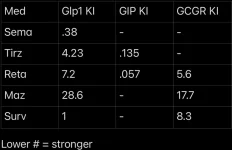
"Stacking GLP-1s may carry more risk than currently understood. These medications are designed to fully activate the GLP-1 receptor at therapeutic doses, so stacking them for enhanced appetite suppression could be dangerous."
This is a bit worrying as this seems to be a protocol that many people have started doing. I guess it is also dose dependant? More research definitely would be useful in this regard.
Just as a correction to the above quote, GLP-1 activation by GLP-1 agonists is not just fully activating the receptors , it is massively supraphysiological, at several orders of magnitude above the effects of endogenous GLP-1, and lasts for a week, compared to natural GLP-1 which only lasts for minutes. Standard maximum doses of any of the GLP-1 drugs are close to the maximum effect possible on the receptors which is why increasing doses often does not cause more weight loss.
While I agree that the risks of most combinations are unknown, and there is no real substantial evidence that stacking weight loss peptides is safe. The large study on cagrisema that showed increased weight loss on the combination compared to either agent alone, but with a fairly high rate of gastrointestinal adverse effects, and to the companies disappointment not that much more weight loss. But with no unexpected severe adverse effects.
There are also the studies of much higher doses of semaglutide of 7.2mg and 16 mg, that also showed improved weight loss, but again not as much as the company would have liked and with quite high rates of adverse gastrointestinal side effects, and some sensory skin side effects at 10% rates that were typically seen with retatrutide but very rarely with low dose semaglutide.
So from the available evidence it can be said that high dose semaglutide is not unsafe, but is well into diminishing returns territory in terms of not a lot of extra weight loss for extra side effects, and unfortunately the only study combining cagrilintide was with semaglutide, not a combination too many people taking grey peptides would pick, but inevitable due to them being owned by the same company and lily owning reta and tirz.
Extrapolating from this knowledge , it is not totally unreasonable to judge that combining cagrilintide with tirz or reta is fairly unlikely to have serious unexpected adverse effects, but it is definitely not proven to be safe.
The higher doses of tirzepatide study that is ongoing has zero information released , not even what dose they are testing.
My personal opinion is that severe obesity has very severe adverse effects on physical, social and mental health, and that the added cardiovascular risks alone from obesity are almost certainly an order of magnitude larger than any plausible long term adverse effects of combining reasonable doses of GLP medications, or of slightly higher than usual doses of tirz or reta. Higher doses of sema are studied, but just not a good choice as 15mg of tirz or 12 of reta is both more effective and has much less side effects than 16mg of semaglutide.
The fact that both semaglutide and tirzepatide , but not yet retatrutide have been shown to reduce overall mortality in high risk groups, diabetics and those with cardiovascular disease, argues against there being currently unknown severe adverse effects, and the fact that they are both proven to reduce risks of a very large number of health problems such as diabetes, hypertension, high lipids, many obesity related cancers, heart attacks, strokes, alcoholism, other drug use disorders etc, makes it extremely unlikely that any long term adverse effects are likely to be discovered that outweigh these effects on long term health, even if used at higher doses or in combinations. The drug companies are definitely interested in this and there will be future studies
One of the pieces of research that needs to be done is to see if higher doses or combinations work in people who respond poorly or substantially less than the average to these drugs.
I think the currently unknown risks of higher doses or combinations is likely to be reasonable in the context of managing severe obesity, this is much less certain in people who are just overweight where the health risks from the extra weight are much less severe. But they will typically not need higher doses or combinations.