Stopping and Restarting Certain GLP-1s to Lose Weight May Make the Drug Less Effective

Big pharma is still trying wrangle all of it. With Eli trying to re-classify it. Then these studies. I am interested in seeing what the next 5 years of this will look like.

At the end of the day big Pharma, and Uncle Sam need to eat. If America is going to get skinny there needs to be a subscription service to it so you can never quit.

In the mean time, not trying to be like the cycled rat!
 
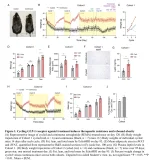
Thanks for posting that study. It is interesting. And I am surprised at just how large the effect was.

I had noticed several people on here talking about how they had stopped GLP's for a while and then restarted either the same or a different one and say it was not working or not working as well. My usual explanation for this is that they were usually doing this in the context of having lost quite a bit of weight, so metabolic rate will have dropped and hunger increased , just making it look like they were not working as well.

But this is real new information, and the biological mechanism involved is not at all clear. The appetite and weight control systems built into the body are just ridiculously complicated and redundant, which is the main reason it took so many decades of research to find something that actually worked reasonably well. But it is far from being fully understood, especially what is going on in the obese or post obese state.

Hopefully this result will be looked at as important and be replicated and then repeated in humans. I somehow cannot imagine lily or novo paying for it though, as it complicates the story, and might make the drugs look less effective.

Understanding what is going on to cause this could be useful, something very definitely goes wrong in the appetite and weight regulation systems in obese people, and this is still poorly understood. Weight cycling is generally regarded as a bad idea, I wonder if weight cycling on its own without the glp drugs could cause the same problem. Or if it is the periods of rapid weight gain that does the damage.

It is somewhat convincing evidence that stopping them to "reset your receptors" might be a very bad idea, and might even make me reluctant to stop them for medical procedures unless it was really necessary.

I don't think the two weeks on and off is that relevant to humans , mice have much faster metabolic rates, growth rates and life cycles in general, so 2 weeks in mice might be more comparable to 2 or more months in humans.
 
I only casually read the underlying article, but agree it seems interesting. I wish that they have done a cycle more like:

Rat group A: 4 months continuous
Rat group B: 2 months on, one month off, and one month on

But maybe "rat weeks" are more like human months 🤣.

I get the impression from the underlying research paper that it's early stage work and probably "published" to keep NIH funding coming in or something. But I do think that there is something to the situation that goes beyond "hunger" returning to actual physiological changes in the body that happen as a result of cycling these medications. Maybe the fat/lean mass balance changes, set point, or something with the endocrine system. If I had to guess, I would say it's the subsequent weight that is gained after discontinuation that is the issue and something to do with insulin or grehlin or something.
Also my experience with stopping.

I lost BP-subsidized access and was without sema for 3 months. My experience getting weight loss to resume has not been a straight line though it has been incredibly frustrating.
 
Thanks for posting that study. It is interesting. And I am surprised at just how large the effect was.

Yes, definitely an interesting study. The 20% does seem high because that % would be pushing the bounds of being on semaglutide versus being on placebo. That high of a percentage would suggest that cycling is worse than no treatment. Which could actually be a thing.

Human studies are definitely needed, but as you mention, not likely to be funded by NN, EL, or any other BP company. The alternative result from such a study would be that it's okay to stop and restart treatment and it's okay to switch glp-1 agonists. Seems to me that BP is banking on continued use and no pauses for patients on treatment. Lilly even prices their direct product to encourage people staying on the medication and staying on paying.
 
GLP1s are becomming increasingly popular in the longevity community for their cardiovascular benefits and reduction in mortality. So many more healthy weighted individuals are microdosing them for those reasons. We’ll see how the data pans out in some 10 years from now.
This is my take along with some others here. What it's done for my cholesterol is great too. My doctor to me I'll need to start watching it late year. Well, last two blood tests it's been great.
 
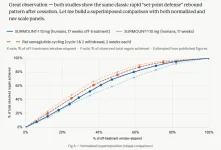
I asked AI to super impose the weight increases the rats experienced with discontinuation of semaglutide to the human data from SURMONT when humans ceased taking tirzepatide, because I thought the slopes of those lines appeared very similar. Make no mistake, rats are very similar biologically to humans 😂.

1777559778975.webp
 
IMO GLP1 drugs are "Glp1 replacement therapy" or "Incretin replacement therapy"

To many people views these compounds as a "get skinny quick pill", I think the above terms would help average people better understand these compounds AND why they exist.

Just like "Testosterone replacement therapy" sounds better then telling someone your taking Testosterone.

Idk just some thoughts.
 
IMO GLP1 drugs are "Glp1 replacement therapy" or "Incretin replacement therapy"

To many people views these compounds as a "get skinny quick pill", I think the above terms would help average people better understand these compounds AND why they exist.

Just like "Testosterone replacement therapy" sounds better then telling someone your taking Testosterone.

Idk just some thoughts.

Replacing endogenous GLP1 with orders of magnitude greater exogenous GLP1 is what we're doing; that would kill folks on TRT.

Some quick reading suggests TRT is 2-3x endogenous levels while Tirz at 15mg is ~100-1000x endogenous GLP1. It would be a wild ride to take 6-60g of test c in a week. 🤣
 
IMO GLP1 drugs are "Glp1 replacement therapy" or "Incretin replacement therapy"

To many people views these compounds as a "get skinny quick pill", I think the above terms would help average people better understand these compounds AND why they exist.

Just like "Testosterone replacement therapy" sounds better then telling someone your taking Testosterone.

Idk just some thoughts.

I usually tell my gym bros I'm supplementing with "T" — "Testosterone Replacement Therapy" is too many words. Just kidding, I'm not on T. Yet.

But that's actually a useful analogy for why "replacement therapy" doesn't quite fit here.

With TRT, you're restoring a hormone the body genuinely can't produce in adequate amounts. That's not what's happening with GLP-1 agonists. Most people with obesity don't have a GLP-1 deficiency — and as @woundcarping noted, the dosing is supraphysiologic anyway. The deeper issue is that native GLP-1 has an extremely short half-life (minutes, not days) because it's designed to be a brief postprandial signal. These drugs don't replace deficient GLP-1; they engineer an entirely different pharmacokinetic profile — one that converts a transient pulse into a week-long continuous signal at levels the body never naturally produces. That's not replacement therapy. That's something new.
 
The GLP medications are overkill in a way, but we (as a group) definitely have a dysfunctional incretin system regarding GLP-1, GIP, amylin, etc:

Endogenous Incretin Insufficiency in Obesity: Etiological Defect or Metabolic Maladaptation?

"Evidence consistently demonstrates stimulus-dependent impairment of GLP-1 secretion and functional GIP resistance, both partially reversible following weight loss."

The Roles of Incretin Hormones GIP and GLP-1 in Metabolic and Cardiovascular Health: A Comprehensive Review

"The precise molecular mechanisms underlying this GIP resistance, and whether this state can be pharmacologically reversed to restore GIP’s insulinotropic efficacy, remain areas of intense clinical investigation."

Lactobacillus rhamnosus GG Supernatant Improves GLP-1 Secretion Through Attenuating L Cell Lipotoxicity and Modulating Gut Microbiota in Obesity

"Obesity is associated with decreased secretion of glucagon-like peptide-1 (GLP-1), which may result from lipotoxic damage to L cells caused by elevated levels of free fatty acids (FFAs)."


"Glucagon-like peptide-1 (GLP-1) deficiency occurs in obesity-related pathologies due to defects in the intestinal lumen. And expanding the L-cell population has emerged as a promising avenue to elevate GLP-1 secretion to tackle metabolic disorders."


"The elevated amylin levels in obesity may lead to down-regulation of amylin receptors and lessen the impact of postprandial amylin secretion on satiety and gastric emptying. Amylin administration may overcome resistance at target tissues, delay gastric emptying, and have potential for inducing weight loss in obese individuals."


"Hyperamylinemia is common in patients with obesity and insulin resistance, coincides with hyperinsulinemia, and results in amyloid deposition. Amylin amyloids are generally considered a pancreatic disorder in type 2 diabetes. However, elevated circulating levels of amylin may also lead to amylin accumulation and proteotoxicity in peripheral organs, including the heart."

 
Last edited:
The GLP medications are overkill in a way, but we (as a group) definitely have a dysfunctional incretin system regarding GLP-1, GIP, amylin, etc:

Endogenous Incretin Insufficiency in Obesity: Etiological Defect or Metabolic Maladaptation?

"Evidence consistently demonstrates stimulus-dependent impairment of GLP-1 secretion and functional GIP resistance, both partially reversible following weight loss."

The Roles of Incretin Hormones GIP and GLP-1 in Metabolic and Cardiovascular Health: A Comprehensive Review

"The precise molecular mechanisms underlying this GIP resistance, and whether this state can be pharmacologically reversed to restore GIP’s insulinotropic efficacy, remain areas of intense clinical investigation."

Lactobacillus rhamnosus GG Supernatant Improves GLP-1 Secretion Through Attenuating L Cell Lipotoxicity and Modulating Gut Microbiota in Obesity

"Obesity is associated with decreased secretion of glucagon-like peptide-1 (GLP-1), which may result from lipotoxic damage to L cells caused by elevated levels of free fatty acids (FFAs)."


"Glucagon-like peptide-1 (GLP-1) deficiency occurs in obesity-related pathologies due to defects in the intestinal lumen. And expanding the L-cell population has emerged as a promising avenue to elevate GLP-1 secretion to tackle metabolic disorders."


"The elevated amylin levels in obesity may lead to down-regulation of amylin receptors and lessen the impact of postprandial amylin secretion on satiety and gastric emptying. Amylin administration may overcome resistance at target tissues, delay gastric emptying, and have potential for inducing weight loss in obese individuals."


"Hyperamylinemia is common in patients with obesity and insulin resistance, coincides with hyperinsulinemia, and results in amyloid deposition. Amylin amyloids are generally considered a pancreatic disorder in type 2 diabetes. However, elevated circulating levels of amylin may also lead to amylin accumulation and proteotoxicity in peripheral organs, including the heart."

I think that the issue is that the body is complicated and there is a lot that science doesn't know about the various mechanism that lead to obesity. But agree, there is definitely some dsyfunction in the mind-gut signaling system of most obese individuals.

The last two articles are the most interesting to me. Mostly because I'm obsessed right now (like a mad scientist or lunatic 🤣) about eloralintide and the amylin receptor pathways.

The first of the two article really shows how fast knowledge is being created in this area. Just in 2012, the authors speculate that amylin administration has the "potential" of inducing weight loss. Fast forward 14 years and elora is not only effective at inducing weight loss, but also appears to provide equivalent weight loss as glp-1 pathways, which can provide excess weight loss comparable to gastric surgery, which had been the standard of care for the truly obese for decades. Who would have thunk that there was an entire different pathway that could induce such large weight loss? But what does this mean. I think it means that obesity is complicated.

The second of the two amylin articles is also interesting. I never thought about amylin levels being too high in the obese. And it looks like too high levels can result in aggregation of fibrils in the heart. Just when I was convinced that fibrils weren't going to make their way to my brain, now I have to worry about my heart 🤷🏻‍♂️.
 
Last edited:
You can even see GLP-1 "granules" in the imaging of the L-cells secreting them:


"At the highest magnification, the individual GLP-1 granules are visible."
 
Last edited:
I think the problem is people are getting off the drug too early. It takes a while for body to adjust to new set weight/metabolism, that's the reason of the weight regain. Our body wants to get back to previous weight, by increasing cravings. I think at least 6 months maintenance with the lowest possible dose that keep us from maintaining healthy lifestyle is a MUST. I'd be confident to stop using tirz/reta once I know I'm metabolically healthy.
The studies I've read suggest that fat cells not only have a "memory" of their largest size, but that they live for approximately 8 years. It will be interesting to see what happens to people that maintain goal weight for long periods of time (I'm talking years) that discontinue. Can we actually create a new set point if enough of our fat cells from the obesity years die off? I would like to discontinue at some point but it will be a few more years of maintaining before I'll seriously entertain the thought.
 
"The findings suggest that short-term weight loss may not immediately reduce the risk of some disease conditions associated with obesity, including type 2 diabetes and some cancers," says co-lead author Claudio Mauro, an immunologist at the University of Birmingham in the UK.

"Instead, ongoing weight management following loss will see the 'obesity memory' slowly fade," Mauro says.

"This may take several years of sustained weight loss maintenance, likely five to 10 years, though this requires further study, to fully reverse the effects of obesity on T cells." https://www.sciencealert.com/immune-cells-remember-obesity-long-after-weight-loss-study-finds

1777740818911.webp
 
"The findings suggest that short-term weight loss may not immediately reduce the risk of some disease conditions associated with obesity, including type 2 diabetes and some cancers," says co-lead author Claudio Mauro, an immunologist at the University of Birmingham in the UK.

"Instead, ongoing weight management following loss will see the 'obesity memory' slowly fade," Mauro says.

"This may take several years of sustained weight loss maintenance, likely five to 10 years, though this requires further study, to fully reverse the effects of obesity on T cells." https://www.sciencealert.com/immune-cells-remember-obesity-long-after-weight-loss-study-finds

View attachment 21819

Do you guys also plan to share some good news in this thread? 😒
 
Well this confirms my fear that I'll have to be a lifer on a GLP. It kind of stresses me out, like, I don't mind taking them but also LIFE is still kinda long and I have worries about ongoing access in the far future. Even the 8 year fat cell life theory is a little more hopeful - If I think I have to be on for 8 years that seems less alarming than LIFE.
 
Well this confirms my fear that I'll have to be a lifer on a GLP. It kind of stresses me out, like, I don't mind taking them but also LIFE is still kinda long and I have worries about ongoing access in the far future. Even the 8 year fat cell life theory is a little more hopeful - If I think I have to be on for 8 years that seems less alarming than LIFE.

But, who knows what the future will hold? I wouldn't stress out and get fixated on taking these meds for LIFE, maybe think about it as the foreseeable future, especially if you're young(er).

To me, since these medications correct one or more signaling issues in the endocrine system and given the fact that some people are afflicated and some not, then that would point to genetics playing a role. Maybe one day, if you're young enough, there is a gene therapy.

Also, who knows what the future will hold as far as frequency and even the need to take shots. MariTide is a once a month injectable. Amgen used a monoclonal antibody backbone to extend the half-life. Some of the current pills coming to market might also be a possible more palatable path forward for many on maintenance.

The future is bright for obesity treatments. As much as many of us hate BP sometimes, they did bring us these miracle medications.
 
Last edited:
What would this mean for people who occasionally stack glp1 meds for breaking stalls? Would going up and down have the same impact as start/stopping?
 
What would this mean for people who occasionally stack glp1 meds for breaking stalls? Would going up and down have the same impact as start/stopping?
That is a question that hasn't been studied.

It's along the same lines as getting to maintenance and reducing the dose. Some people have good experiences with dose reduction and maintaining weight. There was a study on reducing dose/increasing duration that was "positive" for the idea, but at the moment I don't recall the specific.
 
Well this confirms my fear that I'll have to be a lifer on a GLP. It kind of stresses me out, like, I don't mind taking them but also LIFE is still kinda long and I have worries about ongoing access in the far future. Even the 8 year fat cell life theory is a little more hopeful - If I think I have to be on for 8 years that seems less alarming than LIFE.
Just take it one day at a time. You can eat an elephant in small bites.
 

Trending Topics

Forum Statistics

Threads
17,614
Posts
182,786
Members
59,275
Newest
pdroge
Back
Top Bottom