SURMOUNT-4: Weight regain despite continuing lifestyle and diet modifications

BioDad

GLP-1 Apprentice
Member Since
Sep 23, 2025
Posts
51
Likes Received
130
Location
Baltimore, MD
United-States
I'm not sure if this study was posted here yet, but the long and short of it is...

Obese adults did 36 weeks of tirzepatide + lifestyle modification (500 kcal/day deficit + ≥150 min/wk activity). After 36 weeks, the group was randomized and split into a tirzepatide group and a placebo group, which is just evil, for 52 weeks.

Despite remaining on the lifestyle interventions, in the placebo group, 82.5% regained ≥25% of the weight they had lost within 1 year, and cardiometabolic improvements (waist, BP, glycemic markers, lipids/insulin resistance) reversed in proportion to the amount of weight regained.

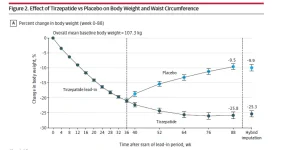
Worth a read and at the very least, a peek at the graphs - the 36 week divergence in weight is significant.

 
It's really not shocking. If you stop cholesterol meds but still maintain good lifestyle choices, your cholesterol will still creep back up as well.

That poor placebo group probably thought they were going crazy with returning food noise and "just a little bit" justification snacking.
Amen! But I’ll bet it was ALOT of food noise roaring back. I think I’d know in just a few days if I was in the placebo group bc the noise would be back. I wonder how that effects trials like this one.
 
That's the exact result I'd expect, if I'm being honest.

Had the "lifestyle" intervention been sufficient to converge at a BMI of 25 (or whatever target one chose) then there would have been no need for the drug in the first place. The problem is that the primary lifestyle driver chosen was simple calorie-restriction. That's obviously going to break down when you take away the drug that enables easy calorie-restriction.
 
Clearly, "remaining on the lifestyle interventions" was a lie. If someone could explain to me how someone could gain weight in a 500-calorie deficit and 150+ minutes a week of cardio, I would appreciate it.
 
Clearly, "remaining on the lifestyle interventions" was a lie. If someone could explain to me how someone could gain weight in a 500-calorie deficit and 150+ minutes a week of cardio, I would appreciate it.
Lying or failing is the more common reasons, but there are people out there who gain weight on what they believe to be a 500-calorie deficit. The problem with using "calorie deficit" as a metric is that you don't know if you're in an actual deficit until after the fact. If you lose weight then by definition it was a deficit. If you don't lose weight then by definition it was not. "Calories out" is a moving target.
 
A similar study is currently ongoing with Reta, the only difference is subjects receive the drug for 80 weeks, follow by 26 weeks of either placebo or drug…
I expect a very similar outcome on this one 🙁
 
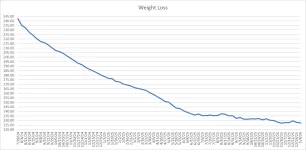
I have tried every diet there is and always gained the weight back. So, it's not a surprise to me. On the other hand, here is what my weight loss and maintenance looks like 75 weeks in. I think I'll stick with the medicine for the rest of my life, thank you very much.1767561369994.webp
 
Worth a read and at the very least, a peek at the graphs - the 36 week divergence in weight is significant.


Thanks for sharing. This recent article is actually not the SURMONT-4 clinical trial results, which were published back at the end of 2023. This new article is a post hoc analysis using the Surmont-4 data trying to tease out the cardiovascular parameter changes based on weight-regain after stopping tirzepatide.

To me, this figure from Surmont-4 study always suggested a weight regain after stopping tirzepatide, so nothing surprising when folks stop treatment that weight gain would occur.

The big takeaway for me with this new study is that that cardiovascular benefits persist for a certain group of individuals even after stopping treatment. So that the weight gain is not homogeneous across the non-treatment group. A significant portion (~20%) regained less than 25% of the excess weight loss.

1767570642438.webp
 
I like that graph a lot , very clear signal about what happens when it is stopped, and a strong argument for staying on glp-1 agonists for maintenance. But even for those who stopped there are still significant benefits in terms of weight and long term risks. Before these medications were available research would talk about the metabolic and risk benefits of 5-10% weight loss, and that those benefits were still significant.
 
I think it’s important to point out that people with diabetes are excluded from this post hoc analysis. It seems almost cruel that this study included a randomization after successful treatment and weight loss to placebo or continued Tirzapeptide. It’s a very effective argument by the drug companies that obese individuals without diabetes need to continue to stay on the meds or risk regaining weight and loosing cardio metabolic benefits. Sadly, I don’t think that it will convince insurance companies to continue paying for these expensive medications for individuals who can no longer be considered obese.
 
It seems almost cruel that this study included a randomization after successful treatment and weight loss to placebo or continued Tirzapeptide.

Yeah, it’s does seem kind of cruel to take participants off treatment, especially in later stage clinical trials when researchers actually know that the medication is safe and effective. But we all benefit from the knowledge from these studies and participants know about the placebo arms of these studies before they agree to participate. But it still must suck. Can you imagine being on trizepatide for 9 months and then being yanked off and being expected to continue in the study for another year….
 
There are alternatives to staying on GLP-1 for life, such as moving to Contrave after stopping GLP-1. One university also found that non-diabetics are able to keep the weight off by moving to metformin after stopping the GLP-1.

It isn't in Lilly's or Novo's interest to help people find alternative drugs so that they can stop using GLP-1s forever, but there are universities doing the studies showing that there are alternatives that work.

For now, anyone who maybe can't afford to stay on the GLP-1 forever, or has some other reason to not take it, can look at the non-Lilly and non-Novo studies.
 
does seem kind of cruel to take participants off treatment
I assume this is for participants who've completed a full run of a study, rather than getting yanked early.

Their alternatives to this free placebo-randomized study might be to pay >$$$$$/month cash, or possibly a very high monthly insurance co-pay, or in most cases complete insurance coverage denial and discontinuation.

I don't think clinical trials offer anything to their participants post-graduation...???
 
I assume this is for participants who've completed a full run of a study, rather than getting yanked early.

Their alternatives to this free placebo-randomized study might be to pay >$$$$$/month cash, or possibly a very high monthly insurance co-pay, or in most cases complete insurance coverage denial and discontinuation.

I don't think clinical trials offer anything to their participants post-graduation...???

From a research perspective, I get the idea (especially in early stage clinical trials) that placebo arms are needed to test the intention-to-treat. But I guess for me, that is participants receving the placebo from the beginning of the study. Not putting participants on an amazing medication that's life changing for many people and then taking it away. But in the end, now that I think of it, everyone in the clinical study eventually is taken off the medication. No free rides forever.

It brings up the proverbial question, is it better to have loved and lost than never to have loved at all. Now that I love tirzepatide, I don't want to lose it, so I just want to keep on lovin' 😆
 
I don't think clinical trials offer anything to their participants post-graduation...???
I think you are right. We've got a few people who were in clinical trials and said that nothing was offered or suggested as the trials ended. I think people would do much better if they had a plan ready for a possible eventuality that their insurance might stop paying for their GLP, or that they may no longer tolerate the GLP.

If not a different medication, then at least counseling or therapy.
 
Analysis of SURMOUT-4, with 9 percent regaining more than 100 percent of their weight (after stopping) vs. 4 percent continuing to lose weight (after stopping):

Cardiometabolic Parameter Change by Weight Regain on Tirzepatide Withdrawal in Adults With Obesity
Approximately 1 in 2 participants have regained 50% or more of the weight reduction and 1 in 4 regained most (≥75%) of the weight reduction, with almost 9% of participants experiencing more than 100% weight regain. On the other hand, a small fraction of the participants (54 [17.5%]) experienced limited weight regain (<25%) on withdrawal of tirzepatide and with continued lifestyle modification. Approximately 4% of participants continued to lose weight on withdrawal of tirzepatide and continued lifestyle intervention.
 
Last edited:
I have to point out that these “study” participants were taken from a THERAPEUTIC dose to zero. This is an important nuance. If it were an SSRI (depression med) it would be malpractice. We don’t start taking 10mg of tirz out of the gate, that’s absurd. Why would anyone expect anything different than failure going from 10mg to zero? (Picking 10mg randomly.)

This study is for headlines.

I don’t doubt that some folks need to be on a GLP-1 long term to maintain. Power to you, take care of #1. What I doubt is this “proof” that everyone “will” regain once stopping.

What it shows is ONLY what it shows: that stopping suddenly causes regain.

The HOW is key, no one wants that in the headline.

No taper, no meds after the trial. This is cruel and bad for people’s bodies to yo-yo like this. Pushes ethics IMO.
 
As I read more and more about the glps and what has to be done to keep the weight in check I realize that yes obesity is a condition, and some people including me are blessed with it.

Modern medicine aka the glps or any other medicine (BP, Cholesterol etc) offer a temporary cure, the major element comes from lifestyle changes. Out of the 1000s of articles, posts and videos only 4-6% have kept the weight loss, and guess what it takes? Tapering off meds and workouts, a governed diet and yes starving at times. We all do it temporarily but the love for food returns and our bodies love that! Having said that yes the food noise is real and once it's back we will definitely gain.
 
There are alternatives to staying on GLP-1 for life, such as moving to Contrave after stopping GLP-1. One university also found that non-diabetics are able to keep the weight off by moving to metformin after stopping the GLP-1.

The study:
In a real-world study, individuals maintained their weight loss for up to 24 months by transitioning from 12-month GLP-1 RA therapy to generic AOMs.

The most frequently used AOMs for weight maintenance after GLP-1 RA therapy were metformin (used by 80% of patients), topiramate (used by 32.5% of patients), and bupropion (used by 32.5% of patients).
 
Last edited:
I have to point out that these “study” participants were taken from a THERAPEUTIC dose to zero. This is an important nuance. If it were an SSRI (depression med) it would be malpractice. We don’t start taking 10mg of tirz out of the gate, that’s absurd. Why would anyone expect anything different than failure going from 10mg to zero? (Picking 10mg randomly.)
Not entirely true. The half-life of popular GLPs is about a week, which is to say that blood levels decrease by about 50% per week. Meanwhile SSRIs often half a half-life of a day or two, leading to a much more rapid drop off in blood levels.

I've thought about that problem before and I'm not sure what the right answer is there for how best to discontinue taking a GLP if one chose to do so. If you stop cold turkey and just tear the band aid off, blood levels are going to slowly decrease over a 1 month period from from supraphysiological (way higher levels than your body could naturally achieve) to high physiological (levels that are still elevated relative to a normal person, but feel really low to you). In month 2 levels would continue to decrease from high (for a normal person not on GLPs) to physiologically normal, at which point your body's natural system would be able to properly signal your brain again.

2 months is already a pretty long tapering off period as it is and I find myself wondering if stretching that out into an even longer period would be advised, as it's really just prolonging the misery.

To be clear (for those with reading comprehension challenges), I'm not saying people should or shouldn't stop taking GLPs. I'm thinking about what would happen if people choose to stop taking GLPs and how they could best do that.
 
Last edited:
The study:

That was an interesting study and thanks for sharing.

Some critiques I might have of it is that it appears to be subject to some biasing factors that may make the approach appear more effective than it actually is. I'm not sure how they could correct for those factors so I'm not criticizing the researchers or suggesting it's a misleading study, though.

Specifically, they only took the participants who were able to get their BMI under 30 on GLPs into the next phase. That means the people studied in phase 2 (mainly metformin treatment) were either those who responded exceptionally well to GLPs or those who started at lower BMIs to begin with. I'm not sure how this biasing will affect the end result, but I think it should be obvious that some degree of cherry picking applies here due to that decision. I also acknowledge that researchers were probably forced to design the study this way to get it past an ethics review board, which may have objected to taking those who were still obese off of GLPs as part of the study design.

The author also notes that some number of the participants may have continued (secretly) taking GLPs after being moved to metformin, since these are real world people who just lost a bunch of weight and if they see the scales starting to move back up may decide that they value keeping the weight off more than they value study integrity. "I'm sure the other participants will follow the rules even if I break them" or something along those lines.
 
In month 2 levels would continue to decrease from high (for a normal person not on GLPs) to physiologically normal, at which point your body's natural system would be able to properly signal your brain again.
I don’t know if we know whether normal signals start back up. I’m not in the medical field. We expect the body to turn on and off like a switch - and sometimes it does. But sometimes it doesn’t, women coming off of years of birth control sometimes can’t conceive.

Anecdotally some people get pretty slammed by the signals that have been suppressed /with the two month wear-off. I wouldn’t call it a taper, a taper eases discontinuation symptoms.
 
That was an interesting study and thanks for sharing.

Some critiques I might have of it is that it appears to be subject to some biasing factors that may make the approach appear more effective than it actually is. I'm not sure how they could correct for those factors so I'm not criticizing the researchers or suggesting it's a misleading study, though.

Specifically, they only took the participants who were able to get their BMI under 30 on GLPs into the next phase. That means the people studied in phase 2 (mainly metformin treatment) were either those who responded exceptionally well to GLPs or those who started at lower BMIs to begin with. I'm not sure how this biasing will affect the end result, but I think it should be obvious that some degree of cherry picking applies here due to that decision. I also acknowledge that researchers were probably forced to design the study this way to get it past an ethics review board, which may have objected to taking those who were still obese off of GLPs as part of the study design.

The author also notes that some number of the participants may have continued (secretly) taking GLPs after being moved to metformin, since these are real world people who just lost a bunch of weight and if they see the scales starting to move back up may decide that they value keeping the weight off more than they value study integrity. "I'm sure the other participants will follow the rules even if I break them" or something along those lines.
Yeah, I'm not a fan of the study since metformin and bupropion were not verty helpful for me in the past. Jardiance is more promising, despite more frequent urination.
 
Anecdotally some people get pretty slammed by the signals that have been suppressed /with the two month wear-off. I wouldn’t call it a taper, a taper eases discontinuation symptoms.
After a month of stopping all GLPs cold turkey last October, pizza never tasted better. I was fine until end of week three or so. But it was very humbling at end of week four, with weight going up almost daily in week four.

So if I had to go without GLPs, I like the @lessthanhalf philosophy of avoiding addictive foods almost religiously (which may be less difficult with the diets that promote satiety with starch and protein):

My personal solution was to treat high calorie, highly rewarding foods as dangerous addictive drugs and avoid them totally and hopefully forever, but this is a fairly drastic way to deal with it although in my case it has been extremely effective. But a more limited version of this might be worth considering. I am not sure I can say the other treatment options for binge eating disorder are all that great, cognitive behavioural therapy and lisdexamphetamine are the only standard treatments but neither is really all that great.
 
Last edited:
I don’t know if we know whether normal signals start back up. I’m not in the medical field. We expect the body to turn on and off like a switch - and sometimes it does. But sometimes it doesn’t, women coming off of years of birth control sometimes can’t conceive.

Anecdotally some people get pretty slammed by the signals that have been suppressed /with the two month wear-off. I wouldn’t call it a taper, a taper eases discontinuation symptoms.
So here's the general idea:

I'm just going to make up arbitrary numbers and oversimplify for the case of illustration here. Let's say before GLPs, a level of 1 in your body happens when you haven't eaten in 3-6 hours and a level of 10 in your body happens when you just pigged out at the buffet and really got your money's worth. Your body is able to naturally vary the level between 0 and 20 just fine, but beyond that simply can't produce a level higher than that on its own.

You then start taking injections that knock your level up to 50, coming back down to 25 before the next shot. Over time you titrate up to higher doses and your levels are now fluctuating between 300 and 150.

When you stop taking injections, your body can't really do anything impactful for that particular hormone until the level comes back down under 20 again. That's going to be a while. Now hunger and fullness aren't handled by just one hormone and you'll still experience those sensations between meals due to other hormones and systems involved in the process. But you're not going to be "normal" again until that level degrades not just to 20, but likely another month later when it has degraded all the way down from 20 to 1.25. And even then, since these are complex systems, a few other things may need to fall into balance before hunger is fully "normal" again.
 
After a month of stopping all GLPs cold turkey last October, pizza never tasted better. I was fine until end of week three or so. But it was very humbling at end of week four, with weight going up almost daily in week four.

So if I had to go without GLPs, I like the @lessthanhalf philosophy of avoiding addictive foods almost religiously (which may be less difficult with the diets that promote satiety with starch and protein):

I've read many anectdotal accounts online of a ravenous hunger returning after stopping glp-1 treatment, which quite honestly has me convinced the longterm use is the only way forward, at least for me.

If I had to go without glp-1s, I'm not sure anything would work. Focusing on protein and whole foods along with behavioral modifications sounds great, but has never worked for me in the past. Luckily, we don't have to face a future without glp-1s.... Maybe I should stock up on another 10,000milligrams... oh, that's another thread 😂
 
After a month of stopping all GLPs cold turkey last October, pizza never tasted better. I was fine until end of week three or so. But it was very humbling at end of week four, with weight going up almost daily in week four.

So if I had to go without GLPs, I like the @lessthanhalf philosophy of avoiding addictive foods almost religiously (which may be less difficult with the diets that promote satiety with starch and protein):
I have been curious about how that will play out, but have a ways to go before I'll discover it first-hand. It will be interesting to see if various strategies work better or worse for coping with that period. Probably not a great time to schedule a cruise! LOL

One of the problems here is that most people who more seriously study different dietary strategies tend to poo-poo GLPs and that's the group who would actually have the most interesting case studies to read about, since they'd be in the best position to approach such a period strategically.
 
I was in the REDEFINE 4 study in the tirzepatide cohort. No taper period. “Your last dose is Sept 30, and you have one in person blood draw in six weeks” to make sure I wasn’t dead I guess. They gave cursory nutritionist counseling about rejoining the ranks of mere mortals, but nothing more than “continue your healthy habits!” The supervising physician even said to me in my last visit, “the bad news is you will almost assuredly gain all this weight back,” which I thought was an especially prickish way to put it. Then he told me he had eaten keto for like 20 years and that “fruit is God’s candy shop” so I was not convinced I was missing some sage wisdom from him.

It was indeed a rough 6 weeks until I could figure out how to get back on the sauce. However, I had become readdicted to the gym during the 18 month study and liked how eating above maintenance jacked me up right quick.
 

Trending Topics

Forum Statistics

Threads
17,674
Posts
183,315
Members
59,380
Newest
Peptideuser103292
Back
Top Bottom