None of this stuff is "safe."
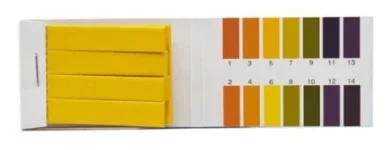
I'm making an assumption that the pH of the water that you're using is high. If that's the case, it's important to note that "high pH" isn't actually the root cause of your problem. If you were dealing with pure water the pH would be 7 (since that is the pH of pure water). If your pH is significantly different than 7 that just means you're not dealing with pure water and whatever the water is contaminated with is the actual root cause of your problem. The high pH is just an indicator of that contamination. And it's reasonably likely that your vial full of gel is an indication of high pH (although that's certainly not the only possible cause). Further, any competent manufacturing facility would have a QC process in place to detect contamination in their purified water product and I'd think pH would be the bare minimum they'd want to check, which suggests the water isn't from a competent manufacturing facility. That's the real crux of your problem here.
As a practical matter, everything we work with will come with some minor degree of contamination. If you've decided you're cool with the mystery contaminant, it's very possible that bringing the pH of the solution down by adding a very small amount of some acid will improve its solubility such that the gel dissolves. If you were to take that approach, you'd want to go very slowly, to avoid adding too much vinegar. "Too much" means that rather than just bringing pH down to a neutral level, the solution has turned acidic and that's a very delicate tipping point. I'd even suggest diluting the vinegar, but I'm not sure what you'd dilute the vinegar with, since if you had purified water available to you, you wouldn't be in this mess to being with.
On the flip side, getting scratched by a cat is probably thousands of times more "dangerous" than a small acetic acid adjustment...