Wegovy pill teaser rate shakedowns

Grogu

GLP-1 Apprentice
Member Since
Dec 1, 2025
Posts
97
Likes Received
180
Location
Florida, US
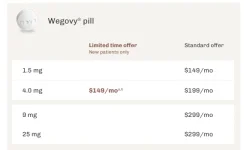
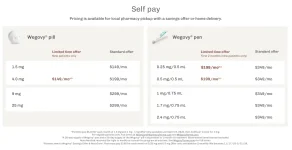
I'm not sure if it's just me, but don't these lower prices for starter doses seem like "teaser rates" and quite frankly shakedowns? Kind of undignified for big pharma intending to get new customers addicted to the product and then charge them significantly more for effective doses....

The pill was supposed to be easier to manufacture and less expensive. These prices are still too high for most americans. I can't imagine that there is any significant incremental cost of making a 25mg pill over a 1.5mg pill.
1767619464444.png
 

Attachments

  • 1767619385060.png
    1767619385060.png
    23.6 KB · Views: 42
It always is teaser rates, prices have very little to do with development, and everything to do with R&D which I expect. But dam that mark up is too dam high considering they could be selling it to like 70% of Americans.


Consider that even the grey market sellers are taking a margin and this price structure is insane.
 
What are you basing "the markup is to high" comment on? Do you know the R&D costs, overhead, regulatory or tax burdens? What should the ROI look like?
Or just feelz based upon what you can get it for from your favorite CN vendor that didn't pay for R&D, trials and doesn't pay license fees, customs fees or taxes and avoids the banking system?
 
What are you basing "the markup is to high" comment on? Do you know the R&D costs, overhead, regulatory or tax burdens? What should the ROI look like?
Or just feelz based upon what you can get it for from your favorite CN vendor that didn't pay for R&D, trials and doesn't pay license fees, customs fees or taxes and avoids the banking system?

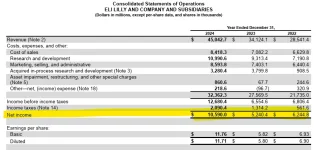
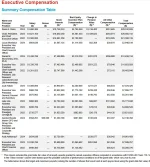
EL has made net profit over 22 billion for the last three years, and that's after R&D and executive salaries and even income taxes. This year's net income after everything is likely to be $20 billion all on it's own.

1767645844688.png
 
What are you basing "the markup is to high" comment on? Do you know the R&D costs, overhead, regulatory or tax burdens? What should the ROI look like?
Or just feelz based upon what you can get it for from your favorite CN vendor that didn't pay for R&D, trials and doesn't pay license fees, customs fees or taxes and avoids the banking system?
Adding to what grogu says its one thing where you take a huge markup for R&D on a drug for a disease that 1 in a million people has because its the only way to recoup the cost and make a profit. But with such a large market if it is currently being sold at a point where people are simply going without because of the price, yeah their margin is too high. They might even make more money if they lowered the price because more people would start using it/not turn to grey markets. I would of never even looked at grey markets if I could get it for like ~$300 a month even but no elly needs to charge me nearly $700 a month.
 
What are you basing "the markup is to high" comment on? Do you know the R&D costs, overhead, regulatory or tax burdens? What should the ROI look like?
Or just feelz based upon what you can get it for from your favorite CN vendor that didn't pay for R&D, trials and doesn't pay license fees, customs fees or taxes and avoids the banking system?
Drug companies recoup the cost of a drug in its first year of sales and they are given 20 years of exclusivity. It costs more to produce the plastic injection pens than it does to make the drug itself. So yes, the markup is absolutely too high.
 
EL has made net profit over 22 billion for the last three years, and that's after R&D and executive salaries and even income taxes. This year's net income after everything is likely to be $20 billion all on it's own.

View attachment 12545
Animated GIF
 
Insurance companies are worse to me. They distort the market, to the point where you can't know the price of any procedure or medicine in advance. A market where you don't know the price of any products... Is not a market.

Yeah, insurance companies are probably worse. Big Pharma is like any other profit seeking enterprise, just trying to maximize shareholder value. How does the C-Suite do that? Make a shitload of money on the backs of everyday people.

The pricing of glp-1 medications, based on dose, is kind a slimy and I'm sure even contrary to these company's stated mission statements, which I haven't checked, but I'm sure say things like "making the world a healthier place". But Big Pharma did bring us these amazing medications and continue to innovate and actually provide something to society. Insurance companies (and not just health insurance) not so much.
 
Yeah this shit pisses me off. At 2.5mg injection for ozempic you pay 350$ a month. Thats 10mg/350 or 1mg/35$. With the new once daily pill at the highest level, you get 25mg * 30 days / 300$ = 25mg/10$ = 1mg/.2$. Thus the new oral semaglutide is 150 times cheaper interms of how much semaglutide you get per dollar.

So what does this prove? They think the most amount of money they can get out of people is 300$ a month, and that there injectable semaglutide could be 150x cheaper, which would be 2$ per month. Thats about the rate we get it 😎 fuck pharma
 
What's worse? A pharma co. that bathes in hundred dollar bills or an insurance Co. that won't cover shit? 🤔

It’s worse when they face off which is where we are.

Insurance not covering overpriced peptides, to try to starve the drug companies into better pricing,

and drug companies offering direct-to-customer sales (with an Rx) to cut out the insurance middle man.

I guess that means the drug lords are worse: they can directly keep prices high. And if any of them gets their ducks in a row they could theoretically bypass insurance on more products and have a vertical monopoly.

Is it an option to choose “evil” and “more evil?”👿
 
The pill was supposed to be easier to manufacture and less expensive.

Not sure who said that, but that seems wrong. The max dose of pills (25mg) use 10x more API than the max dose of injectables (2.4mg ). The pills have much lower bioavailability, require a special coating (SNAC) and special instructions (consume fasted, with very little water, and wait 30 minutes to ingest anything else).
 
Not sure who said that, but that seems wrong. The max dose of pills (25mg) use 10x more API than the max dose of injectables (2.4mg ). The pills have much lower bioavailability, require a special coating (SNAC) and special instructions (consume fasted, with very little water, and wait 30 minutes to ingest anything else).

Just the fact that NN priced the monthly pills at lower prices than the comparable injectible dosages is very telling. If it were more expensive to product pills, they would have priced it that way. It's also been widely reported that the pills are easier to manufacture and store than injectibles and that on earning calls that analysts have been provided this information.

I'm also not sure if it's possible to equate the amount of API into the cost of production as I'm confident that API is a very small fraction of manufacturing costs for both the pill and the injectibles. More is probably spent more on the packaging and keeping the product temperature controlled than API.

Finally, I'm really not sure how method of administration has anything to do with pills being easier and less expensive to manufacture.
 
Insurance companies are worse to me. They distort the market, to the point where you can't know the price of any procedure or medicine in advance. A market where you don't know the price of any products... Is not a market.
Insurance companies have a typical profit margin of about 5% while a pharmaceutical company has a profit margin of about 15%. As for not knowing what things cost that problem lies squarely at the feet of the hospitals themselves.
 
Just the fact that NN priced the monthly pills at lower prices than the comparable injectible dosages is very telling. If it were more expensive to product pills, they would have priced it that way. It's also been widely reported that the pills are easier to manufacture and store than injectibles and that on earning calls that analysts have been provided this information.

I'm also not sure if it's possible to equate the amount of API into the cost of production as I'm confident that API is a very small fraction of manufacturing costs for both the pill and the injectibles. More is probably spent more on the packaging and keeping the product temperature controlled than API.

Finally, I'm really not sure how method of administration has anything to do with pills being easier and less expensive to manufacture.
Good points made, thanks!
 
from EL's perspective they're probably trying to recoup forecasted earnings that were 'ruined' by Tirz lapping Ozempic as fast as it did(same reason they're delaying reta so as not to stomp on tirz's earnings). the pills are much cheaper to manufacture and everything from distribution to storage to administration is easier and they can offer the product at an attractive(to the consumer lacking in knowledge) at a much lower price and maximize their margins.

TLDR for Lilly, greed.

Insurance companies and the borderline useless service they provide could be replaced by a federal regulatory board, I agree that pharma co's make way more than they should, but at least they have some justifiable costs like RnD and production, Insurance companies function as a middleman, feed off both sides and are parasitic by design.
 
Insurance companies have a typical profit margin of about 5% while a pharmaceutical company has a profit margin of about 15%. As for not knowing what things cost that problem lies squarely at the feet of the hospitals themselves.
That 5% is malleable. Especially when you own PBMs and pharmacies, which all the big insurers do.

With vertical integration of PBMs and insurance, insurers are able to move profits from one part of the business to the other. They can do that by forcing patients to use their pharmacies where their prices are marked up. The result is that the pbm side shows modest profits, while most of the profit is recouped on the pharmacy side.

They also love to do spread pricing : charge employers 10 for a drug, but only pay the pharmacy 7. Because this is considered "cost of goods sold ", the $3 fee doesn't show up in accounting.

There are many more ways for an insurance company to "modulate" profits when it owns its own PBMs, pharmacies and hospitals.
 
Top Bottom