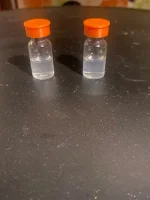
I bought some PBS from amazon and a it comes in a giant jug so any chance of sterility is gone, but it totally did clear up the reta. I will use it for my pin tomorrow and see if I live. yay science.
I did some more research and it seems the peptide is fine after PBS. I wanted to know: where do the TFA salts actually go? I found a technical analysis of what the salts do to the peptide, and it sounds like nothing, once the environment is corrected. I'm not a chemist, so I ran it through an AI and got this summary:
1. Residual TFA is the hidden problem
• During peptide manufacturing, TFA (trifluoroacetic acid) is commonly used
• Some of it stays behind as TFA salts
• If not properly removed:
the peptide powder is acidic
⸻
2. When you add BAC water → pH crashes
• BAC water pH ≈ 5.7
• Add residual TFA → drops to ~4–4.5
👉 That matters because:
• Reta’s isoelectric point (pI) ≈ 6
• Near that point → peptides lose charge
• When they lose charge → they clump together
👉 Result:
cloudiness / flakes (“snowflakes”)
⸻
3. Salt and solvent effects worsen it
He explains three environments:
🟢 Filtered water
• No buffering → unstable → can crash
🟡 BAC water
• Alcohol reduces solubility
• pH too close to pI → aggregation
🔴 Saline
• “salting out” effect
• pushes molecules together → precipitation
⸻
💡 His solution
👉 Use PBS (phosphate-buffered saline)
Why?
• PBS buffers pH at ~7.4
• keeps you away from the pI danger zone
• neutralizes residual acid (TFA)
• stabilizes the peptide in solution
Your peptide is fine — it’s just crashing out because the environment is wrong.
Fix the environment → it stays clear.



 My wife has had questions about what Im doing with so many needles.


