Filter yes or no

This video was helpful to me for filtering. Easy, cheap, fast...not really any downsides.
View: https://youtu.be/fmz4241qPn4?si=j-Di3DFZq8o9qwGC
The video says to connect a luer needle to the output of the filter. But the filter doesn't have a threaded interface. The needle does have a threaded interface.

Is it safe to just slip the needle on? Read some places that this is not an accepted practice. Thoughts?
 
The video says to connect a luer needle to the output of the filter. But the filter doesn't have a threaded interface. The needle does have a threaded interface.

Is it safe to just slip the needle on? Read some places that this is not an accepted practice. Thoughts?
Thats what I do. The ID of the needle is tapered and matched the taper on the output of the filter, so it slips on and friction fits.
 
If the lipophilized vial and the contents are sterile
The gray market raw powder cannot be assumed to be sterile. Actually, even the stuff produced in pharma grade factories isn't either.

I read that sterilization in the pharma supply chain occurs at a later stage. That's what adds to the cost substantially. The gray market completely bypasses that part, and sells it to whoever wants to buy it, right out of the factories.

Having said that, the factories must be doing a decent enough job. Not too many reports of people falling sick (or worse)
 
Draw a few units of air. Inject that thru the filter as well, to push more of your peptide into the vial/cartridge.
So, this final purge to get the holdback in the filter - how many of you practice it? From what I read, the holdback in a Biologix 13mm 0.22μm filter is about 15-25 μ liters (2-3 units). Is that enough to worry about? Or maybe its easy enough?
 
So, this final purge to get the holdback in the filter - how many of you practice it? From what I read, the holdback in a Biologix 13mm 0.22μm filter is about 15-25 μ liters (2-3 units). Is that enough to worry about? Or maybe its easy enough?
That hold back is after purging. No practice is necessary. Watch a video on it once or twice.
 
So, this final purge to get the holdback in the filter - how many of you practice it? From what I read, the holdback in a Biologix 13mm 0.22μm filter is about 15-25 μ liters (2-3 units). Is that enough to worry about? Or maybe its easy enough?
I disconnect filter, draw air into syringe, reconnect filter, and push some air in to purge and recover most of the hold up volume. HOWEVER, when you feel resistance, ie, the plunger feels “springy” and pushes back, STOP. If you push hard enough, you’ll overcome the filter’s “bubble point”, and some foam will come out. Peptides are most often damaged at the air/water interface, and foam, made up of millions of tiny bubbles, is essentially the most air/water interface area that can possibly be created, so you don’t want that in your vial. It’s only a tiny amount of loss anyway, so don’t worry about.

Also, the more liquid volume you use to reconstitute, the less significant the loss from hold up is. Many people seem to use random amounts of water, when ideally you’d want to follow pharma’s lead if it’s a pharma peptide like a GLP, or dig up what the researchers use and copy them. Concentration has a major effect on rate of degradation, and to a lesser extent on the actual pharmacokinetics (absorption rate) of the peptide. For instance, Sema in Wegovy pens, all doses up to 1.4mg use .5ml, while 1.7mg and 2.4mg use .75ml. They didn’t increase the volume of water, making manufacturing more complex, for those two doses for no reason.
 
Last edited:
hmmm - the source I got that from says it's before the purge. Maybe it's not right. I can look more.
My personal experience is that the holdback in a 13 mm filter before air purging is significantly more than 2 to 3 units. I suppose we needed to specify filter size.
 
I suppose we needed to specify filter size.
I stated "Biologix 13mm 0.22μm filter". I'll look around a bit more. In any case, I guess purging seems to be easy enough. No point in leaving behind anything that can be recovered with an easy purge.
 
My personal experience is that the holdback in a 13 mm filter before air purging is significantly more than 2 to 3 units. I suppose we needed to specify filter size.
I guess it varies a lot between brands.

I use Pall 13mm pes filters and there’s about 2 unit equivalent, so .66% for 3ml reconstitution.

For some “dirty” peptides and rHGH that I’ve actually had clog 13mm before 3ml is filtered, I use Pall 25mm Pharmassure, which holds up 3units or 1%.

PS: I’ll add that when you have a filter completely clog, any lingering doubts about whether filtering is worth the effort immediately disappear.
 
Another question. Do you pre-wet a PES filter? Some people recommend this. Getting conflicting opinions.
 
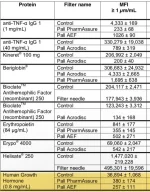
Here’s a chart from a well constructed study using pharmaceutical protein / peptide drugs.

Look at the drop in contaminant particle counts pre filtration (control) and post filtration using one or two different syringe filters (filter needles are 5um and don’t remove much). And these are all guaranteed to be sterile meds (unlike ours), so this is just reducing protein aggregates and trash in the vial, we also ensure sterility by filtering:


IMG_0728.webp
 
Another question. Do you pre-wet a PES filter? Some people recommend this. Getting conflicting opinions.
It’s a good question and something I thought was necessary, but no. That just increases dilution of your peptide. No prewetting.
 
It’s a good question and something I thought was necessary, but no. That just increases dilution of your peptide. No prewetting.
Well, you can always compensate by adding less bac later. But I'd rather avoid it if it's not useful.

Do you know the downside of not pre-wetting?
 
I guess it varies a lot between brands.

I use Pall 13mm pes filters and there’s about 2 unit equivalent, so .66% for 3ml reconstitution.

For some “dirty” peptides and rHGH that I’ve actually had clog 13mm before 3ml is filtered, I use Pall 25mm Pharmassure, which holds up 3units or 1%.

PS: I’ll add that when you have a filter completely clog, any lingering doubts about whether filtering is worth the effort immediately disappear.
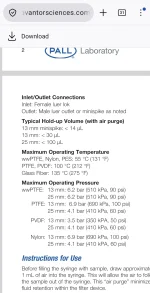
Pall themselves rates hold back as <3 units AFTER air purging, assuming we are talking about the acrodisc line or similar.

1781297914630.webp


Do vendors sell " filtering kits "? I am willing to try but it look kinda overwhelming . I am sure it gets easy rather quickly but, again, overwhelmed. The kits would be a great starting point for me anyway, buy a few and give it a test.
 
Well, you can always compensate by adding less bac later. But I'd rather avoid it if it's not useful.

Do you know the downside of not pre-wetting?
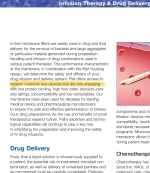
The primary purpose of pre wetting when it’s done in labs, from what I understand, is to ensure you flush contaminants from the filter. However, when using modern, quality PES filters, which is part of the standard process of preparing samples for chromatographic analysis, these days any filter that would impart particulates would be considered unacceptable. “Non-shedding” is the industry standard for sterile PES filters. These are also used by compounding pharmacies to sterilize medications, so you could see hour introducing contaminants would be a problem there too.


IMG_0979.webp
 
This is why I buy from vendors that provide mass, purity, sterility, and endotoxin test results so that I don't have to risk contaminating my own products. But of course, not every product I get contains those tests - they will need to be filtered.

When you join enough groups on telegram, it is inevitable, and in a great way, to find test results of the compound and/or peptide that you received.

I'm telling y'all, if y'all want to find out which groups provide those test results and/or want to get good quality products, DM me. I will show you the way! 🙂
and to your point. Reputable GB's are great as part of many of the buys are the tests u mentioned. I always feel more confident w GB product vs vendor XYZ in China.
 
Do vendors sell " filtering kits "? I am willing to try but it look kinda overwhelming . I am sure it gets easy rather quickly but, again, overwhelmed. The kits would be a great starting point for me anyway, buy a few and give it a test.
Don’t waste your money. Just buy filters, syringes and cheap needles from Amazon. You don’t need to inject yourself with them. Get Biologix filters though. $50 for 100 direct from Biologix. Free shipping.
 
Pall themselves rates hold back as <3 units AFTER air purging, assuming we are talking about the acrodisc line or similar.

View attachment 27271


Less then, yes. I precisely measure the BAC I use to reconstitute, and use both types of filters daily (and have for years).

Caveats: the process below may seem somewhat obsessive, further than most are willing to go, and I’m aware introduces some potential issues of its own, but on balance I’ve decided the risk/reward is worth it for me. Just the basic process of filtering into sterile vials affords you a vast improvement in safety over not filtering, so I’m not suggesting this technique is necessary to be safe. Also, yes the filters are expired, but I bought them in bulk a few years ago, and the expiration date is primarily regarding the sterility guarantee from the manufacturer before a “reinspection” would be required by the FDA, not that the plastics break down 2 years after manufacturing) or that sterility is actually compromised.
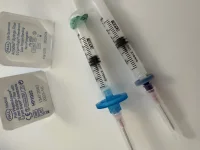
IMG_5945.webp


So that’s a 3ml syringe, with each type of filter attached, and a 22g needle. Instead of filtering into a vial, I draw all 3ml of the reconstituted peptides into these filtering rigs. Of course I don’t inject directly from them (and would never use a 22g harpoon lol). Larger diameter needles reduce velocity and shear stress, by the way, minimizing a known source of damage to peptides being transferred to different containers.

I go one step further than standard filtering, and practice “bedside filtration”, as advocated by one of the pioneers of peptide drug development. That’s filtering EACH DOSE immediately prior to administration. The advantage being that aggregates form over time. So post filtration, in a formula prone to developing aggregates, they can start forming again. By filtering immediately prior to administration they’re reduced to the absolute lowest possible level.

This is to ensure I avoid developing immunogenicity (loss of effectiveness) by the immune system becoming “trained” to eliminate the peptide. This happens when aggregates become large enough to resemble bacteria (10-100um). Because the immune system thinks molecules that size are a pathogen, it’ll sense the shape of the outside “shell” to learn to identify them as something to eliminate. Because these aggregates are essentially a “ball” of millions of the peptide monomers, the outside carries the epitope (the “shape” or pattern) of the peptide, the immune system can develop antibodies to neutralize the peptide. This is a complex topic with many factors, but it’s a HUGE area of concern for the FDA and pharma manufacturers. It’s not a well known issue because consumers are getting a product that’s already minimized the risk of it happening, so you never hear of it being a problem, just like you never hear of bacterial infections or endotoxin issues from Lilly’s Zepbound pens. The risk has been eliminated. Pharma has learned to formulate peptide drugs with excipient ingredients to prevent this, use manufacturing techniques that reduce it from happening, and finally transport and store in controlled temperature.

Unfortunately UGL employs none of the safeguards against this from happening, we can see this aggregation happening every day with “cloudy” peptides. (Ironically only aggregates larger than 100um are visible, not the high risk 10-100um bacteria sized particles). I’d rather not risk becoming immune to useful peptides (or cross immunity to my own endogenous peptides like GLP-1 or GIP). Sometimes these immunities can be permanent. Sometimes it takes years, and hundreds of doses. This has happened numerous times in the early days of peptide pharmaceuticals, sometimes with disastrous, even deadly consequences, when immunity developed to a lifesaving peptide based drug with no alternative, or the patient developed cross immunity to their own proteins.

If anyone wants to nerd out on the topic just look for the work of “Gerhardt Winter bedside filtration” or research the topic “peptide immunogenicity”.


Expanding Bedside Filtration—A Powerful Tool to Protect Patients From Protein Aggregates - Journal of Pharmaceutical Sciences
https://jpharmsci.org/article/S0022-3549(18)30457-X/abstract

 
Last edited:

Trending Topics

Forum Statistics

Threads
17,790
Posts
184,899
Members
59,733
Newest
SillyLilybean
Back
Top Bottom