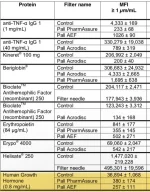
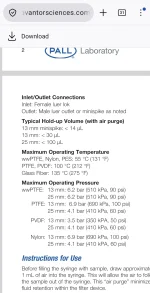
Pall themselves rates hold back as <3 units AFTER air purging, assuming we are talking about the acrodisc line or similar.
View attachment 27271
Less then, yes. I precisely measure the BAC I use to reconstitute, and use both types of filters daily (and have for years).
Caveats:
the process below may seem somewhat obsessive, further than most are willing to go, and I’m aware introduces some potential issues of its own, but on balance I’ve decided the risk/reward is worth it for me. Just the basic process of filtering into sterile vials affords you a vast improvement in safety over not filtering, so I’m not suggesting this technique is necessary to be safe. Also, yes the filters are expired, but I bought them in bulk a few years ago, and the expiration date is primarily regarding the sterility guarantee from the manufacturer before a “reinspection” would be required by the FDA, not that the plastics break down 2 years after manufacturing) or that sterility is actually compromised.
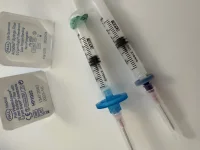
So that’s a 3ml syringe, with each type of filter attached, and a 22g needle. Instead of filtering into a vial, I draw all 3ml of the reconstituted peptides into these filtering rigs. Of course I don’t inject directly from them (and would never use a 22g harpoon lol). Larger diameter needles reduce velocity and shear stress, by the way, minimizing a known source of damage to peptides being transferred to different containers.
I go one step further than standard filtering, and practice “bedside filtration”, as advocated by one of the pioneers of peptide drug development. That’s filtering EACH DOSE immediately prior to administration. The advantage being that aggregates form over time. So post filtration, in a formula prone to developing aggregates, they can start forming again. By filtering immediately prior to administration they’re reduced to the absolute lowest possible level.
This is to ensure I avoid developing immunogenicity (loss of effectiveness) by the immune system becoming “trained” to eliminate the peptide. This happens when aggregates become large enough to resemble bacteria (10-100um). Because the immune system thinks molecules that size are a pathogen, it’ll sense the shape of the outside “shell” to learn to identify them as something to eliminate. Because these aggregates are essentially a “ball” of millions of the peptide monomers, the outside carries the epitope (the “shape” or pattern) of the peptide, the immune system can develop antibodies to neutralize the peptide. This is a complex topic with many factors, but it’s a HUGE area of concern for the FDA and pharma manufacturers. It’s not a well known issue because consumers are getting a product that’s already minimized the risk of it happening, so you never hear of it being a problem, just like you never hear of bacterial infections or endotoxin issues from Lilly’s Zepbound pens. The risk has been eliminated. Pharma has learned to formulate peptide drugs with excipient ingredients to prevent this, use manufacturing techniques that reduce it from happening, and finally transport and store in controlled temperature.
Unfortunately UGL employs none of the safeguards against this from happening, we can see this aggregation happening every day with “cloudy” peptides. (Ironically only aggregates larger than 100um are visible, not the high risk 10-100um bacteria sized particles). I’d rather not risk becoming immune to useful peptides (or cross immunity to my own endogenous peptides like GLP-1 or GIP). Sometimes these immunities can be permanent. Sometimes it takes years, and hundreds of doses. This has happened numerous times in the early days of peptide pharmaceuticals, sometimes with disastrous, even deadly consequences, when immunity developed to a lifesaving peptide based drug with no alternative, or the patient developed cross immunity to their own proteins.
If anyone wants to nerd out on the topic just look for the work of “Gerhardt Winter bedside filtration” or research the topic “peptide immunogenicity”.

www.coriolis-pharma.com
Expanding Bedside Filtration—A Powerful Tool to Protect Patients From Protein Aggregates - Journal of Pharmaceutical Sciences
https://jpharmsci.org/article/S0022-3549(18)30457-X/abstract