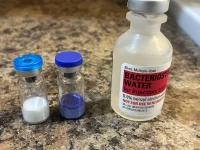
Need help finding citric acid for my MOTS-C

Clavicular's Hammer

GLP-1 Apprentice
Member Since
Jun 1, 2026
Posts
116
Likes Received
184
Location
Canada
Basically the title. Seems like MOT-C like to get a little gelly. Many suggest adjusting the ph a little. Just not sure where to find, other than some vendors but I’d rather source it from a shop.
 
Basically the title. Seems like MOT-C like to get a little gelly. Many suggest adjusting the ph a little. Just not sure where to find, other than some vendors but I’d rather source it from a shop.
Goodlifesupplies.com sells an acetic acid glycerin solution with 0.9% Benzyl alcohol, though not sure if the glycerin would contribute to viscosity? Keeping my eye on this thread.
 
Basically the title. Seems like MOT-C like to get a little gelly. Many suggest adjusting the ph a little. Just not sure where to find, other than some vendors but I’d rather source it from a shop.
Mots-c is already somewhat acidic. That's where the sting comes from for most people. I've never had a gelling issue with Hospira BAC. Are many people reporting this in your vendor group?
 
Mots-c is already somewhat acidic. That's where the sting comes from for most people. I've never had a gelling issue with Hospira BAC. Are many people reporting this in your vendor group?
I saw some people talking about it and one mentioned their vendor did not guarantee no gelling.

Someone mentioned their vendor called for a 2.5ml BAC and a .5ml acid mix

Could just be my water but I feel like it’s good quality
 

Attachments

  • IMG_4910.webp
    IMG_4910.webp
    1.8 MB · Views: 1
I would just recon a vial and see what happens. It should be fine with Hospira. If you want to keep some AA on hand just in case, you can find it at the usual places. Underground Supply, Peptidetest, and others.
 
I am also interested in AA for using as a mini solvent for GHK-Cu (0.1-0.2mL AA, then reach target dilution with BAC). At undergroundsupply.shop, I see a similar sort of mix for acetic acid (3% glycerin + 1% acetic acid + 0.9% benzyl alcohol. pH = 3) that is at goodlifesupplies.com. At UgS, they say it’s often used for mixing with AOD which is notorious for gelling, whereas goodlife touts theirs for topical use. At Carolina.com a lab (not peptide) company, they sell 17.4M glacial acetic acid (not diluted) ACS grade, which obviously you’d need a LOT less of than the solutions at GL and UCS. However, in looking into glycerin injections on their own, it seems it’s used for collapsing spider veins or treating ocular or intracranial pressure, so I’m thinking this is NOT what I’d want to inject since I’m not aiming for pressure reduction or vein collapse (or capillary collapse since I’m not doing an IV injections).

Alternately, NaCl BAC seems to have a target pH of 5.3 vs target of regular BAC at 5.7 (both with 4.5-7 as acceptable range) and I’ve read that NaCl BAC is good for mitigating sting in MOTS-C, NAD+ and SS-31, all of which I plan on taking. I’ve got 99 problems and pH is one!

Obviously those with experience have used just BAC and seem to like that just fine, and I am listening. However, I’d like to mitigate stinging and solubility/viscosity issues if possible.

The more I research, the more confused I get! RABBIT HOLE!!! Time for a pause and a protein shake. (If and biochemistry folk or @eidos are bored and wants to chime in…🤣)
 
I am also interested in AA for using as a mini solvent for GHK-Cu (0.1-0.2mL AA, then reach target dilution with BAC). At undergroundsupply.shop, I see a similar sort of mix for acetic acid (3% glycerin + 1% acetic acid + 0.9% benzyl alcohol. pH = 3) that is at goodlifesupplies.com. At UgS, they say it’s often used for mixing with AOD which is notorious for gelling, whereas goodlife touts theirs for topical use. At Carolina.com a lab (not peptide) company, they sell 17.4M glacial acetic acid (not diluted) ACS grade, which obviously you’d need a LOT less of than the solutions at GL and UCS. However, in looking into glycerin injections on their own, it seems it’s used for collapsing spider veins or treating ocular or intracranial pressure, so I’m thinking this is NOT what I’d want to inject since I’m not aiming for pressure reduction or vein collapse (or capillary collapse since I’m not doing an IV injections).

Alternately, NaCl BAC seems to have a target pH of 5.3 vs target of regular BAC at 5.7 (both with 4.5-7 as acceptable range) and I’ve read that NaCl BAC is good for mitigating sting in MOTS-C, NAD+ and SS-31, all of which I plan on taking. I’ve got 99 problems and pH is one!

Obviously those with experience have used just BAC and seem to like that just fine, and I am listening. However, I’d like to mitigate stinging and solubility/viscosity issues if possible.

The more I research, the more confused I get! RABBIT HOLE!!! Time for a pause and a protein shake. (If and biochemistry folk or @eidos are bored and wants to chime in…🤣)

Hello dear 😉

I found sterile AA from my supplier from the "town near the sea", but I haven't had a use for it in three months. I found USP phosphate, but I can't find any NaOH to stabilize around 7. To be continued.

My "tough training" as a biochemist warned me that something didn't add up about mixing GHK with a very acidic buffer based on acetic or citric acid. So I dug.

Since I no longer have access to the Handbook of Chemistry, I asked ChatGPT for the isoelectric point of GHK Cu and the pKa values of its amino acids, and the "thing" "understood" perfectly why I asked it.

In short, the histidine core becomes protonated below a pH of about 5.5 and releases Cu²+
So this acid buffer is not a good idea.
A pH range of around 6.5-7 seems like a better idea (around 8 is the isoelectric point, and aggregates could form).

For my personal use, I add 0.9% NaCl (without BA) to the SS31 MOTS-c or GHK-Cu, which last 5, 10, and 20 days. When using a pen, this reduces the risk of introducing bugs that can be introduced more likely with a syringe.
It doesn't sting anymore, and the isotonic solution has eliminated the hardening. (MOTSc in BA really hurts). If it reassures you, take some BAC Saline.
It's a cultural thing, so there's no need to stress about this choice. You live in a country where eggs are washed, disinfected, and then stored in the fridge. Here, it's forbidden to wash them because that preserves their natural protective coating (cuticle/bloom), and there's no need to store them in the fridge. The contamination rate is the same; there has been no difference between the two methods for decades. It's just that our refrigerators are smaller and our chlorine industry is less thriving.

As for NAD+, I don't know, I take NR orally. AZ has actually just delivered a fresh bottle, with vitamin E, because Reta makes my skin look like grilled chicken.
 
Hello dear 😉

I found sterile AA from my supplier from the "town near the sea", but I haven't had a use for it in three months. I found USP phosphate, but I can't find any NaOH to stabilize around 7. To be continued.

My "tough training" as a biochemist warned me that something didn't add up about mixing GHK with a very acidic buffer based on acetic or citric acid. So I dug.

Since I no longer have access to the Handbook of Chemistry, I asked ChatGPT for the isoelectric point of GHK Cu and the pKa values of its amino acids, and the "thing" "understood" perfectly why I asked it.

In short, the histidine core becomes protonated below a pH of about 5.5 and releases Cu²+
So this acid buffer is not a good idea.
A pH range of around 6.5-7 seems like a better idea (around 8 is the isoelectric point, and aggregates could form).

For my personal use, I add 0.9% NaCl (without BA) to the SS31 MOTS-c or GHK-Cu, which last 5, 10, and 20 days. When using a pen, this reduces the risk of introducing bugs that can be introduced more likely with a syringe.
It doesn't sting anymore, and the isotonic solution has eliminated the hardening. (MOTSc in BA really hurts). If it reassures you, take some BAC Saline.
It's a cultural thing, so there's no need to stress about this choice. You live in a country where eggs are washed, disinfected, and then stored in the fridge. Here, it's forbidden to wash them because that preserves their natural protective coating (cuticle/bloom), and there's no need to store them in the fridge. The contamination rate is the same; there has been no difference between the two methods for decades. It's just that our refrigerators are smaller and our chlorine industry is less thriving.

As for NAD+, I don't know, I take NR orally. AZ has actually just delivered a fresh bottle, with vitamin E, because Reta makes my skin look like grilled chicken.
Merci, mon ami!! I really appreciate your (always) excellent answers (and promise I won’t summon you unnecessarily)! 😁 Vous etes le meilleur! Stay cool in all this crazy heat 😎
 
Merci, mon ami!! I really appreciate your (always) excellent answers (and promise I won’t summon you unnecessarily)! 😁 Vous etes le meilleur! Stay cool in all this crazy heat 😎
You're welcome. Glad to help. It's really fun to dig into this kind of question.

In the middle of the heat, a strange side effect (Tirz or Reta?): I was freezing. My feet were as cold as those of my ex-wife. I had to cover up. Very weird.
 

Trending Topics

Forum Statistics

Threads
18,944
Posts
197,692
Members
63,036
Newest
BigDupeEnergy
Back
Top Bottom